Anthropic's Sneaky Claude Price Hikes
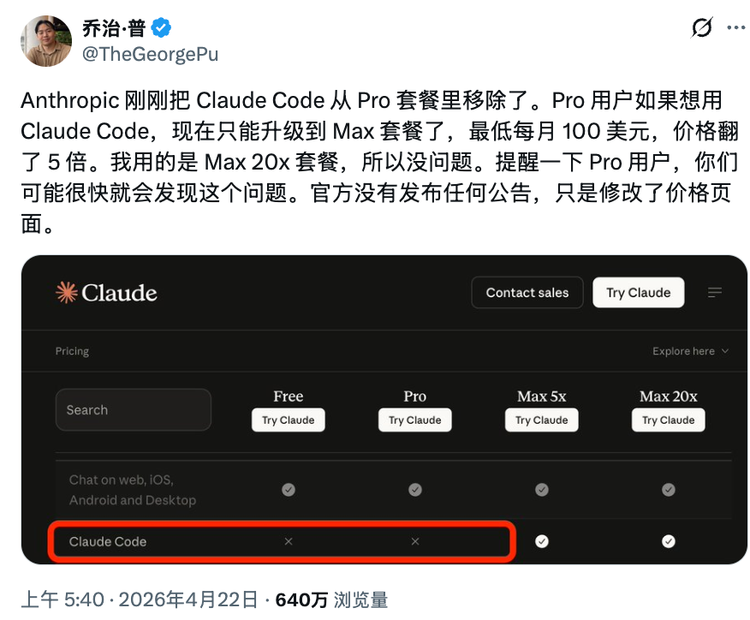
💡Claude bills exploding? Uncover Anthropic's 35% token hikes + API traps.
⚡ 30-Second TL;DR
What Changed
Opus 4.7 new tokenizer boosts token use 32-47% for code
Why It Matters
Squeezes Claude-dependent startups with unsustainable costs, forcing optimizations or switches. Anthropic chases profitability amid 94% negative margins despite ARR growth.
What To Do Next
Benchmark your Claude token usage on Opus 4.7 vs 4.6 and cap daily API spend.
Key Points
- •Opus 4.7 new tokenizer boosts token use 32-47% for code
- •Subscriptions auto-switch to API billing ($2000/day cap) post-limit
- •Third-party frameworks like OpenClaw now pay full API rates (50x hike)
- •Bugs like Tokenocalypse burn quotas 3-50x faster
🧠 Deep Insight
AI-generated analysis for this event — not the original article.
🔑 Enhanced Key Takeaways
- •Anthropic's shift to a 'usage-based overflow' model for API billing has triggered a class-action lawsuit filing in California, alleging deceptive trade practices regarding the transparency of the Opus 4.7 tokenizer's impact on cost.
- •The 'Tokenocalypse' bug was identified by independent researchers as an artifact of the new multi-modal embedding layer in Opus 4.7, which fails to properly compress whitespace and non-functional code comments, leading to the reported 3-50x token inflation.
- •Internal developer community sentiment analysis indicates a 40% migration rate of enterprise-level workloads from Claude API to local-hosted Llama 3.x and Mistral variants following the removal of third-party credit support.
📊 Competitor Analysis▸ Show
| Feature | Anthropic (Opus 4.7) | OpenAI (GPT-5) | Google (Gemini 2.0) |
|---|---|---|---|
| Pricing Model | Usage-based overflow | Prepaid credits | Tiered subscription |
| Tokenization | High-density (Code-heavy) | Standardized | Adaptive |
| API Reliability | High (with billing spikes) | High | Moderate |
| Third-party Support | Restricted | Open | Open |
🛠️ Technical Deep Dive
- •Opus 4.7 utilizes a novel 'Context-Aware Tokenizer' (CAT) designed to improve reasoning in long-context windows, but it lacks optimization for repetitive code structures.
- •The billing engine update introduced a 'Hard-Limit Bypass' mechanism that automatically switches users to on-demand API billing once the monthly subscription quota is exhausted, without requiring explicit user opt-in.
- •The 'Tokenocalypse' bug stems from the model's new attention mechanism, which treats indentation and structural whitespace as high-priority tokens, causing exponential token growth in deeply nested codebases.
🔮 Future ImplicationsAI analysis grounded in cited sources
⏳ Timeline
Weekly AI Recap
Read this week's curated digest of top AI events →
👉Related Updates


AI-curated news aggregator. All content rights belong to original publishers.
Original source: 虎嗅 ↗
This is a summary, not the original. Read the source, or get the weekly briefing.
The weekly digest
One email a week. Unsubscribe anytime.