Anthropic prepares for IPO with massive SpaceX computing deal
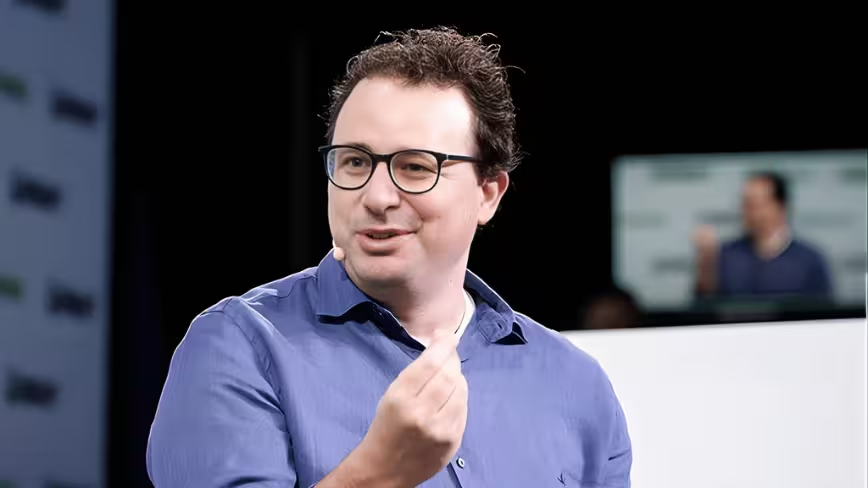
💡Anthropic's IPO plans and massive $1.25B/month compute deal reveal the true cost of scaling frontier AI models.
⚡ 30-Second TL;DR
What Changed
Anthropic filed confidentially for an IPO with Morgan Stanley and Goldman Sachs as lead underwriters.
Why It Matters
This move signals Anthropic's transition into a mature public enterprise, likely increasing pressure to demonstrate sustainable revenue growth. The massive infrastructure spend highlights the extreme capital requirements for scaling frontier AI models.
What To Do Next
Monitor Anthropic's public filings for insights into their infrastructure costs and compute-to-revenue efficiency ratios.
Key Points
- •Anthropic filed confidentially for an IPO with Morgan Stanley and Goldman Sachs as lead underwriters.
- •The company is targeting a potential public listing as early as October.
- •A massive computing infrastructure deal with SpaceX is valued at $1.25 billion per month.
🧠 Deep Insight
Background and context from public sources — not the original article. 28 sources cited.
🔑 Enhanced Key Takeaways
- •JPMorgan Chase & Co. has also been selected as an underwriter for Anthropic's upcoming IPO, joining Morgan Stanley and Goldman Sachs.
- •Anthropic's valuation reached $965 billion after its latest Series H funding round in May 2026, reportedly surpassing OpenAI's valuation.
- •The computing deal with SpaceX grants Anthropic access to over 300 megawatts of compute capacity from SpaceX's Colossus 1 data center, which is equipped with more than 220,000 Nvidia AI chips.
- •Elon Musk clarified that the SpaceX computing deal is structured as an initial 180-day lease with a mutual 90-day cancellation notice thereafter, indicating SpaceX's potential need to reclaim capacity for its own internal AI operations.
- •Anthropic's annualized revenue run rate climbed to approximately $47 billion by May 2026, largely attributed to the success of its Claude Code AI tool, which commands a significant share of the AI coding market.
📊 Competitor Analysis▸ Show
| Feature/Model | Anthropic Claude (Opus 4.7/4.6, Sonnet 4.6, Haiku 4.5) | OpenAI (GPT-5.4, GPT-5.4 Mini, GPT-4.1) | Google Gemini (3 Pro, 3 Flash, 2.5 Pro) | xAI Grok (Grok-4.1 Fast) | Meta Llama (Llama 4 Maverick) |
|---|---|---|---|---|---|
| Primary Focus | AI Safety, Constitutional AI, Enterprise, Coding | Broad ecosystem, Agentic tooling, General-purpose | Multimodal, Long context, Google Cloud integration | Real-time information, Humor, X integration | Open-source, Flexible deployment, Multimodal |
| Flagship Pricing (per 1M tokens) | Opus 4.7: $5 input / $25 output | GPT-5.4: $2.50 input / $15 output | Gemini 3 Pro: $2 input / $12 output | Grok-4.1 Fast: $0.20 input / $0.50 output | N/A (Open-source, self-hosted) |
| Mid-tier Pricing (per 1M tokens) | Sonnet 4.6: $3 input / $15 output | GPT-4.1: $2 input / $8 output | Gemini 2.5 Pro: $1.25 input / $10 output | N/A | N/A |
| Budget Pricing (per 1M tokens) | Haiku 4.5: $1 input / $5 output | GPT-5.4 Nano: $0.20 input / $1.25 output | Gemini 3 Flash: $0.50 input / $3 output | N/A | N/A |
| Context Window | Up to 1M tokens (Opus 4.7/4.6) | Up to 128K tokens (GPT-5) | Up to 2M tokens (Gemini 3 Pro) | Up to 2M tokens (Grok 4) | Up to 10M tokens (Llama 4 Maverick) |
| Coding Benchmarks | Opus 4.6: 80.8% on SWE-bench Verified | GPT-5.2: 80.0% on SWE-bench Verified | Gemini 1.5 (pre-3.0): Overtook Claude in Arena LLM Leaderboard for web dev | N/A | N/A |
| Key Strengths | Strong reasoning, safety alignment, enterprise-grade SLAs, high-resolution vision | Mature developer ecosystem, robust service levels, multimodal | Multimodal analytics, tight integration with Google Cloud, large context | Cost-effective, fast, large context window | Open-source flexibility, customizable, multimodal understanding |
🛠️ Technical Deep Dive
- Constitutional AI: Anthropic's models are trained using Constitutional AI, a method that guides model behavior through a set of written principles and self-critique, aligning them with human values and safety objectives.
- Claude Code Architecture: The autonomous coding agent, Claude Code, operates on a single-threaded master loop (codenamed "nO"). This architecture prioritizes debuggability and reliability, using disciplined tools and planning for controllable autonomy.
- Three-Layer Memory System (Claude Code): Claude Code employs a sophisticated memory architecture comprising:
- A persistent
memory.mdfile for long-term facts, decisions, and context across sessions. - A grep-based active search layer for real-time retrieval of information from the codebase during a session.
- A background process, the Chyros daemon, for continuous indexing, semantic search, and memory maintenance.
- A persistent
- Model Planning: Despite the token-by-token prediction nature of transformer models, Anthropic's research indicates that Claude models exhibit emergent planning capabilities, activating features for future words before generating them.
- Hallucination Mechanism: Anthropic's research provides a mechanistic account of hallucination, attributing it to misfires in a "familiarity circuit" where the model incorrectly classifies unfamiliar entities as familiar, leading to confident but incorrect outputs.
- Safety Mechanisms: Internal analysis reveals that safety mechanisms are not monolithic and can be mechanistically overridden by strong pattern-completion circuits, particularly when the model commits to a structured syntactic form.
- Vision Capabilities: Claude 3 models possess advanced vision capabilities, capable of processing diverse visual formats including photos, charts, graphs, and technical diagrams. The latest Opus 4.7 model supports high-resolution images up to 2,576 pixels on the long edge.
🔮 Future ImplicationsAI analysis grounded in cited sources
⏳ Timeline
📎 Sources (28)
Factual claims are grounded in the sources below. Forward-looking analysis is AI-generated interpretation.
- advisorhub.com
- cryptobriefing.com
- seekingalpha.com
- fool.com
- intellectia.ai
- anthropic.com
- investing.com
- indiatimes.com
- zacks.com
- forbes.com
- intuitionlabs.ai
- finout.io
- marsdevs.com
- teamai.com
- lorka.ai
- neurocoretech.com
- metacto.com
- morphllm.com
- mindset.ai
- zapier.com
- anthropic.com
- anthropic.com
- magicdoor.ai
- medium.com
- zenml.io
- mindstudio.ai
- medium.com
- microventures.com
Weekly AI Recap
Read this week's curated digest of top AI events →
👉Related Updates


AI-curated news aggregator. All content rights belong to original publishers.
Original source: The Next Web (TNW) ↗
This is a summary, not the original. Read the source, or get the weekly briefing.
The weekly digest
One email a week. Unsubscribe anytime.