Anthropic Launches Memory for Claude Agents
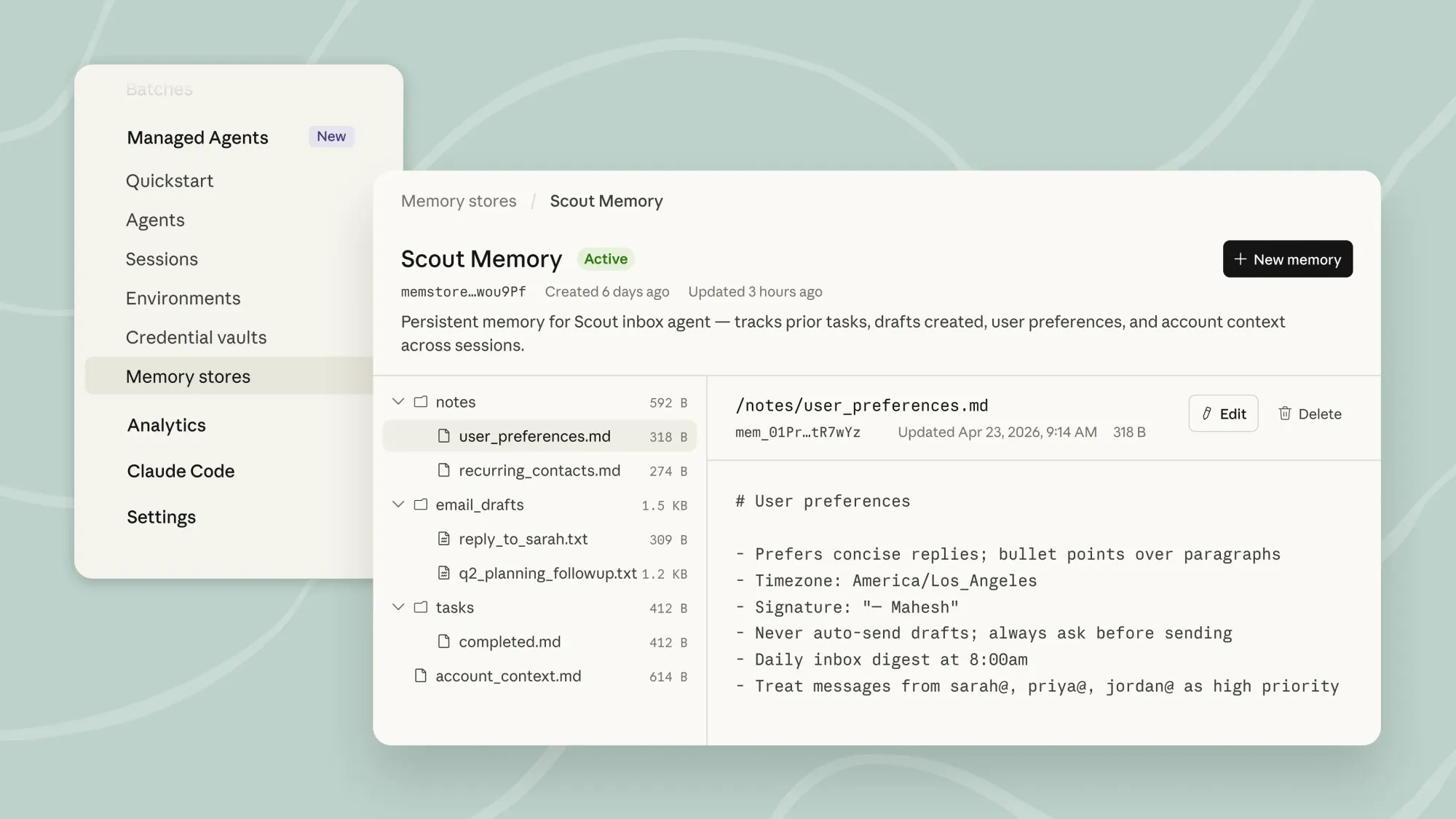
💡Enterprise memory beta for Claude Agents adds audit trails—key for production workflows.
⚡ 30-Second TL;DR
What Changed
Memory feature now in public beta for Claude managed agents
Why It Matters
This enhances enterprise adoption of Claude Agents by providing persistent memory and compliance-friendly audit logs, potentially reducing operational overhead in agent-based workflows.
What To Do Next
Sign up for Claude Console beta to test memory in your enterprise agents.
Key Points
- •Memory feature now in public beta for Claude managed agents
- •Accessible via Claude Console and APIs
- •Stores session files and logs changes with audit trails
- •Targeted at enterprise teams for better tracking
🧠 Deep Insight
AI-generated analysis for this event — not the original article.
🔑 Enhanced Key Takeaways
- •The memory feature utilizes a persistent vector-based storage architecture that allows agents to retrieve context across long-running workflows, moving beyond the limitations of standard context window constraints.
- •Enterprise administrators gain granular control over data retention policies, enabling the purging of specific session logs to comply with GDPR, CCPA, and internal data governance requirements.
- •The implementation includes a 'Human-in-the-Loop' (HITL) review mechanism where agents can flag memory updates for human approval before committing them to the permanent knowledge base.
📊 Competitor Analysis▸ Show
| Feature | Anthropic Claude Memory | OpenAI GPT-4o Memory | Google Gemini Advanced Memory |
|---|---|---|---|
| Primary Focus | Enterprise Auditability | User Personalization | Cross-App Integration |
| Audit Trails | Native/Granular | Limited | Limited |
| Pricing | Enterprise Tier/API Usage | Subscription/API Usage | Subscription/API Usage |
| Benchmarks | High Context Fidelity | High Personalization | High Ecosystem Sync |
🛠️ Technical Deep Dive
- •Architecture: Employs a tiered storage system separating short-term working memory (in-context) from long-term persistent memory (vector database).
- •Retrieval Mechanism: Uses semantic search with hybrid keyword matching to ensure high-precision recall of specific session logs.
- •Security: All memory stores are encrypted at rest using AES-256, with support for customer-managed encryption keys (CMEK) for enterprise clients.
- •API Integration: Exposes new endpoints for 'Memory Management' allowing programmatic CRUD operations on agent state files.
🔮 Future ImplicationsAI analysis grounded in cited sources
⏳ Timeline
Weekly AI Recap
Read this week's curated digest of top AI events →
👉Related Updates
AI-curated news aggregator. All content rights belong to original publishers.
Original source: TestingCatalog ↗
This is a summary, not the original. Read the source, or get the weekly briefing.
The weekly digest
One email a week. Unsubscribe anytime.