Anthropic Launches Claude Opus 4.8 with Dynamic Workflows
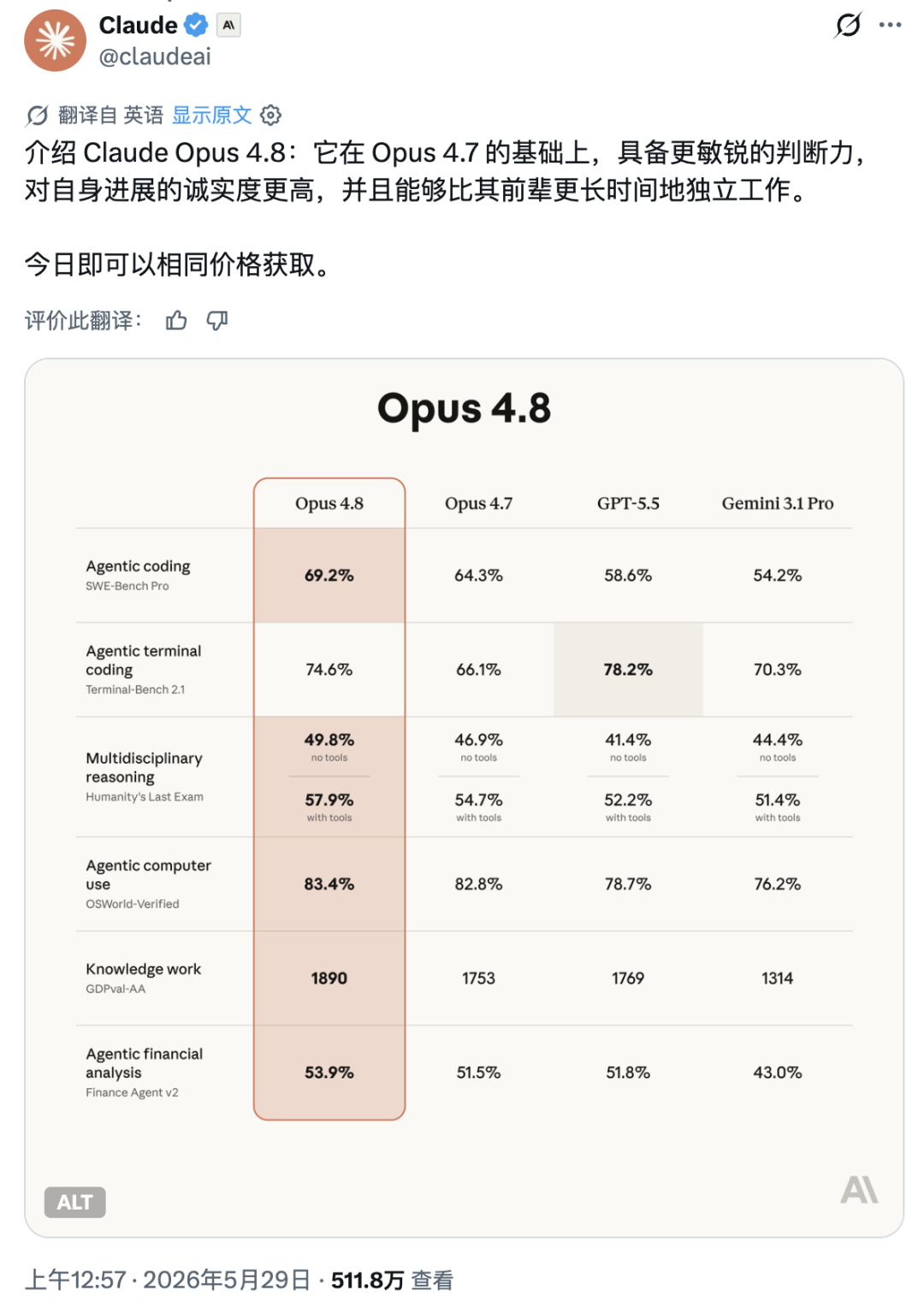
💡Claude Opus 4.8 introduces multi-agent orchestration and inference control, changing how we build complex AI apps.
⚡ 30-Second TL;DR
What Changed
Opus 4.8 improves coding accuracy and reduces hallucinations in uncertain scenarios.
Why It Matters
The introduction of dynamic workflows significantly lowers the barrier for automating large-scale code migrations and complex software engineering tasks. It signals a shift toward agentic AI that can autonomously manage multi-step, long-duration projects.
What To Do Next
Test the new 'Dynamic Workflows' in Claude Code on a complex refactoring task to evaluate its ability to manage multi-agent orchestration.
Key Points
- •Opus 4.8 improves coding accuracy and reduces hallucinations in uncertain scenarios.
- •Dynamic Workflows enable Claude to orchestrate hundreds of sub-agents for complex, long-running engineering tasks.
- •New 'effort control' allows users to adjust inference compute intensity for better quality or faster response.
- •The model maintains previous pricing despite performance upgrades.
🧠 Deep Insight
Background and context from public sources — not the original article. 27 sources cited.
🔑 Enhanced Key Takeaways
- •Claude Opus 4.8 introduces a 'fast mode' that operates at 2.5 times the normal speed and is three times cheaper than fast modes in previous Opus models, priced at $10 per million input tokens and $50 per million output tokens.
- •The model demonstrates enhanced 'honesty' and reliability, with early testers reporting it is more prone to flag uncertainties and less likely to make unsupported claims, being approximately four times less likely to allow flaws in its code to pass unremarked than its predecessor.
- •Anthropic is actively developing and has previewed a 'Mythos-class' model for cybersecurity applications, which is described as having even higher intelligence than Opus, with a general release expected in the coming weeks.
- •The Messages API for Claude Opus 4.8 now supports system entries within the messages array, enabling developers to update Claude's instructions mid-task without disrupting the prompt cache or requiring a user turn, which can reduce input costs for agentic loops.
- •While a 'modest but tangible improvement' over Opus 4.7, Opus 4.8 specifically targets behavioral enhancements in long-horizon agentic coding, reasoning effort calibration, and tool triggering, leading to more reliable performance across various domains.
📊 Competitor Analysis▸ Show
| Feature / Model | Claude Opus 4.8 | OpenAI GPT-5.5 | Google Gemini 3.1 Pro | OpenAI GPT-4o | Google Gemini 1.5 Pro |
|---|---|---|---|---|---|
| Release Date | May 28, 2026 | Not specified, but exists as a competitor to 4.8 | Not specified, but exists as a competitor to 4.8 | May 13, 2024 | February 2024 |
| Key Strengths | Agentic coding, reasoning, reliability, "honesty", dynamic workflows, effort control | Strong on terminal/CLI workflows | Extended context, cost-efficiency for high-throughput | Real-time multimodal, low latency, structured output, broad tooling | Large context window (1M tokens), cost-efficient |
| Pricing (per 1M tokens) | Input: $5, Output: $25 (Regular) Input: $10, Output: $50 (Fast Mode) | Implied higher than Opus 4.8 regular | Not specified for 3.1 Pro | Half price of GPT-4 Turbo, six times cheaper than GPT-4 | Significantly lower than Claude Opus 4 |
| Benchmarks (Opus 4.8 vs.) | SWE-Bench Pro: 69.2% Outperforms GPT-5.5 & Gemini 3.1 Pro on several synthetic benchmarks | Opus 4.8 beats it on 12+ benchmarks, but GPT-5.5 wins on terminal/CLI workflows | Opus 4.8 outperforms it on several synthetic benchmarks | Claude 3.5 Sonnet (previous) 93.7% coding accuracy vs GPT-4o 90.2% | Claude 3.5 Sonnet (previous) 71.9% coding accuracy |
🛠️ Technical Deep Dive
- Dynamic Workflows: This feature, available in research preview for Claude Code (Enterprise, Team, and Max plans), allows Claude to orchestrate hundreds of parallel subagents to tackle large-scale engineering tasks, such as codebase-scale migrations across hundreds of thousands of lines of code. Claude plans the work, writes a JavaScript script for orchestration, and a runtime executes it in the background, verifying outputs before reporting back. The system supports up to 16 concurrent agents and caps at 1,000 agents total per run, with intermediate results stored in script variables to keep Claude's context focused on the final answer.
- Effort Control: Users on claude.ai and Cowork can adjust the inference compute intensity through an 'effort control' setting. Options include 'low', 'high' (default), 'extra' ('xhigh' in Claude Code), and 'max'. Higher effort settings lead to more frequent and deeper thinking for better results, potentially using more tokens, while lower settings provide faster responses and slower rate limit consumption.
- Messages API Enhancements: The Messages API now accepts
role: "system"entries directly within the messages array after a user turn. This allows developers to update Claude's instructions mid-conversation without needing to restate the full system prompt, preserving prompt cache hits on earlier turns and reducing input costs for long-running agentic loops.
🔮 Future ImplicationsAI analysis grounded in cited sources
⏳ Timeline
📎 Sources (27)
Factual claims are grounded in the sources below. Forward-looking analysis is AI-generated interpretation.
- anthropic.com
- venturebeat.com
- macrumors.com
- gizmodo.com
- 9to5mac.com
- axios.com
- cryptobriefing.com
- claude.com
- 9to5google.com
- encord.com
- tradingkey.com
- braincuber.com
- anotherwrapper.com
- ofox.ai
- anthropic.com
- medium.com
- marktechpost.com
- wikipedia.org
- hidekazu-konishi.com
- timesofai.com
- taskade.com
- anthropic.com
- google.com
- time.com
- anthropic.com
- issarice.com
- substack.com
Weekly AI Recap
Read this week's curated digest of top AI events →
👉Related Updates

AI-curated news aggregator. All content rights belong to original publishers.
Original source: 虎嗅 ↗
This is a summary, not the original. Read the source, or get the weekly briefing.
The weekly digest
One email a week. Unsubscribe anytime.