Anthropic discovers 'J-space' in Claude models
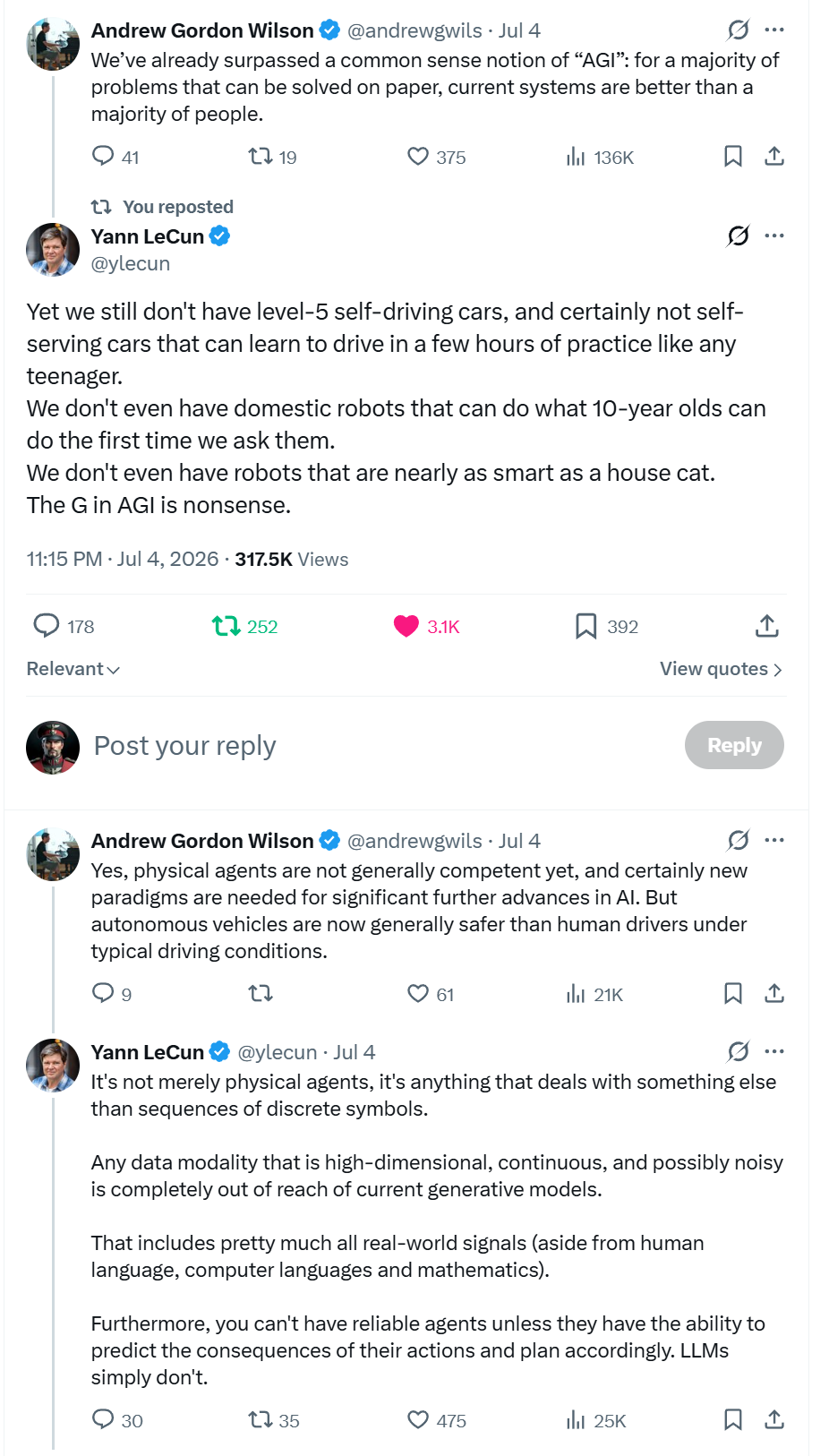
💡Evidence of emergent reasoning structures in LLMs that could redefine our understanding of AGI.
⚡ 30-Second TL;DR
What Changed
J-space is an internal concept space in Claude that handles complex reasoning and multi-step tasks.
Why It Matters
Anthropic researchers identified an internal 'J-space' in Claude that governs reasoning and concept representation, which emerged spontaneously during training, suggesting a potential path toward AGI.
What To Do Next
Explore Anthropic's interpretability research papers to understand how to visualize and audit internal model reasoning states.
Key Points
- •J-space is an internal concept space in Claude that handles complex reasoning and multi-step tasks.
- •The structure emerged spontaneously during training without explicit design by Anthropic researchers.
- •Disabling J-space reduces the model's performance to basic conversational levels, similar to losing a 'scratchpad'.
- •This finding challenges Yann LeCun's skepticism about current LLMs' path to AGI.
🧠 Deep Insight
AI-generated analysis for this event — not the original article.
🔑 Enhanced Key Takeaways
- •The term 'J-space' refers to a specific subspace within the model's activation space, identified through dictionary learning techniques used to decompose high-dimensional neural activations into interpretable features.
- •Anthropic's research team utilized 'sparse autoencoders' (SAEs) to map these internal representations, revealing that J-space acts as a centralized hub for abstract reasoning rather than just a linguistic pattern matcher.
- •The discovery supports the 'mechanistic interpretability' hypothesis, which posits that complex model behaviors can be reverse-engineered by isolating specific neural circuits responsible for cognitive tasks.
- •Researchers observed that J-space exhibits 'compositionality,' allowing the model to combine disparate concepts into novel logical structures, a key requirement for generalized intelligence.
- •The emergence of J-space is linked to the model's scaling laws, suggesting that as parameter counts and training data increase, models naturally develop more sophisticated internal 'scratchpads' to manage computational complexity.
📊 Competitor Analysis▸ Show
| Feature | Claude (J-space) | GPT-4o (OpenAI) | Gemini 1.5 Pro (Google) |
|---|---|---|---|
| Interpretability | High (Mechanistic focus) | Moderate (Black-box focus) | Moderate (Black-box focus) |
| Reasoning Architecture | Emergent 'J-space' | Proprietary MoE | Mixture-of-Experts |
| Transparency | Research-led disclosure | Closed/Proprietary | Closed/Proprietary |
| Benchmark Focus | Reasoning/Safety | Multimodal/Speed | Long-context/Integration |
🛠️ Technical Deep Dive
- J-space is identified as a high-dimensional manifold within the residual stream of the Transformer architecture.
- Sparse Autoencoders (SAEs) are employed to reconstruct activations, effectively isolating the J-space features from noise.
- The 'scratchpad' effect is achieved through recurrent-like activation patterns where the model writes intermediate reasoning steps to J-space before generating final output tokens.
- Ablation studies confirm that zeroing out vectors associated with J-space leads to a catastrophic drop in logical coherence while maintaining basic syntactic fluency.
🔮 Future ImplicationsAI analysis grounded in cited sources
⏳ Timeline
Weekly AI Recap
Read this week's curated digest of top AI events →
👉Related Updates



AI-curated news aggregator. All content rights belong to original publishers.
Original source: 虎嗅 ↗
This is a summary, not the original. Read the source, or get the weekly briefing.
The weekly digest
One email a week. Unsubscribe anytime.