Anthropic Boosts Claude Skill Testing
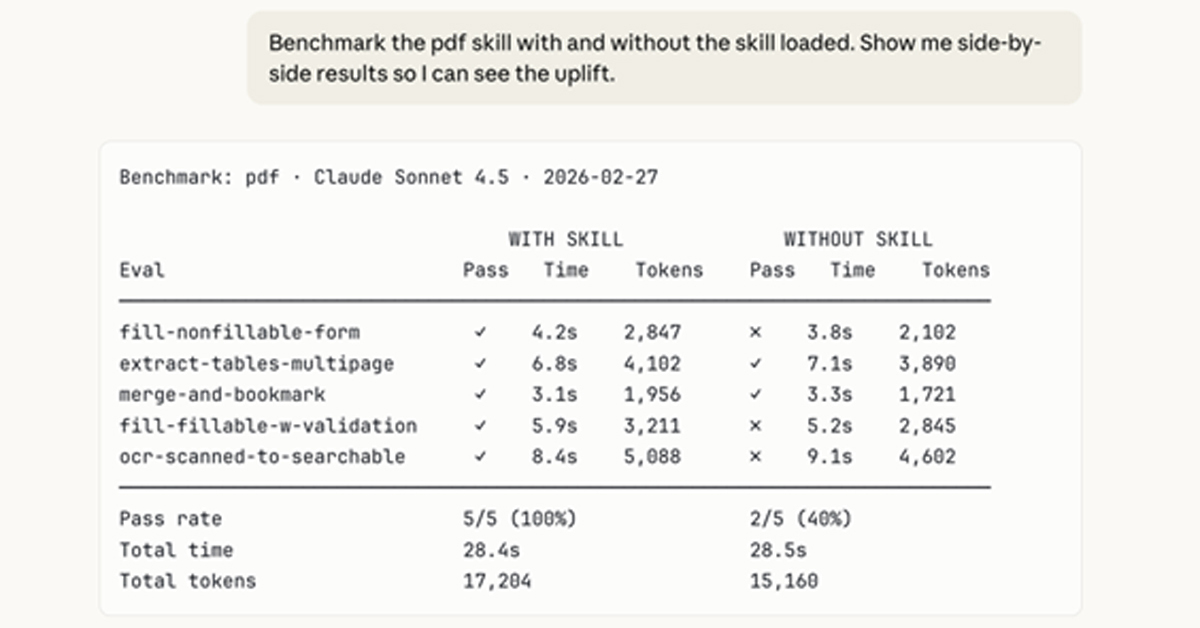
💡No-code testing for Claude skills prevents quality drops—essential for agent builders
⚡ 30-Second TL;DR
What Changed
New evaluation features for no-code skill verification
Why It Matters
Enables faster, more reliable AI agent development, reducing errors for builders deploying production skills. Could standardize quality checks across Claude ecosystem.
What To Do Next
Test the new evaluation tools in Anthropic's skill-creator for your Claude agents today.
Key Points
- •New evaluation features for no-code skill verification
- •Benchmark tools to measure Claude agent skill quality
- •Prevents degradation in AI agent skills during development
- •Targets skill-creator users extending Claude functionality
🧠 Deep Insight
AI-generated analysis for this event — not the original article.
🔑 Enhanced Key Takeaways
- •The new evaluation suite integrates with Anthropic's 'Claude Agentic Workflow' framework, allowing developers to run automated unit tests against agent outputs using a library of pre-defined, domain-specific evaluation datasets.
- •Anthropic has introduced a 'Regression Guard' feature that automatically flags potential performance drops when a user updates a skill's prompt or tool definition, comparing the new version against a baseline of historical successful executions.
- •The tool now supports 'Human-in-the-loop' (HITL) feedback loops, where developers can route ambiguous agent outputs to a human reviewer within the interface to generate ground-truth data for future automated benchmark fine-tuning.
📊 Competitor Analysis▸ Show
| Feature | Anthropic (Claude Skill Testing) | OpenAI (GPTs/Assistants) | Google (Vertex AI Agent Builder) |
|---|---|---|---|
| Evaluation Approach | No-code automated regression testing | Manual testing/evals via Playground | Integrated Vertex AI Evaluation service |
| Pricing | Usage-based (API/Token) | Usage-based (API/Token) | Tiered (Platform/Compute) |
| Benchmarks | Proprietary skill-specific metrics | Standardized model benchmarks | Custom evaluation pipelines |
🛠️ Technical Deep Dive
- •The evaluation engine utilizes a 'Judge-LLM' architecture, where a high-capability model (e.g., Claude 3.5 Sonnet or Opus) is tasked with scoring the output of the agent skill based on user-defined rubrics.
- •Supports JSON-schema validation for tool-use outputs, ensuring that agent-generated tool calls adhere strictly to the defined API specifications before execution.
- •Implements a 'Semantic Similarity' scoring mechanism using vector embeddings to compare agent responses against reference 'golden' answers, providing a quantitative quality metric.
- •The framework allows for 'Multi-turn Simulation,' where the testing environment maintains state across multiple agent-tool interactions to verify long-horizon task completion.
🔮 Future ImplicationsAI analysis grounded in cited sources
⏳ Timeline
Weekly AI Recap
Read this week's curated digest of top AI events →
👉Related Updates

AI-curated news aggregator. All content rights belong to original publishers.
Original source: ITmedia AI+ (日本) ↗
This is a summary, not the original. Read the source, or get the weekly briefing.
The weekly digest
One email a week. Unsubscribe anytime.