Anthropic begins red teaming new Claude Mythos model
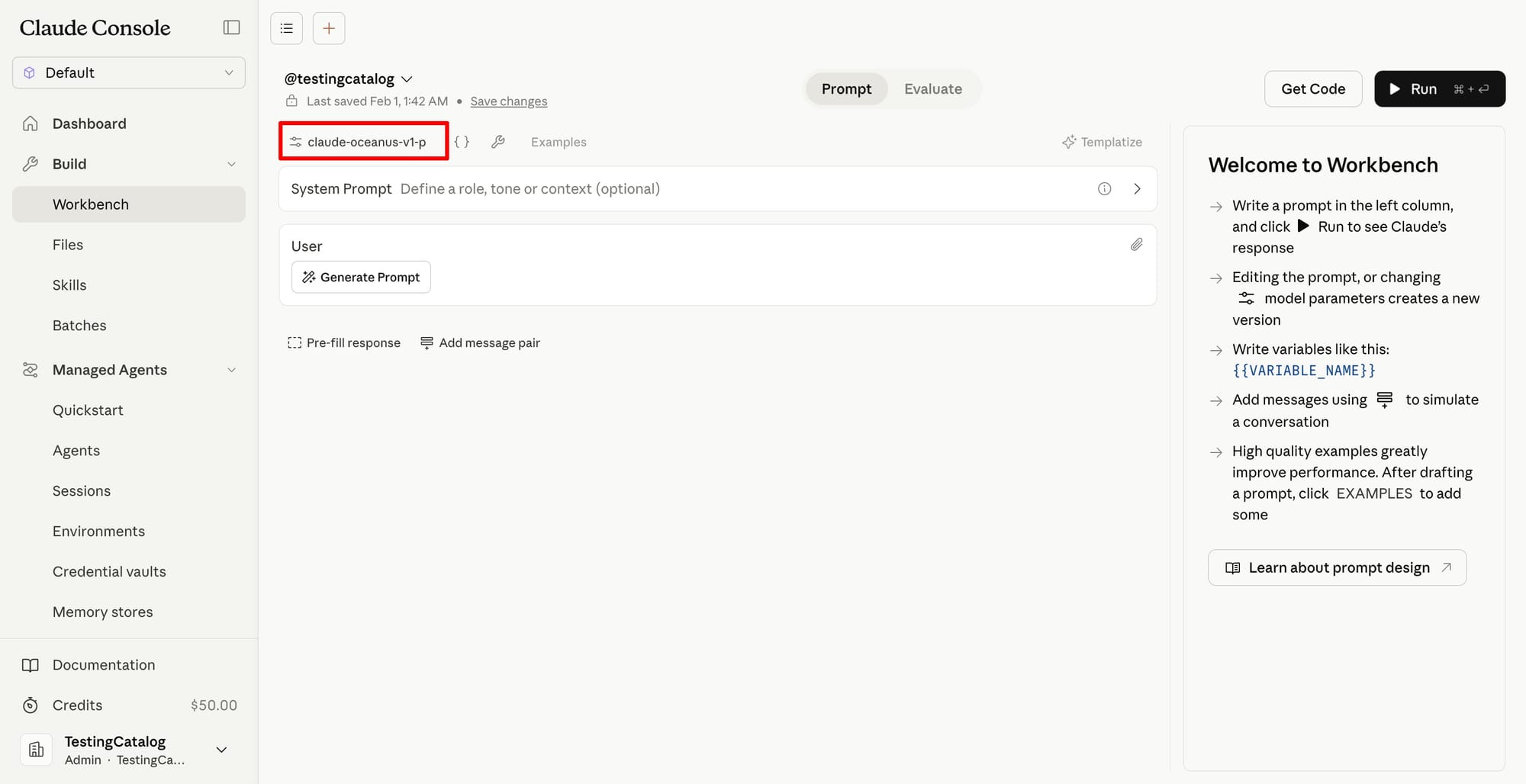
💡Anthropic's new 'Oceanus' checkpoint model targets coding and cybersecurity—key areas for enterprise AI adoption.
⚡ 30-Second TL;DR
What Changed
Claude Mythos is derived from the new 'Oceanus' checkpoint.
Why It Matters
The focus on cybersecurity and reasoning suggests Anthropic is positioning this model to compete directly in high-stakes enterprise and technical workflows. Practitioners should prepare for potential shifts in benchmark leadership for coding and security tasks.
What To Do Next
Monitor the Anthropic API documentation and release notes for early access or waitlist opportunities for the Mythos model.
Key Points
- •Claude Mythos is derived from the new 'Oceanus' checkpoint.
- •The model focuses on specialized capabilities in reasoning and coding.
- •Red teaming is currently underway to ensure safety and performance in cybersecurity applications.
🧠 Deep Insight
Background and context from public sources — not the original article. 24 sources cited.
🔑 Enhanced Key Takeaways
- •Claude Mythos is positioned as a new model tier above Claude Opus, designed for the most demanding AI tasks, particularly those requiring advanced reasoning, long agentic task sequences, and deep domain expertise.
- •The model is currently in a limited cybersecurity preview called Project Glasswing, providing exclusive access to a consortium of over 40 companies, including AWS, Apple, Google, and Microsoft, to test and harden their systems.
- •Mythos has demonstrated the ability to autonomously identify and exploit zero-day vulnerabilities across every major operating system and web browser, including a 27-year-old vulnerability in OpenBSD, often reproducing exploits on the first attempt in over 83% of cases.
- •The powerful cybersecurity capabilities of Claude Mythos emerged as a downstream consequence of general improvements in code, reasoning, and autonomy, rather than explicit training for vulnerability discovery.
- •The 'Oceanus' checkpoint, from which Claude Mythos is derived, was recently spotted in the Anthropic Console and is undergoing red teaming, with leaked pricing suggesting it could be approximately three times more expensive than Claude Opus 4.8.
📊 Competitor Analysis▸ Show
| Feature/Model | Anthropic Claude Mythos (Oceanus) | Anthropic Claude Opus 4.8 | OpenAI GPT-5.2 | Anthropic Claude Haiku 4.5 | OpenAI GPT-5-mini |
|---|---|---|---|---|---|
| Capabilities | Advanced reasoning, coding, cybersecurity (vulnerability discovery/exploitation), long agentic tasks. | Complex reasoning, nuanced analysis, coding, agentic workflows, professional work. | Reasoning depth, general purpose, DALL-E image generation, web browsing. | High-volume tasks, chatbots, real-time applications, content moderation, cost-efficient. | Lightweight tasks, chatbots, cost-sensitive workloads. |
| Pricing (per 1M tokens) | Input: ~$16, Output: ~$80 (leaked, for Oceanus) | Input: $5, Output: $25 | Input: $1.75, Output: $14.00 | Input: $1.00, Output: $5.00 | Input: $0.25, Output: $2.00 |
| Benchmarks (SWE-bench Verified) | "far surpasses the latest frontier" for agentic coding. | 80.8% (for Opus 4.6, indicative for 4.8) | 80.0% | Not explicitly specified, but optimized for speed/cost. | Not explicitly specified, but optimized for speed/cost. |
| Context Window | 1M tokens | 200K tokens standard, 1M in beta | 400K tokens | 200K tokens | Not explicitly stated, but for lightweight tasks. |
| Availability | Limited cybersecurity preview (Project Glasswing) | API, Amazon Bedrock, Google Cloud Vertex AI, Microsoft Foundry, Claude.ai | API, ChatGPT Plus | API, Amazon Bedrock, Google Cloud Vertex AI, Claude.ai | API |
🛠️ Technical Deep Dive
- Claude Mythos supports a 1 million token context window, allowing it to process and reason across extensive codebases or months of system logs in a single session.
- The model employs a dedicated reasoning mode where it generates a private chain-of-thought, which is not directly visible to the user but consumes a significant portion of the token budget.
- Its cybersecurity capabilities are facilitated by a standardized agentic scaffolding, granting the model access to tools like shell execution, file reading, compiler invocation, and debugger output.
- Anthropic's models, including Claude Mythos, are developed using 'Constitutional AI,' a technique focused on improving ethical and legal compliance by applying predefined rules to guide behavior.
- The Model Context Protocol (MCP), an open standard, enables AI models to securely connect with external data sources and tools, enhancing interoperability and reducing hallucinations by providing real-time, relevant context.
- Anthropic utilizes multi-agent architectures, where a lead agent orchestrates specialized subagents to tackle complex problems, which can significantly increase token usage but improve performance on open-ended tasks.
🔮 Future ImplicationsAI analysis grounded in cited sources
⏳ Timeline
📎 Sources (24)
Factual claims are grounded in the sources below. Forward-looking analysis is AI-generated interpretation.
- mindstudio.ai
- wikipedia.org
- armorcode.com
- turing.ac.uk
- anthropic.com
- firecompass.com
- medium.com
- testingcatalog.com
- github.com
- wikipedia.org
- vantage.sh
- morphllm.com
- youtube.com
- teamai.com
- hidekazu-konishi.com
- digitalocean.com
- metacto.com
- timesofai.com
- milvus.io
- medium.com
- anthropic.com
- anthropic.com
- anthropic.com
- entro.security
Weekly AI Recap
Read this week's curated digest of top AI events →
👉Related Updates
AI-curated news aggregator. All content rights belong to original publishers.
Original source: TestingCatalog ↗
This is a summary, not the original. Read the source, or get the weekly briefing.
The weekly digest
One email a week. Unsubscribe anytime.