Anthropic accuses Chinese firms of Claude theft
💡Anthropic's distillation accusations reveal API risks & US-China LLM wars for devs training rivals.
⚡ 30-Second TL;DR
What Changed
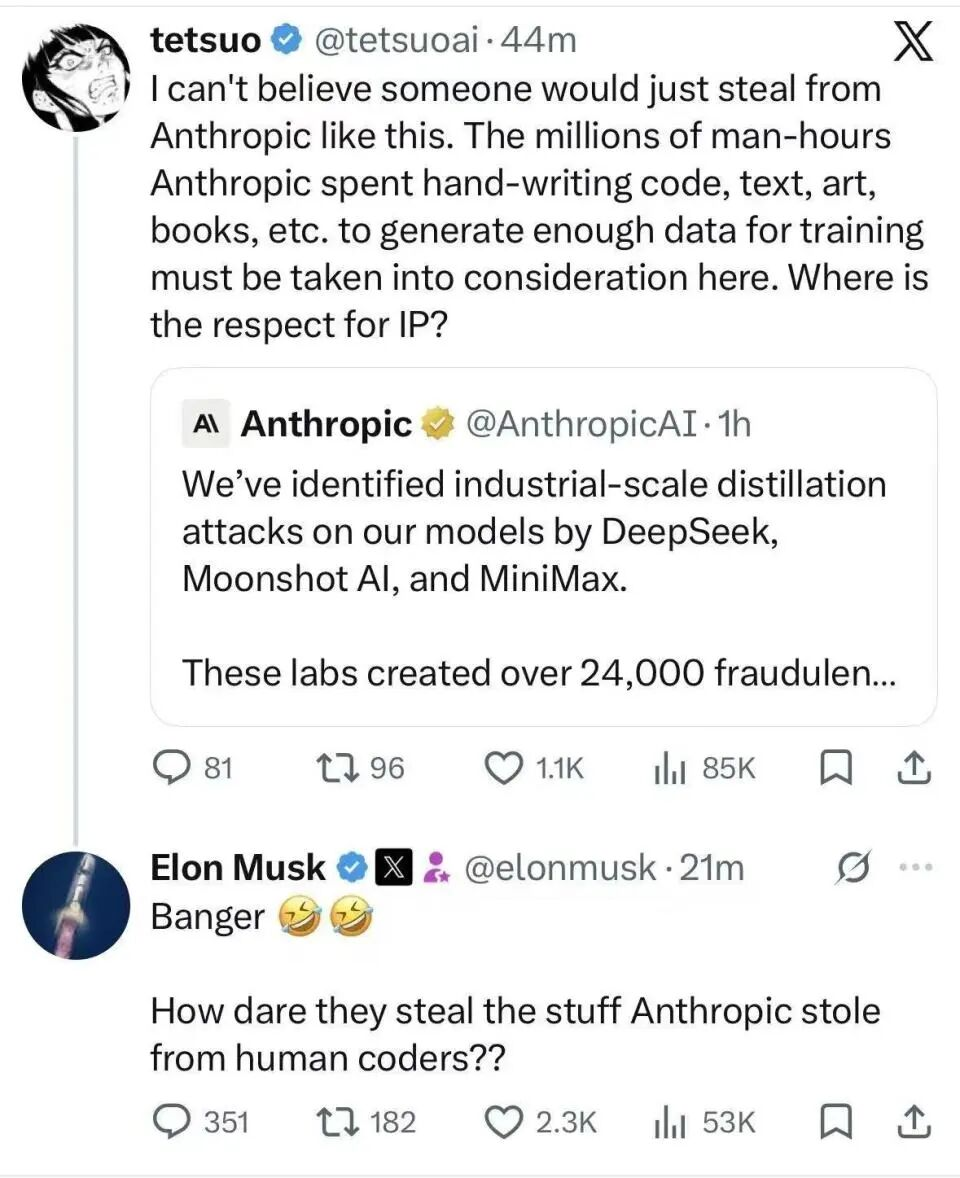
Anthropic detected 24k accounts from three Chinese AI firms making 16M+ Claude API calls.
Why It Matters
Escalates US-China AI rivalry, prompting tighter API monitoring and terms. May chill cross-border model training collaborations for practitioners.
What To Do Next
Review Anthropic's Claude API terms and audit usage logs for distillation compliance.
Key Points
- •Anthropic detected 24k accounts from three Chinese AI firms making 16M+ Claude API calls.
- •Accusations focus on distillation to copy Claude capabilities, bypassing regional blocks.
- •Musk sarcastically tweeted about Anthropic 'stealing' from human programmers.
- •Legal analysis: Hard to prove damages or copyright infringement from API outputs.
- •Anthropic links issue to national security, aligning with US export controls.
🧠 Deep Insight
Background and context from public sources — not the original article. 2 sources cited.
🔑 Enhanced Key Takeaways
- •Anthropic detected over 24,000 fraudulent accounts from DeepSeek, Moonshot AI, and MiniMax, generating more than 16 million Claude interactions via distillation to extract capabilities like agentic reasoning, tool use, coding, and data analysis.[1][2]
- •DeepSeek focused on 150,000+ exchanges for foundational logic, alignment, and censorship-safe query alternatives; Moonshot AI on 3.4 million for agentic reasoning, coding, and computer vision (recently released Kimi K2.5); MiniMax on 13 million targeting agentic coding and orchestration, redirecting traffic to new Claude launches.[1]
- •The campaigns violated Anthropic's terms of service and regional bans, using proxy services to evade detection, with prompts structured for deliberate capability extraction rather than normal use.[1][2]
- •Anthropic calls for industry-wide defenses, cloud provider cooperation, and stricter US export controls on AI chips to counter national security risks like cyber operations and surveillance from distilled models.[1][2]
- •OpenAI has previously accused DeepSeek of similar distillation; experts note challenges in proving IP theft but highlight risks of unleashing unguardrailed capabilities.[2]
🛠️ Technical Deep Dive
- Distillation technique: Involves querying a target model (Claude) at scale with structured prompts to generate training data for replicating capabilities, bypassing direct model access; prompts focused on differentiated features like agentic reasoning (multi-step planning), tool use (API integration), coding, data analysis, computer vision, and orchestration.[1]
- Detection methods: Anthropic identified anomalous patterns in volume, structure, and focus of 16M+ exchanges from 24k accounts, distinct from legitimate usage, using fraudulent accounts and proxies.[1][2]
- Specific targets: DeepSeek emphasized logic/alignment for policy-sensitive queries; Moonshot on agentic/tool development (e.g., Kimi K2.5 coding agent); MiniMax orchestrated traffic spikes to latest Claude versions for coding/tool extraction.[1]
🔮 Future ImplicationsAI analysis grounded in cited sources
Anthropic's accusations intensify US-China AI tensions, potentially accelerating export controls on chips and coordinated defenses against distillation, while raising debates on API IP enforceability and risks of proliferated capabilities enabling cyber threats without safety guardrails.[1][2]
📎 Sources (2)
Factual claims are grounded in the sources below. Forward-looking analysis is AI-generated interpretation.
📰 Event Coverage
Weekly AI Recap
Read this week's curated digest of top AI events →
👉Related Updates
AI-curated news aggregator. All content rights belong to original publishers.
Original source: 虎嗅 ↗
This is a summary, not the original. Read the source, or get the weekly briefing.
Weekly AI briefing
One email a week. Unsubscribe anytime.