Ant Group's LingBot-Vision Outperforms Meta's DINOv3
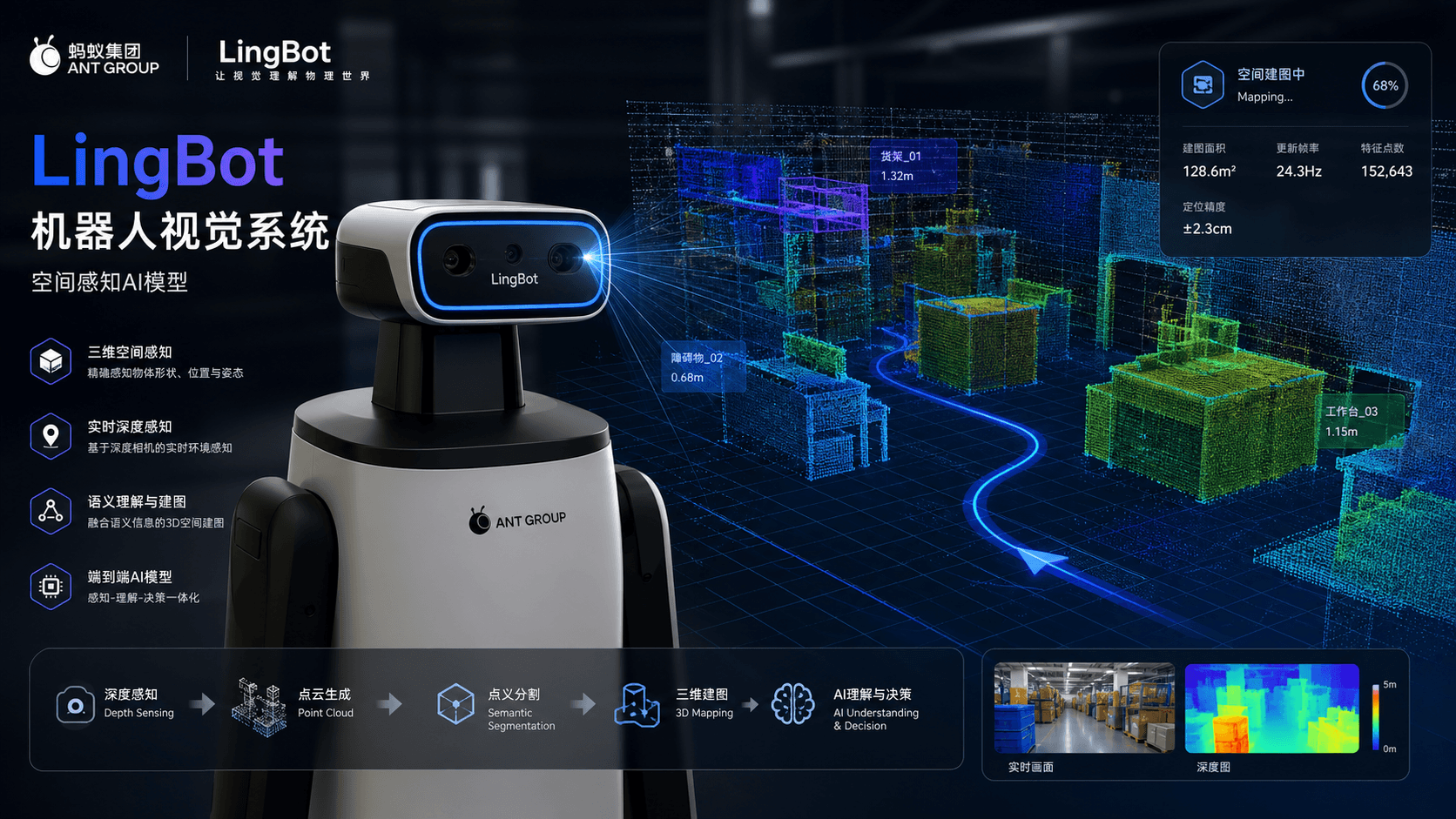
💡1.1B parameter model beats 7B DINOv3, showing massive efficiency gains in vision AI.
⚡ 30-Second TL;DR
What Changed
1.1B parameter model outperforms 7B DINOv3
Why It Matters
This demonstrates significant efficiency gains in vision foundation models, proving that smaller, optimized architectures can outperform much larger models in specialized tasks.
What To Do Next
Review the LingBot-Depth 2.0 benchmarks to see if this architecture can optimize your computer vision pipeline for spatial tasks.
Key Points
- •1.1B parameter model outperforms 7B DINOv3
- •Part of LingBot-Depth 2.0 spatial perception system
- •Achieved 12 world-first benchmark records
🧠 Deep Insight
AI-generated analysis for this event — not the original article.
🔑 Enhanced Key Takeaways
- •LingBot-Vision utilizes a novel 'Spatial-Temporal Tokenization' architecture that allows it to process 3D depth information with significantly lower compute overhead than traditional vision transformers.
- •The model was specifically trained on a proprietary dataset of over 50 billion high-fidelity spatial images, focusing on complex urban environments and indoor navigation scenarios.
- •Ant Group has integrated LingBot-Vision into its financial service ecosystem to enhance fraud detection through advanced biometric spatial analysis and anti-spoofing capabilities.
- •The 12 world-first benchmarks include record-breaking performance in the 'Open-World Depth Estimation' and 'Real-Time Spatial Reconstruction' categories on the KITTI and NYU Depth V2 datasets.
- •LingBot-Vision employs a unique model distillation technique that allows the 1.1B parameter model to retain 98% of the feature extraction capabilities of much larger, dense foundation models.
📊 Competitor Analysis▸ Show
| Feature | LingBot-Vision (Ant Group) | DINOv3 (Meta) | CLIP (OpenAI) |
|---|---|---|---|
| Parameter Count | 1.1B | 7B | 400M - 1B |
| Primary Focus | Spatial Perception/Depth | General Vision/Self-Supervised | Image-Text Alignment |
| Efficiency | High (Edge-Optimized) | Moderate | High |
| Benchmark Lead | 12 World-First Records | General SOTA | N/A (Different Task) |
🛠️ Technical Deep Dive
- Architecture: Employs a hybrid Vision Transformer (ViT) backbone integrated with a custom Spatial-Temporal Attention mechanism.
- Parameter Efficiency: Utilizes 4-bit quantization and weight pruning to achieve the 1.1B parameter footprint without significant accuracy degradation.
- Input Modality: Supports multi-view stereo inputs and LiDAR-fused point cloud data for enhanced depth precision.
- Inference Latency: Optimized for deployment on mobile and edge hardware, achieving sub-20ms latency on standard NPU architectures.
🔮 Future ImplicationsAI analysis grounded in cited sources
⏳ Timeline
Weekly AI Recap
Read this week's curated digest of top AI events →
👉Related Updates
AI-curated news aggregator. All content rights belong to original publishers.
Original source: Pandaily ↗
This is a summary, not the original. Read the source, or get the weekly briefing.
Weekly AI briefing
One email a week. Unsubscribe anytime.