🇨🇳cnBeta (Full RSS)•Stalecollected in 69m
Android Auto's Decade-Biggest Update Fits All Screens
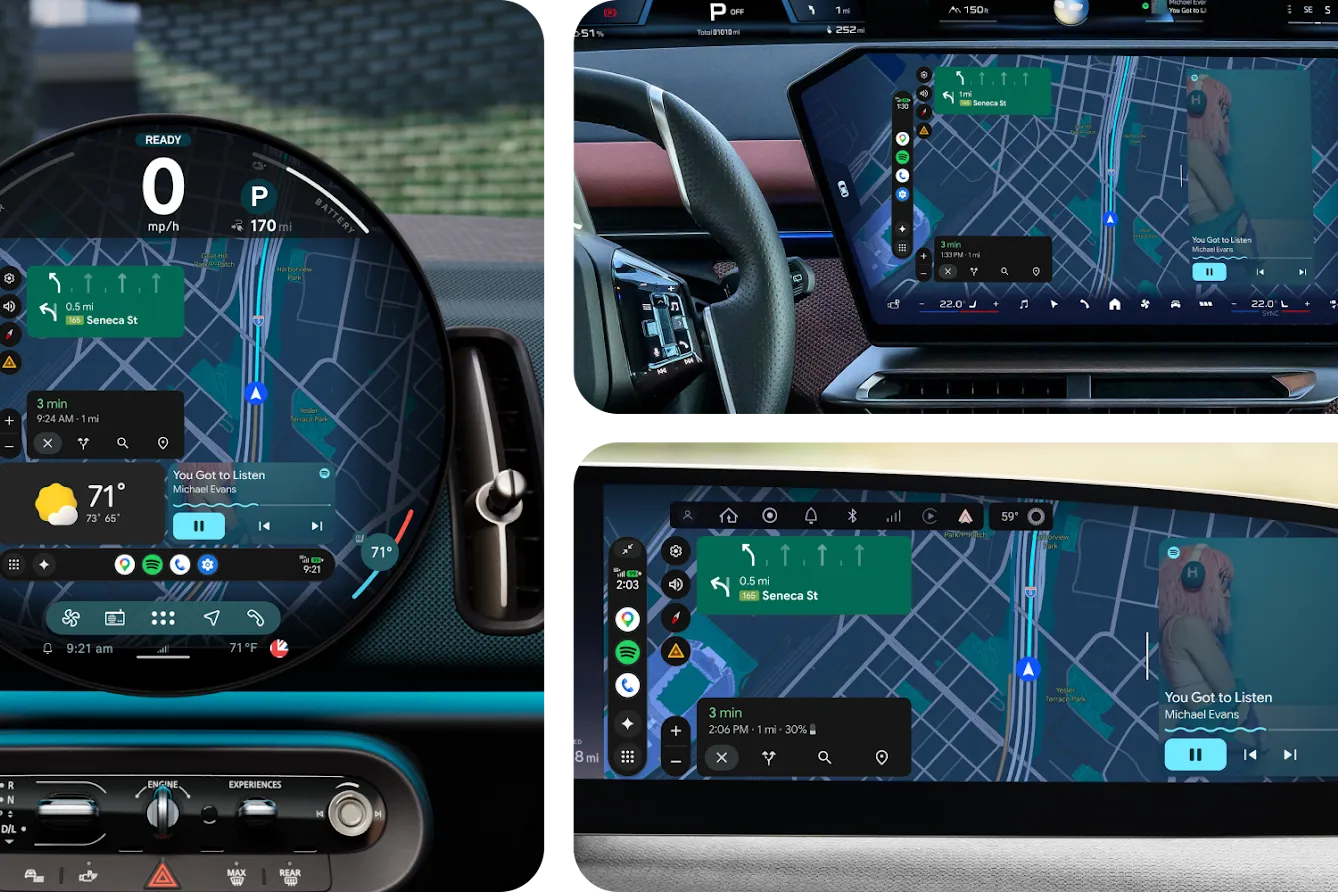
💡Gemini powers Android Auto queries on car issues + YouTube—build AI car apps.
⚡ 30-Second TL;DR
What Changed
Unified interface adapts to irregular car screen shapes
Why It Matters
Integrates Gemini AI into vehicles for smarter assistance, boosting developer opportunities in automotive AI apps.
What To Do Next
Experiment with Gemini API for vehicle queries in your Android Auto prototypes.
Who should care:Developers & AI Engineers
Key Points
- •Unified interface adapts to irregular car screen shapes
- •New additions: YouTube video playback and widget support
- •Gemini AI enables vehicle-specific queries in native systems
- •Largest update in 10 years, announced at Google I/O
🧠 Deep Insight
AI-generated analysis for this event — not the original article.
🔑 Enhanced Key Takeaways
- •The unified interface utilizes a new responsive layout engine based on Jetpack Compose for Auto, allowing developers to define UI components that dynamically reflow across ultra-wide, portrait, and non-rectangular dashboard displays.
- •YouTube playback is restricted to parked mode for safety, utilizing a new 'Media Projection' API that enforces strict vehicle speed sensor integration to prevent driver distraction.
- •Gemini integration leverages a new 'Vehicle Contextual Awareness' layer, allowing the model to access real-time CAN bus data such as tire pressure, battery health, and diagnostic trouble codes via the Android Automotive OS (AAOS) middleware.
📊 Competitor Analysis▸ Show
| Feature | Android Auto (2026 Update) | Apple CarPlay (Next-Gen) |
|---|---|---|
| Screen Adaptability | Dynamic Jetpack Compose engine | Fixed grid/flexible UI modules |
| AI Integration | Gemini (Vehicle-specific) | Apple Intelligence (Siri-based) |
| Video Playback | Native YouTube (Parked) | Limited third-party streaming |
| OS Integration | Deep AAOS/CAN bus access | Proprietary vehicle data access |
🛠️ Technical Deep Dive
- Responsive UI Framework: Transitioned from fixed-layout XML templates to a declarative UI model using Jetpack Compose, enabling real-time rendering adjustments for varying aspect ratios.
- Gemini Implementation: Utilizes a lightweight, on-device Gemini Nano model for latency-sensitive vehicle commands, with cloud-based Gemini Pro fallback for complex diagnostic queries.
- CAN Bus Bridge: New middleware layer in AAOS provides a secure, sandboxed API for third-party apps to read vehicle telemetry without compromising safety-critical systems.
🔮 Future ImplicationsAI analysis grounded in cited sources
Android Automotive OS will become the dominant standard for mid-range and luxury EVs by 2028.
The ability to provide deep vehicle diagnostics via Gemini reduces the need for proprietary OEM infotainment development.
In-car video streaming will become a primary revenue stream for Google Play in the automotive sector.
Standardizing YouTube playback across all screen shapes creates a massive, captive audience during charging sessions.
⏳ Timeline
2014-06
Google announces Android Auto at I/O to bring smartphone functionality to car dashboards.
2017-11
Android Auto introduces 'Phone Screen' mode, allowing the interface to run directly on mobile devices.
2021-09
Google launches Android Automotive OS (AAOS) in the Polestar 2, a standalone OS for vehicles.
2023-01
Google unveils 'Coolwalk' redesign, introducing a split-screen interface for better multitasking.
2026-05
Google announces the largest Android Auto update at I/O, featuring Gemini AI and unified screen support.
📰
Weekly AI Recap
Read this week's curated digest of top AI events →
👉Related Updates
AI-curated news aggregator. All content rights belong to original publishers.
Original source: cnBeta (Full RSS) ↗
This is a summary, not the original. Read the source, or get the weekly briefing.
Weekly AI briefing
One email a week. Unsubscribe anytime.