America’s AI Bet Risks a Bubble—and Strategic Fallout
A warning on AI’s trillion-dollar bubble, compute race, and the strategic risks of betting everything on AGI.
30-Second TL;DR
What Changed
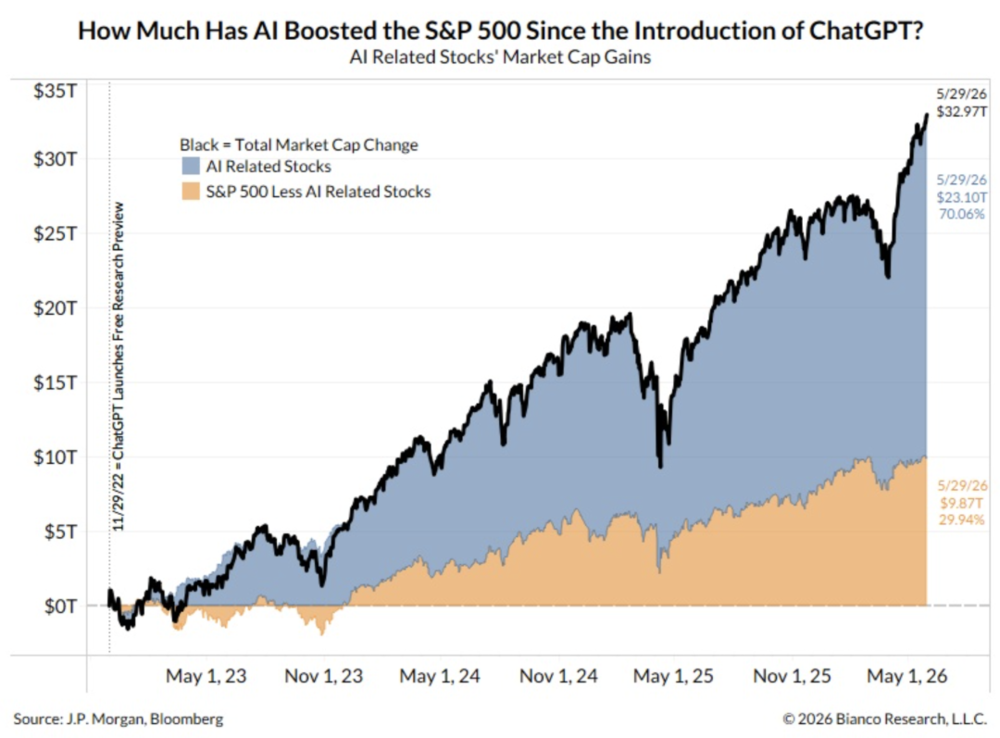
AI-related investment reportedly accounts for roughly half of U.S. business investment, while AI stocks have driven most recent S&P 500 gains.
Why It Matters
AI practitioners should treat compute expansion and frontier-model spending as high-risk strategic bets rather than guaranteed growth drivers. The article also suggests that open-source models, efficient inference, and application-scale deployment could become increasingly important if capital markets retrench.
What To Do Next
Use the OpenAI API usage dashboard and a vLLM benchmark to compare model quality, GPU utilization, and inference cost before committing to additional compute capacity.
Key Points
- •AI-related investment reportedly accounts for roughly half of U.S. business investment, while AI stocks have driven most recent S&P 500 gains.
- •Google, Microsoft, Meta, and Amazon plan to invest more than $1 trillion in AI during 2025–2026, increasingly supported by debt financing.
- •Circular transactions involving OpenAI, Nvidia, chips, cloud services, and equity arrangements may be amplifying valuations and bubble risk.
- •China is pursuing a lower-cost, open-source, and large-scale application strategy rather than matching the U.S. primarily through massive compute expansion.
- •AI misuse could create national-security disasters, including biological attacks, financial disruption, or critical-infrastructure failures.
Deep Insight
AI-generated analysis for this event — not the original article.
Enhanced Key Takeaways
- •The U.S. Department of Commerce has expanded export controls on high-end AI chips to include more stringent restrictions on cloud access for Chinese entities, aiming to prevent the circumvention of hardware bans through remote computing power.
- •Recent analysis by the Federal Reserve indicates that while AI-related capital expenditure is high, the 'AI productivity paradox' persists, as labor productivity growth in the U.S. has not yet decoupled from historical trends despite massive tech sector investment.
- •The U.S. government has initiated the 'AI Safety and Security Board' under the DHS to specifically address the risk of AI-enabled biological threats, formalizing the concerns raised by Graham Allison regarding national security vulnerabilities.
- •Energy grid operators in the U.S. have reported that AI data center power demands are forcing a re-evaluation of coal-plant retirement schedules, creating a tension between AI infrastructure growth and corporate ESG commitments.
- •Financial regulators are increasingly scrutinizing 'AI-washing' in corporate filings, with the SEC launching investigations into companies that may be overstating the integration and revenue impact of their AI models to maintain stock valuations.
Future ImplicationsAI analysis grounded in cited sources
Timeline
- 2023-10Biden Administration issues Executive Order on the Safe, Secure, and Trustworthy Development and Use of Artificial Intelligence.
- 2024-05Graham Allison publishes initial warnings regarding the 'Thucydides Trap' in the context of U.S.-China AI competition.
- 2025-03Major U.S. cloud providers announce record-breaking capital expenditure budgets exceeding $500 billion for the fiscal year.
- 2026-02U.S. regulators begin formal audits of AI-related debt financing structures among major tech firms.
Weekly AI Recap
Read this week's curated digest of top AI events →
AI-curated news aggregator. All content rights belong to original publishers.
Original source: 虎嗅 ↗
This is a summary, not the original. Read the source, or get the weekly briefing.
The weekly digest
One email a week. Unsubscribe anytime.