America Builds AGI, China Deploys AI
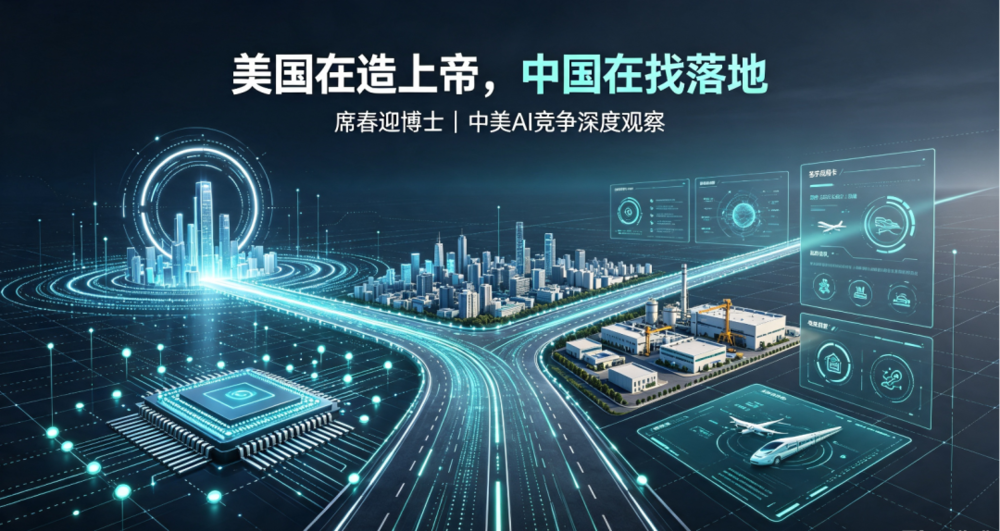
The next AI advantage may come from pairing frontier models with faster, cheaper real-world deployment.
30-Second TL;DR
What Changed
U.S. AI companies often frame AI as a potential new cognitive主体 capable of science, management, and decision-making.
Why It Matters
AI builders should expect competition to extend beyond model quality into deployment economics, manufacturing, sensors, actuators, and service networks. The strongest companies may combine U.S.-style long-term research with China-style rapid iteration in real-world workflows.
What To Do Next
Create a two-track AI roadmap: benchmark one agentic workflow for long-term capability and deploy one factory, service, or back-office pilot with measurable ROI.
Key Points
- •U.S. AI companies often frame AI as a potential new cognitive主体 capable of science, management, and decision-making.
- •Chinese companies prioritize measurable outcomes such as revenue growth, labor reduction, lower costs, and rapid deployment.
- •China’s manufacturing and supply-chain strengths may become more valuable as AI moves from text and images into physical-world systems.
- •The U.S. risks excessive hype and valuation dependence on AGI breakthroughs, while China risks underinvesting in foundational research by demanding early revenue.
Deep Insight
AI-generated analysis for this event — not the original article.
Enhanced Key Takeaways
- •The U.S. strategy is heavily supported by massive capital expenditure from hyperscalers like Microsoft, Google, and Meta, which prioritize scaling compute infrastructure to achieve AGI, often decoupling short-term profitability from long-term model capability.
- •China's 'AI+ Action' initiative, promoted by the Ministry of Industry and Information Technology (MIIT), explicitly mandates the integration of AI into industrial sectors to boost productivity and combat demographic-driven labor shortages.
- •U.S. venture capital investment in AI has shifted toward 'Agentic AI' startups that aim to automate complex workflows, whereas Chinese investment is increasingly concentrated in 'Embodied AI' and robotics to leverage the country's existing manufacturing base.
- •Regulatory environments differ significantly: the U.S. maintains a relatively permissive stance on foundational model development to foster innovation, while China has implemented strict algorithmic filing requirements and content control mandates that shape the deployment of commercial AI products.
- •Chinese AI firms are increasingly adopting a 'Small Model' (SLM) strategy, optimizing for edge computing and local deployment to reduce latency and costs for enterprise clients, contrasting with the U.S. trend of training increasingly massive, centralized foundation models.
Technical Deep Dive
- U.S. AGI development focuses on scaling laws, utilizing massive GPU clusters (H100/B200) to train transformer-based models with trillions of parameters, emphasizing reasoning and multi-step planning capabilities.
- Chinese industrial AI deployment utilizes edge-optimized architectures, often employing knowledge distillation and quantization to run models on local industrial controllers and IoT devices.
- Embodied AI in China integrates Large Vision-Language Models (LVLMs) with proprietary robotic control stacks, focusing on sim-to-real transfer learning for factory automation.
- U.S. agentic frameworks (e.g., AutoGPT, LangChain-based systems) prioritize high-level cognitive reasoning and tool-use, whereas Chinese deployments prioritize deterministic control and safety-critical reliability in physical environments.
Future ImplicationsAI analysis grounded in cited sources
Timeline
- 2023-07China releases Interim Measures for the Management of Generative AI Services, establishing the regulatory framework for deployment.
- 2024-01The U.S. government issues an Executive Order on Safe, Secure, and Trustworthy AI, focusing on safety standards for frontier models.
- 2024-05China's MIIT accelerates the 'AI+ Action' initiative to integrate AI into manufacturing and industrial sectors.
- 2025-03Major U.S. tech firms report record-breaking capital expenditures dedicated to building out AGI-scale data centers.
- 2026-02Chinese industrial AI adoption reaches a critical mass, with significant labor cost reductions reported in the automotive and electronics sectors.
Weekly AI Recap
Read this week's curated digest of top AI events →
AI-curated news aggregator. All content rights belong to original publishers.
Original source: 虎嗅 ↗
This is a summary, not the original. Read the source, or get the weekly briefing.
The weekly digest
One email a week. Unsubscribe anytime.