AMD Ryzen Prices Surge 50%+ in Japan
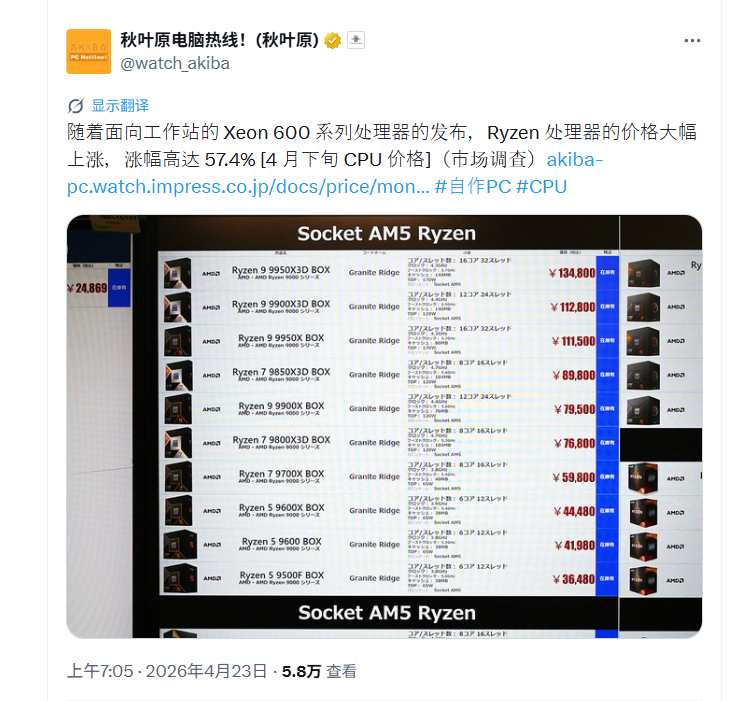
💡AI boom spikes Ryzen prices 50% in Japan—key for hardware budgeting now.
⚡ 30-Second TL;DR
What Changed
Ryzen CPUs up over 50% in Japan DIY market
Why It Matters
Price surges raise costs for AI builders sourcing CPUs in Japan, potentially pushing shifts to Intel or cloud infrastructure. Global supply chain ripples may follow.
What To Do Next
Check current AMD Ryzen quotes from Japanese vendors before budgeting AI training rigs.
Key Points
- •Ryzen CPUs up over 50% in Japan DIY market
- •AM4 socket legacy processors also price-hiked
- •Driven by AI hardware demand panic
- •Reported by PC Watch media
🧠 Deep Insight
AI-generated analysis for this event — not the original article.
🔑 Enhanced Key Takeaways
- •The price surge is largely attributed to a supply chain bottleneck caused by AMD prioritizing high-margin EPYC and Instinct MI300 series chips for data center AI workloads, leading to reduced wafer allocation for consumer Ryzen desktop processors.
- •Japanese retailers are reporting significant inventory depletion as speculative buying by local system integrators and AI hobbyists has outpaced AMD's replenishment cycles in the APAC region.
- •The impact on AM4 processors is specifically linked to a surge in demand for budget-friendly, high-core-count workstations used for local LLM inference and fine-tuning, which are being built using older, cost-effective platforms.
📊 Competitor Analysis▸ Show
| Feature | AMD Ryzen (DIY) | Intel Core (Desktop) | Apple Silicon (Mac) |
|---|---|---|---|
| Pricing | Volatile (Surging) | Stable/Standard | Fixed (Premium) |
| AI Capability | High (via discrete GPU) | Moderate (NPU integrated) | High (Unified Memory) |
| Platform | AM4/AM5 (Flexible) | LGA 1700/1851 | Closed Ecosystem |
🛠️ Technical Deep Dive
- •The Ryzen architecture utilizes a chiplet-based design (Zen 4/5) which allows AMD to bin high-performance silicon for server-grade EPYC processors, directly competing for the same TSMC 5nm/4nm capacity used for consumer Ryzen CPUs.
- •AM4 processors, particularly the Ryzen 5000 series, remain popular for AI tasks due to their high core-to-price ratio, allowing for cost-effective multi-threaded processing when paired with high-VRAM GPUs.
- •The current supply constraint is exacerbated by the 'CoWoS' (Chip-on-Wafer-on-Substrate) packaging bottleneck, which is required for both high-end AI accelerators and modern Ryzen chiplet integration.
🔮 Future ImplicationsAI analysis grounded in cited sources
⏳ Timeline
Weekly AI Recap
Read this week's curated digest of top AI events →
👉Related Updates
AI-curated news aggregator. All content rights belong to original publishers.
Original source: cnBeta (Full RSS) ↗
This is a summary, not the original. Read the source, or get the weekly briefing.
The weekly digest
One email a week. Unsubscribe anytime.