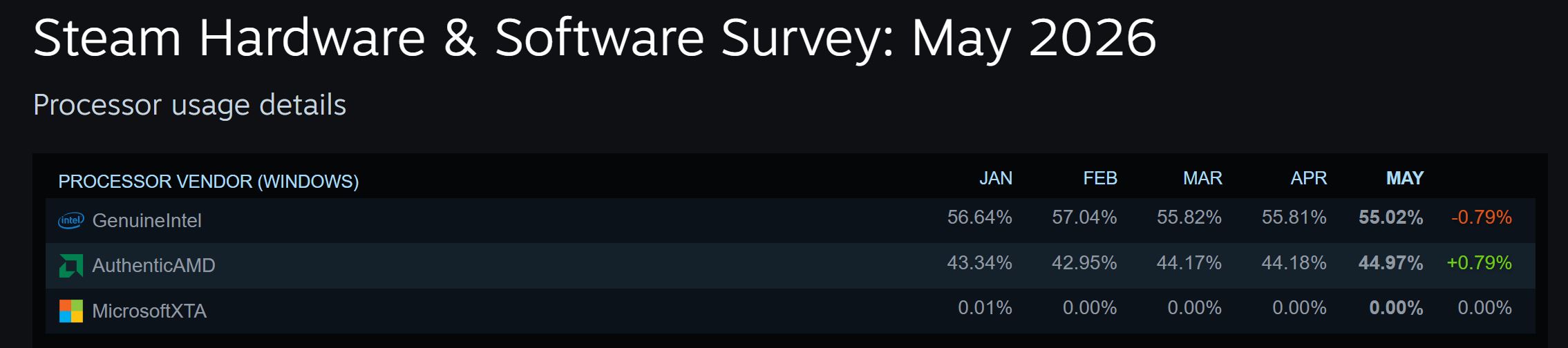
AMD CPU market share hits 45% on Steam
💡Understanding hardware trends is critical for developers optimizing local AI model deployment and performance.
⚡ 30-Second TL;DR
What Changed
AMD CPU market share reached 44.97% in May 2026
Why It Matters
The shift in CPU market share suggests a potential change in hardware optimization priorities for developers targeting high-performance gaming and local AI inference tasks.
What To Do Next
Optimize your local inference workloads to ensure compatibility and performance parity across both AMD and Intel architectures.
Key Points
- •AMD CPU market share reached 44.97% in May 2026
- •Intel's market share declined to 55.02%
- •AMD has gained nearly 2 percentage points over the last two months
🧠 Deep Insight
Background and context from public sources — not the original article. 22 sources cited.
🔑 Enhanced Key Takeaways
- •AMD's 44.97% CPU market share in May 2026 represents an all-time high for the company on the Steam platform.
- •The consistent growth in AMD's Steam market share is largely driven by the strong reception and gaming performance of its X3D processors, which incorporate 3D V-Cache technology.
- •Intel's CPU market share on Steam has been in a consistent decline for over a year, with the gap between the two rivals narrowing to just under 10 percentage points in May 2026.
- •Despite Intel's recent launches, such as the Core Ultra 200 Plus chips, which have been well-received, they have not managed to halt the company's decline in the Steam hardware survey.
- •AMD has publicly committed to supporting its AM5 platform through 2029, offering users a longer upgrade path and investment protection compared to Intel's more frequent socket changes.
📊 Competitor Analysis▸ Show
| Feature/Metric | AMD Ryzen (e.g., Ryzen 7 9800X3D, 9850X3D) | Intel Core (e.g., Core Ultra 9 285K, Core Ultra 7 270K Plus) |
|---|---|---|
| Gaming Performance | Dominant, especially with X3D (25-38% faster than Intel flagships in processor-limited tests). | Competitive in budget builds, but generally slower than AMD's X3D in high-end gaming. |
| Multi-threading/Productivity | Excellent, particularly Ryzen 9 9950X for content creation and pure CPU rendering. | Strong, especially with P-cores and E-cores; Core Ultra 7 270K Plus performs within 2-5% of Ryzen 9 9950X in multi-threaded workloads at a lower price. |
| Power Efficiency | Generally better, especially X3D chips (e.g., Ryzen 7 9800X3D draws 65-88W under gaming load). | Higher power consumption for flagship gaming performance (e.g., Core Ultra 9 285K draws 125-185W). |
| Pricing (Flagship Gaming) | Often offers better value per frame; Ryzen 7 9800X3D is around $479. | Flagship Core Ultra 9 285K is around $589. |
| Key Technology | 3D V-Cache for enhanced gaming performance. | Hybrid architecture (P-cores/E-cores), integrated NPU for AI, Intel Arc graphics. |
| Platform Longevity | AM5 socket supported through 2029. | More frequent socket changes, though Intel is working on platform stability. |
🛠️ Technical Deep Dive
- AMD Ryzen 7000/9000 Series (Zen 4/Zen 5 Architecture):
- Built on TSMC's 5nm process technology for CCDs (CPU core dies) and 6nm for the I/O die.
- Features "Zen 4" and "Zen 5" microarchitectures, offering significant improvements in single-thread performance and performance-per-watt over previous generations.
- 3D V-Cache Technology: Stacks an additional 64MB or more of L3 cache directly on top of the CPU die, significantly reducing memory latency for games and boosting frame rates.
- AM5 Platform: Supports up to 170W TDP processors, dual-channel DDR5 memory, and PCIe 5.0 for GPUs and SSDs.
- Integrated AMD RDNA 2 graphics on the I/O die for the first time in Ryzen desktop processors.
- AMD EXPO (Extended Profiles for Overclocking) technology for easy DDR5 memory speedups.
- Intel Core Ultra (Series 1/2/3) Processors (Meteor Lake/Arrow Lake Refresh/Panther Lake):
- Hybrid Architecture: Combines Performance-cores (P-cores) for high-demand tasks and Efficiency-cores (E-cores) for background tasks, optimizing performance and power efficiency.
- Tiled Architecture (Meteor Lake): Features multiple chips (tiles) built with different silicon flavors connected by Intel's Foveros advanced packaging technology.
- Integrated NPU (Neural Processing Unit): Dedicated hardware for AI acceleration, offloading AI workloads from the CPU and GPU, improving power efficiency for AI PCs.
- Integrated Intel Arc Graphics: Enhanced integrated GPU designed for modern graphics and AI workloads, supporting high-end gaming and video editing.
- Process Technology: Core Ultra Series 3 is the first platform built on Intel 18A process technology.
- Support for WiFi 7 and Turbo Boost Max Technology 3.0.
🔮 Future ImplicationsAI analysis grounded in cited sources
⏳ Timeline
📎 Sources (22)
Factual claims are grounded in the sources below. Forward-looking analysis is AI-generated interpretation.
Weekly AI Recap
Read this week's curated digest of top AI events →
👉Related Updates
AI-curated news aggregator. All content rights belong to original publishers.
Original source: cnBeta (Full RSS) ↗
This is a summary, not the original. Read the source, or get the weekly briefing.
The weekly digest
One email a week. Unsubscribe anytime.