Amazon's Proteus robot gains natural language control
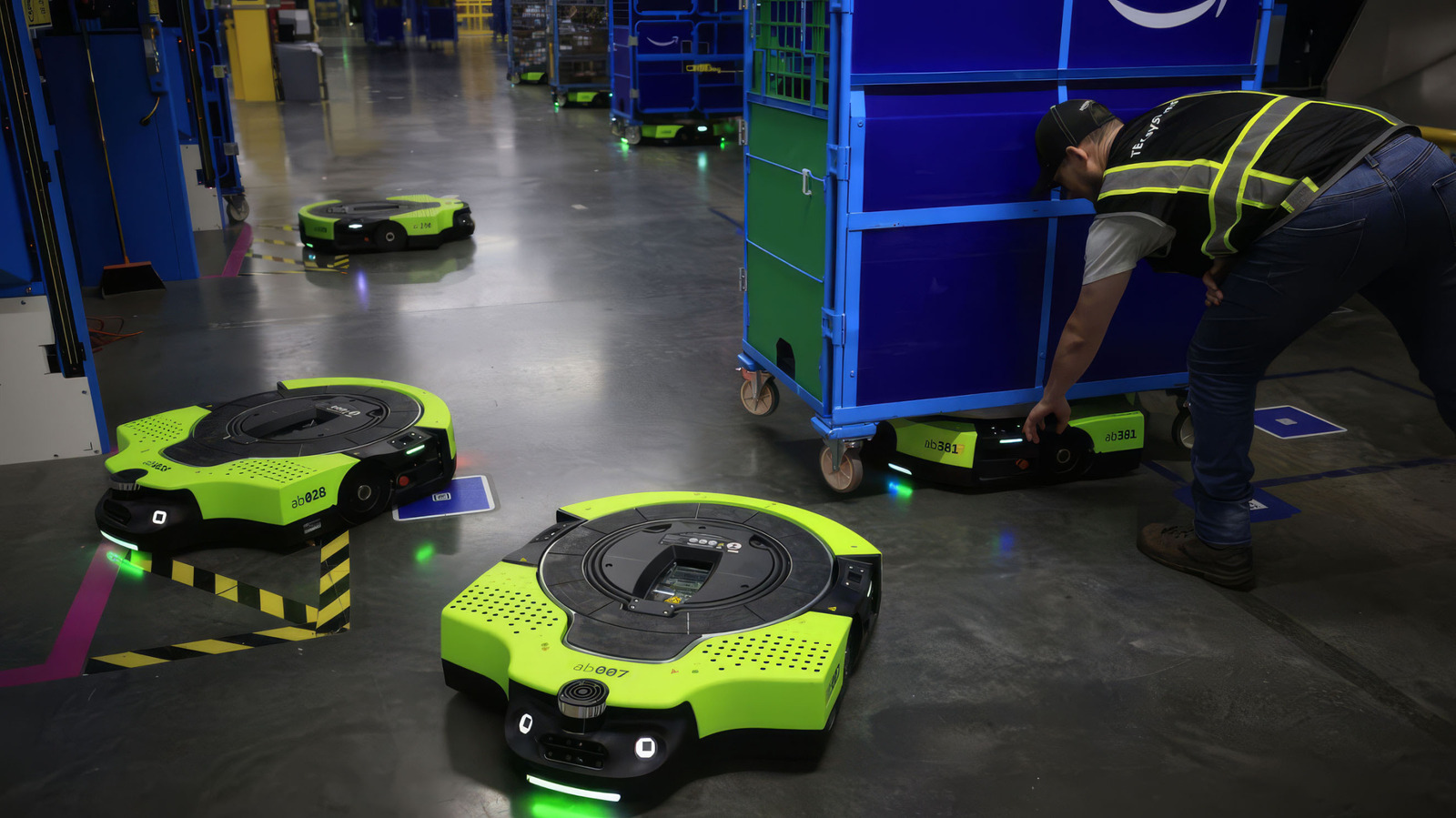
💡See how Amazon is bridging LLMs and physical robotics to allow plain-language control of warehouse fleets.
⚡ 30-Second TL;DR
What Changed
Proteus is now fully autonomous in warehouse operations
Why It Matters
This shift towards natural language interfaces in robotics reduces the barrier for warehouse staff to manage complex fleets. It signals a broader trend of LLMs being integrated into physical industrial automation.
What To Do Next
Research how to integrate LLM-based intent parsing with your existing ROS2 (Robot Operating System) nodes to enable voice-controlled automation.
Key Points
- •Proteus is now fully autonomous in warehouse operations
- •Integration of natural language processing for robot control
- •Enhanced operational efficiency through intuitive human-robot communication
🧠 Deep Insight
Background and context from public sources — not the original article. 18 sources cited.
🔑 Enhanced Key Takeaways
- •The next-generation Proteus robot expands its operational scope beyond the original version's limitation to dock areas, now capable of working anywhere across fulfillment centers and delivery sites to transport containers and assist employees between workstations.
- •The natural language control system allows employees to direct Proteus using plain, conversational language, enabling the robot to autonomously determine task priority, route, and timing without requiring technical commands or programming interfaces.
- •This advancement is part of Amazon's broader €10 billion investment to modernize and expand its European fulfillment network, which also includes the deployment of other advanced robotics like Vulcan (a touch-sensitive robot) and STARK (a collaborative tote-handling system).
- •The new Proteus is currently undergoing piloting in Amazon's labs, with its deployment across European facilities anticipated for the first half of 2027.
- •Proteus was initially introduced in July 2022 as Amazon's first fully autonomous mobile robot (AMR) designed to safely operate in the same physical space as human employees, a significant departure from earlier Kiva robots that required caged-off areas.
🛠️ Technical Deep Dive
- The original Proteus robot is designed to transport heavy carts weighing up to 400 kilograms (approximately 800 pounds).
- It utilizes advanced safety, perception, and navigation technologies, including LiDAR sensors and Simultaneous Localization and Mapping (SLAM) for autonomous movement.
- For precise interaction with GoCarts, Proteus employs a two-step detection and motion process, which includes an 'S' curve maneuver to correct lateral positioning errors before sliding underneath the cart.
- Storage locations are identified using 'fiducial plus,' a custom-made ground target that assists Proteus with alignment capabilities.
- The robot's design incorporates a distinct 'protruding face' that appears to house a puck LiDAR sensor and two Time-of-Flight (ToF) cameras positioned at slight downward and sharp upward angles.
- Proteus is built to comply with the voluntary safety standard R15.08 and features 'Safety-aware' trajectory planning software to anticipate and avoid potential collisions.
- The natural language control functionality is powered by an AI foundation model framework developed by Amazon's agentic AI team within its Lab126 hardware research-and-development unit.
- It is designed to operate for two 10-hour shifts, autonomously finding and utilizing designated docks for recharging every couple of hours.
🔮 Future ImplicationsAI analysis grounded in cited sources
⏳ Timeline
📎 Sources (18)
Factual claims are grounded in the sources below. Forward-looking analysis is AI-generated interpretation.
Weekly AI Recap
Read this week's curated digest of top AI events →
👉Related Updates

AI-curated news aggregator. All content rights belong to original publishers.
Original source: Engadget ↗
This is a summary, not the original. Read the source, or get the weekly briefing.
The weekly digest
One email a week. Unsubscribe anytime.