Amazon Signs Billion-Dollar Corning Deal for AI Data Centres
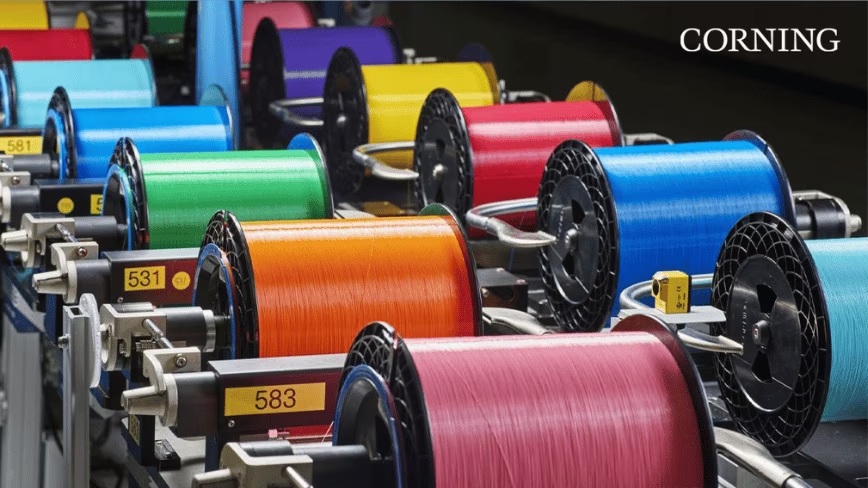
💡AI isn't just chips; it's glass. See why Amazon is betting billions on the physical backbone of AI infrastructure.
⚡ 30-Second TL;DR
What Changed
Multi-billion dollar deal for optical fibre supply
Why It Matters
The massive investment in fibre optics confirms that data throughput is a primary bottleneck for AI, necessitating massive physical infrastructure upgrades.
What To Do Next
When architecting distributed AI training clusters, factor in the availability and lead times of high-bandwidth optical networking components.
Key Points
- •Multi-billion dollar deal for optical fibre supply
- •Supports Amazon's expanding US data center footprint
- •Creates 1,000 new jobs at Corning's North Carolina factories
🧠 Deep Insight
Background and context from public sources — not the original article. 21 sources cited.
🔑 Enhanced Key Takeaways
- •The multi-year, multi-billion dollar agreement extends beyond just optical fiber to include cable and connectivity solutions, aiming to strengthen the entire U.S. supply chain for AI infrastructure.
- •Amazon and Corning will collaborate on expanding a Fiber Optic Technician Training Program with Catawba Valley Community College, addressing the need for skilled labor in fiber optic manufacturing and related technical roles.
- •This deal marks Corning's third significant AI-related agreement in 2026, following multi-billion dollar commitments from Meta (up to $6 billion) and Nvidia (up to $3.2 billion), underscoring Corning's pivotal role in the AI infrastructure boom.
- •The escalating demand for optical fiber in AI data centers is driven by the requirement for over 10 times more fiber than traditional data centers, necessitating advanced high-density solutions and specialized fiber types.
📊 Competitor Analysis▸ Show
| Company | Optical Fiber Market Share (approx.) | Key Offerings for Data Centers | Recent Strategic Moves |
|---|---|---|---|
| Corning | 25-30% global share | SMF-28® Contour fiber, Multicore Fiber (MCF), Contour™ Flow micro cable, GlassWorks AI™ Solutions, PRIZM® TMT optical ferrule technology | Multi-billion dollar deals with Amazon, Meta (up to $6B), and Nvidia (up to $3.2B) for AI data center supply; expanding North Carolina facilities |
| Amphenol Corporation | Not specified, but a significant competitor | Optical interconnects, fiber management systems, high-speed connectivity products | Expanding fiber-optic business; acquired CommScope's Connectivity and Cable Solutions business |
| Lumen Technologies, Inc. | Not specified | Strengthened fiber network, NorthLine fiber route connecting Seattle and Minneapolis | Investing in AI-ready fiber infrastructure and high-capacity optical connectivity services |
| Prysmian Group | Major global rival | Optical fiber and cable | Expanding footprint through acquisitions in Europe and Latin America |
| CommScope | Major global rival | Fiber optic networking solutions | Connectivity and Cable Solutions business acquired by Amphenol |
| YOFC (Chinese firms) | Increased share in mid-market fiber | Standard fiber | Pressure prices in commodity segments |
🛠️ Technical Deep Dive
- AI data centers demand high-density optical solutions to accommodate significantly more fiber in confined spaces, often requiring over 10 times the fiber of traditional data centers.
- Corning's SMF-28® Contour fiber is designed with a smaller diameter to fit more connectivity into existing data center footprints.
- Corning's Multicore Fiber (MCF) solution integrates multiple cores into a single 125-micron fiber strand, achieving up to four times the optical pathway density, which can reduce cable mass by up to 70% and installation time by up to 60%.
- The Corning® Contour™ Flow micro cable significantly reduces cable diameter, enabling double the fiber count (e.g., 1728 fibers) in approximately half the size of legacy ribbon cables for long-distance and campus interconnectivity.
- Corning is leveraging PRIZM® TMT optical ferrule technology, which uses precision-aligned microlenses instead of direct fiber-to-fiber contact, allowing for higher fiber counts in tighter spaces, faster installation, and improved contamination resistance.
- AI workloads necessitate ultra-high-speed, low-latency connections, with large AI data centers currently operating at 400/800Gbps and planning for even faster technologies.
- Single-mode fiber (SMF) is critical for long-distance, high-bandwidth transmissions, such as inter-data center links, while multimode fiber (MMF) is cost-effective for shorter, intra-rack connections within data centers.
- MPO/MTP connectors are widely used in data centers to manage multiple fiber connections efficiently, minimizing rack space and accelerating deployment.
- Emerging technologies like hollow-core fiber optics offer significant improvements in transmission latency (up to 30%) and increased reach distance (up to 46% for fixed latency) compared to solid fiber.
🔮 Future ImplicationsAI analysis grounded in cited sources
⏳ Timeline
📎 Sources (21)
Factual claims are grounded in the sources below. Forward-looking analysis is AI-generated interpretation.
Weekly AI Recap
Read this week's curated digest of top AI events →
👉Related Updates

AI-curated news aggregator. All content rights belong to original publishers.
Original source: The Next Web (TNW) ↗
This is a summary, not the original. Read the source, or get the weekly briefing.
The weekly digest
One email a week. Unsubscribe anytime.