Amazon Quick Launches Agentic Catalog Experience for Data Curators
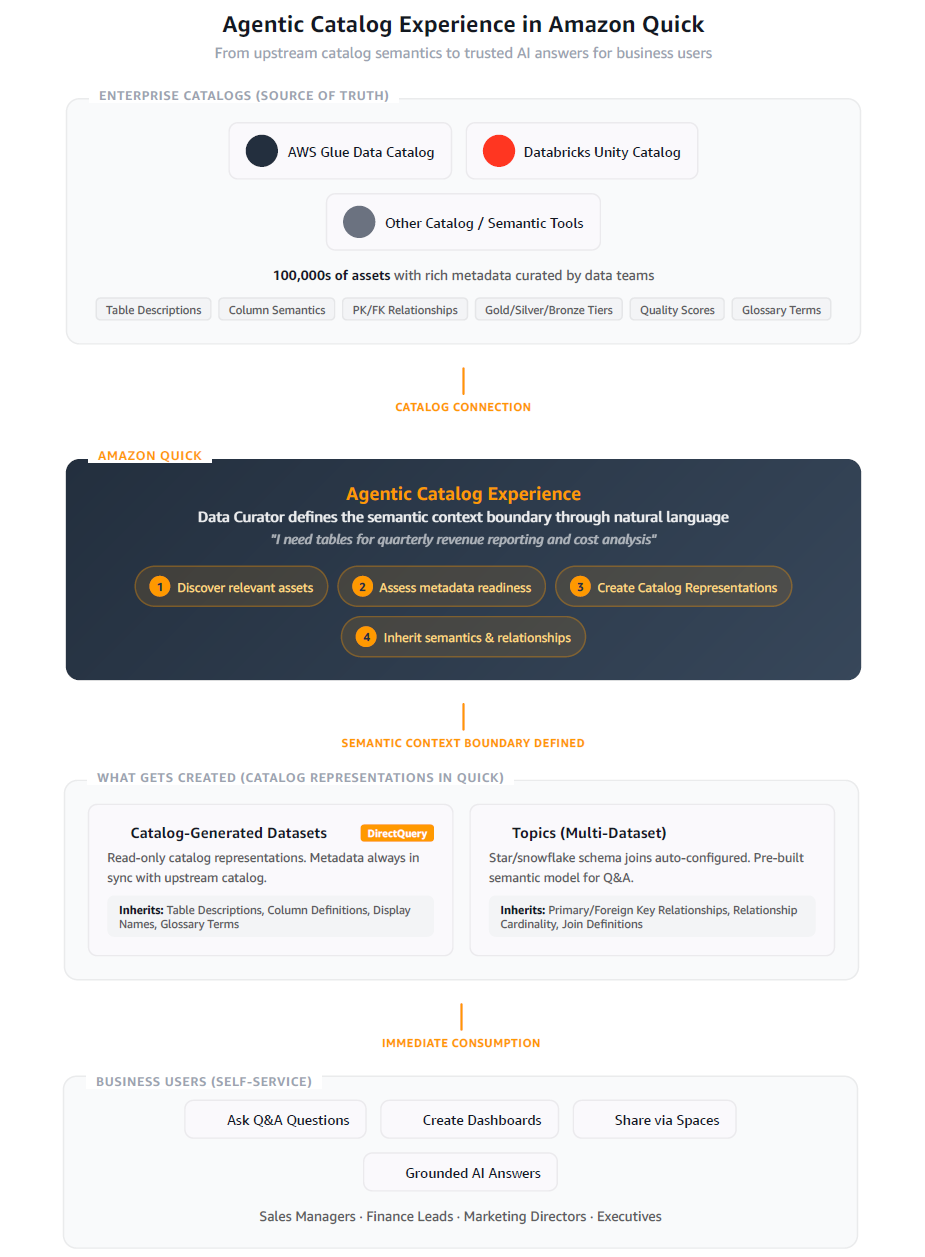
Automate your data cataloging and semantic mapping using natural language with the new Amazon Quick agentic workflow.
30-Second TL;DR
What Changed
Enables natural language discovery of upstream catalog assets
Why It Matters
This feature significantly reduces the manual overhead for data engineers and curators when setting up analytics environments. By automating semantic inheritance, it ensures better consistency across data pipelines.
What To Do Next
If you use AWS Glue or Databricks, sign up for the preview to test if the semantic inheritance reduces your manual data modeling time.
Key Points
- •Enables natural language discovery of upstream catalog assets
- •Automates creation of Datasets and Topics with inherited semantics
- •Currently in preview for AWS Glue Data Catalog and Databricks Unity Catalog
Deep Insight
AI-generated analysis for this event — not the original article.
Enhanced Key Takeaways
- •The agentic workflow utilizes Amazon Bedrock's foundation models to interpret natural language intent and map it to specific metadata schemas within the AWS Glue Data Catalog.
- •The system employs a 'semantic inheritance' engine that automatically propagates data lineage, column-level descriptions, and business glossaries from the catalog to new QuickSight assets.
- •Integration with Databricks Unity Catalog is achieved via a cross-platform connector that synchronizes governance policies and access controls in real-time.
- •The feature includes a 'Human-in-the-Loop' validation step where the agent presents a draft configuration of the Dataset or Topic for curator approval before final deployment.
- •This launch is part of the broader 'Amazon Q for Data' initiative, aimed at reducing the time-to-insight for data engineers by automating the semantic layer setup.
Competitor Analysis
- Amazon Quick (Agentic)
- Yes (Agentic)
- Microsoft Fabric (Copilot)
- Yes (Copilot)
- Google Cloud Dataplex
- Yes (Gemini)
- Amazon Quick (Agentic)
- Automated
- Microsoft Fabric (Copilot)
- Semi-automated
- Google Cloud Dataplex
- Manual/Policy-based
- Amazon Quick (Agentic)
- AWS Glue, Databricks
- Microsoft Fabric (Copilot)
- OneLake, SQL Warehouse
- Google Cloud Dataplex
- BigQuery, GCS
- Amazon Quick (Agentic)
- Consumption-based
- Microsoft Fabric (Copilot)
- Capacity-based (SKU)
- Google Cloud Dataplex
- Usage-based
| Feature | Amazon Quick (Agentic) | Microsoft Fabric (Copilot) | Google Cloud Dataplex |
|---|---|---|---|
| Natural Language Discovery | Yes (Agentic) | Yes (Copilot) | Yes (Gemini) |
| Semantic Inheritance | Automated | Semi-automated | Manual/Policy-based |
| Catalog Support | AWS Glue, Databricks | OneLake, SQL Warehouse | BigQuery, GCS |
| Pricing Model | Consumption-based | Capacity-based (SKU) | Usage-based |
Technical Deep Dive
- Architecture utilizes a ReAct (Reasoning and Acting) agent pattern to decompose natural language queries into multi-step catalog search and metadata extraction tasks.
- Employs RAG (Retrieval-Augmented Generation) over the organization's data dictionary and technical metadata store to ensure context-aware asset suggestions.
- Implements a schema-mapping algorithm that uses vector embeddings to match user intent with existing column definitions and data types.
- Supports asynchronous background processing for large-scale catalog ingestion, allowing curators to continue working while the agent builds the semantic model.
Future ImplicationsAI analysis grounded in cited sources
Timeline
- 2023-11Amazon Q is announced at AWS re:Invent as a generative AI assistant for businesses.
- 2024-05AWS expands Amazon Q capabilities to include data integration and analytics features.
- 2025-02AWS Glue introduces enhanced metadata management features to support AI-driven data discovery.
- 2026-07Amazon Quick launches the Agentic Catalog Experience for data curators.
Weekly AI Recap
Read this week's curated digest of top AI events →
Related Updates

AI-curated news aggregator. All content rights belong to original publishers.
Original source: AWS Machine Learning Blog ↗
This is a summary, not the original. Read the source, or get the weekly briefing.
The weekly digest
One email a week. Unsubscribe anytime.