Also Raises $150M to Build Autonomous Vehicles
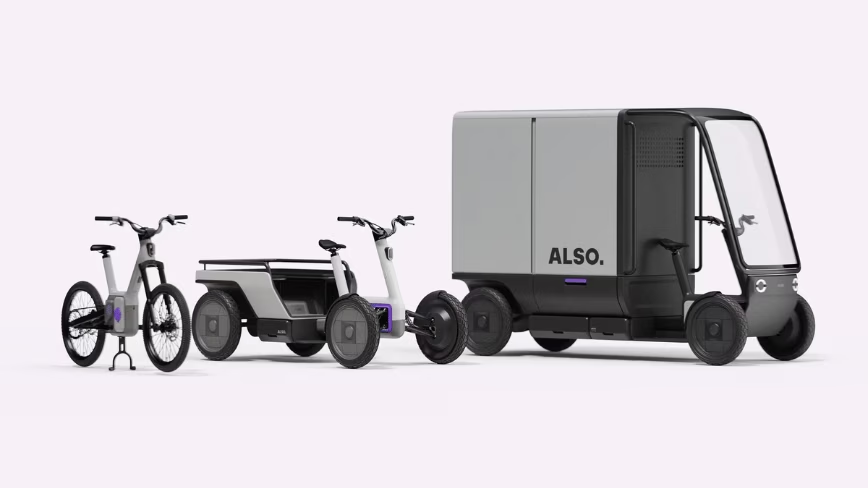
💡Also’s $150M round signals a funded path from e-bikes to small autonomous vehicles.
⚡ 30-Second TL;DR
What Changed
Also raised $150 million in Series D funding.
Why It Matters
The funding gives Also substantial capital to move from micromobility products toward embodied AI and autonomous transportation. Its strategy may interest founders building staged paths from commercially viable hardware to higher-risk autonomy platforms.
What To Do Next
Track Also’s future autonomy announcements and benchmark its sensor, safety, and vehicle-control stack against established autonomous-mobility platforms.
Key Points
- •Also raised $150 million in Series D funding.
- •The round values the Rivian spinout at more than $1 billion.
- •Also plans to use e-bikes as a wedge toward small autonomous vehicles.
- •Prysm Capital led the financing, according to TechCrunch.
🧠 Deep Insight
AI-generated analysis for this event.
🔑 Enhanced Key Takeaways
- •Also's autonomous vehicle strategy centers on a proprietary 'Level 4-lite' software stack designed specifically for low-speed, urban environments rather than highway autonomy.
- •The company's spinout agreement with Rivian includes a strategic partnership allowing Also to leverage Rivian's existing sensor fusion data and supply chain logistics for hardware components.
- •Prysm Capital's investment was joined by existing backers including Amazon's Climate Pledge Fund, which has been a consistent investor since the company's seed stage.
- •Also has begun pilot programs in three major U.S. cities to test autonomous delivery pods that utilize the same battery architecture as their current e-bike fleet.
- •The Series D funding is specifically earmarked for the construction of a new R&D facility in California dedicated to robotics and edge computing hardware.
📊 Competitor Analysis▸ Show
| Feature | Also | Bird | Lime | Segway-Ninebot |
|---|---|---|---|---|
| Primary Focus | Autonomous Micromobility | Shared E-Scooters | Shared E-Scooters/Bikes | Consumer/Commercial Robotics |
| Autonomy Level | Level 4 (Targeted) | None | None | Level 2/3 (Assisted) |
| Funding Stage | Series D | Public (SPAC) | Private (Late Stage) | Subsidiary (Public) |
🛠️ Technical Deep Dive
- Architecture: Utilizes a modular sensor suite combining LiDAR, ultrasonic sensors, and high-resolution cameras for 360-degree obstacle detection.
- Edge Computing: Employs a custom-designed SoC (System on Chip) optimized for real-time path planning and low-latency decision making in dense urban traffic.
- Battery Tech: Uses a swappable, high-density lithium-ion battery pack compatible with both e-bike and autonomous pod chassis.
- Connectivity: Integrates 5G-V2X (Vehicle-to-Everything) communication protocols to interact with smart city infrastructure and traffic management systems.
🔮 Future ImplicationsAI analysis grounded in cited sources
⏳ Timeline
Weekly AI Recap
Read this week's curated digest of top AI events →
👉Related Updates



AI-curated news aggregator. All content rights belong to original publishers.
Original source: The Next Web (TNW) ↗