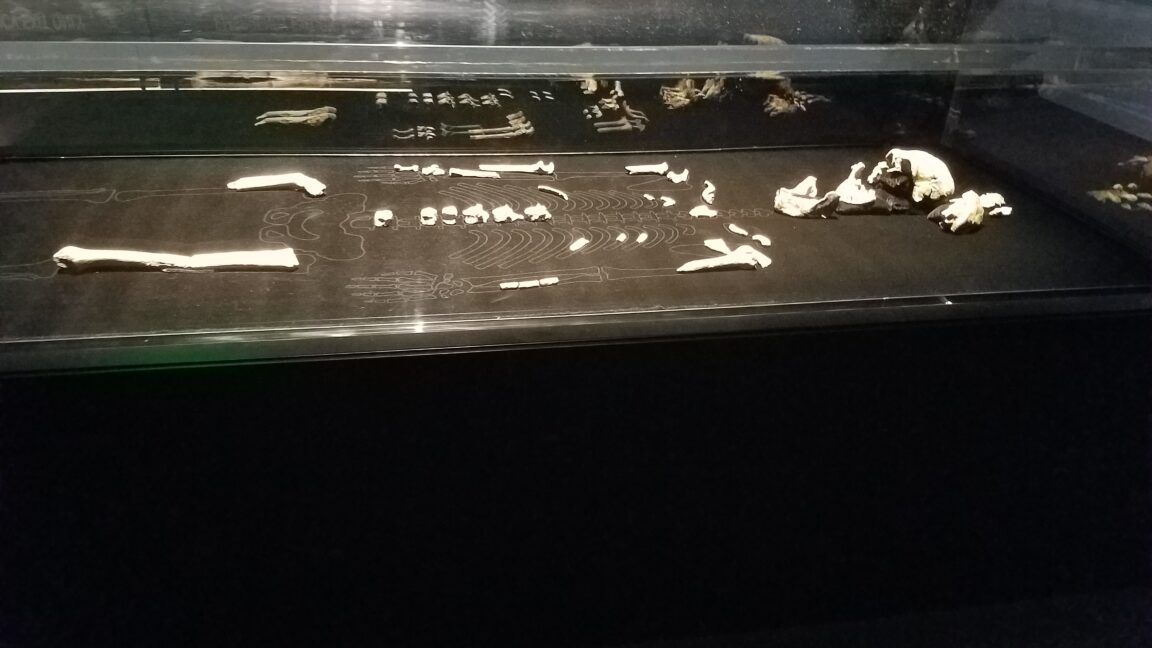
All discovered Homo naledi fossils are female
Learn how identifying statistical anomalies in data can lead to groundbreaking scientific discoveries.
30-Second TL;DR
What Changed
All known Homo naledi specimens are female
Why It Matters
Highlights the potential for AI-driven pattern recognition in archaeology to uncover anomalies in historical data.
What To Do Next
Apply anomaly detection algorithms to your existing datasets to identify outliers that defy standard distribution models.
Key Points
- •All known Homo naledi specimens are female
- •Findings challenge current paleoanthropological theories
- •John Hawks notes the lack of a natural explanation
Deep Insight
AI-generated analysis for this event — not the original article.
Enhanced Key Takeaways
- •The claim that all Homo naledi fossils are female is a misinterpretation or a specific hypothesis regarding the Dinaledi Chamber assemblage, which has been subject to intense scientific debate regarding sex estimation methods.
- •Many Homo naledi specimens are fragmentary, making sex determination highly speculative and dependent on specific dental and skeletal metrics that are not universally accepted by the paleoanthropological community.
- •The Rising Star cave system, where these fossils were found, exhibits complex taphonomic processes that may have biased the preservation or accumulation of specific skeletal elements.
- •Some researchers argue that the perceived female-only bias is a statistical artifact of small sample sizes and the difficulty of applying modern human sexual dimorphism standards to a species with a unique mosaic of primitive and derived traits.
- •The hypothesis of 'intentional burial' or 'ritual deposition' in the Rising Star cave, often associated with these findings, remains highly controversial and lacks consensus among experts in the field.
Technical Deep Dive
- Sex estimation in Homo naledi relies heavily on dental metrics (specifically canine size and molar dimensions) and postcranial measurements such as femoral head diameter.
- The species exhibits a unique mosaic anatomy, combining a small brain size (approx. 465-610 cc) with human-like limb proportions and foot morphology.
- Taphonomic analysis of the Dinaledi Chamber suggests a lack of carnivore damage or water transport, leading to the controversial 'deliberate disposal' hypothesis.
- Statistical sexing models often utilize discriminant function analysis, which can be prone to error when applied to extinct hominin species lacking clear sexual dimorphism markers.
Future ImplicationsAI analysis grounded in cited sources
Timeline
- 2013-09Discovery of the Dinaledi Chamber in the Rising Star cave system.
- 2015-09Formal description and naming of Homo naledi published in eLife.
- 2017-05Announcement of the Lesedi Chamber fossils and dating of the species to 236,000–335,000 years ago.
- 2023-06Publication of controversial claims regarding intentional burials and engravings in the Rising Star cave.
Weekly AI Recap
Read this week's curated digest of top AI events →
AI-curated news aggregator. All content rights belong to original publishers.
Original source: Ars Technica ↗
This is a summary, not the original. Read the source, or get the weekly briefing.
The weekly digest
One email a week. Unsubscribe anytime.