Alibaba's TRAE Work Adds Design Mode for Unified Development
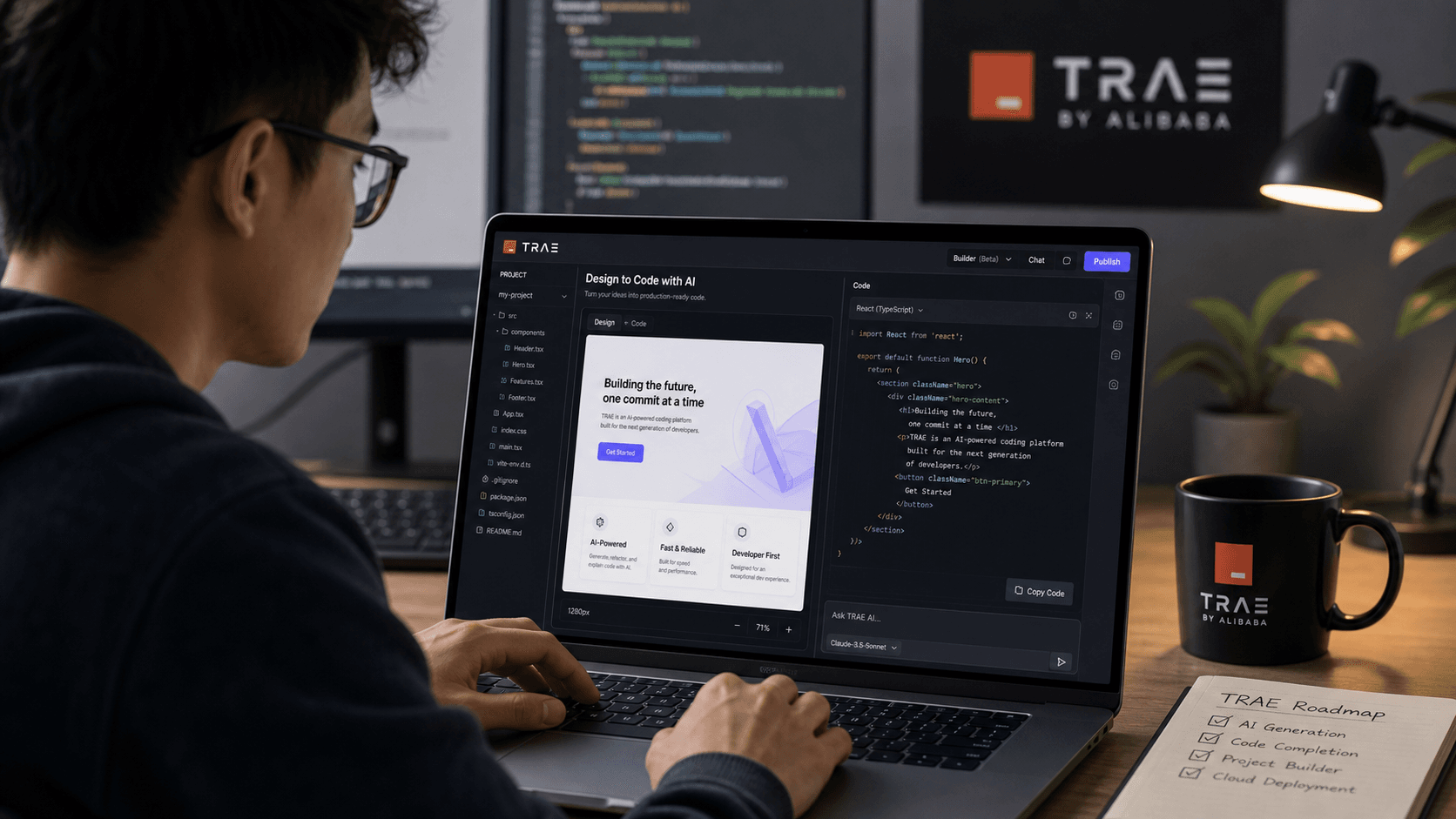
See how Alibaba is closing the gap between UI design and production-ready code using a unified AI environment.
30-Second TL;DR
What Changed
Introduces a dedicated Design mode within the TRAE Work environment
Why It Matters
This integration reduces context switching for developers by centralizing design and coding tasks. It signals a shift toward more holistic AI-assisted software engineering platforms.
What To Do Next
Explore the TRAE Work interface to evaluate if its design-to-code pipeline can accelerate your team's prototyping speed.
Key Points
- •Introduces a dedicated Design mode within the TRAE Work environment
- •Closes the loop between product requirements and automated code generation
- •Provides a unified AI-powered development ecosystem for engineers
Deep Insight
AI-generated analysis for this event — not the original article.
Enhanced Key Takeaways
- •TRAE is built upon Alibaba's proprietary Qwen large language model series, leveraging its advanced reasoning capabilities for code generation.
- •The Design mode utilizes multi-modal AI capabilities to interpret wireframes and UI mockups, converting visual design files directly into frontend code components.
- •The platform integrates with existing IDEs and version control systems, allowing developers to maintain their current workflow while utilizing AI-assisted design-to-code features.
- •Alibaba positions TRAE as an 'AI-native' software engineering agent, moving beyond simple code completion to autonomous task execution across the software development lifecycle.
- •The update includes enhanced context-awareness features that allow the AI to reference specific design system tokens and brand guidelines during the code generation process.
Competitor Analysis
- TRAE Work (Alibaba)
- End-to-end Design-to-Code
- GitHub Copilot Workspace
- Issue-to-PR Workflow
- Cursor
- AI-Native IDE Experience
- v0 (Vercel)
- Rapid UI/Frontend Prototyping
- TRAE Work (Alibaba)
- Qwen
- GitHub Copilot Workspace
- OpenAI GPT-4o
- Cursor
- Claude 3.5 Sonnet / GPT-4o
- v0 (Vercel)
- Claude 3.5 Sonnet
- TRAE Work (Alibaba)
- Native Design Mode
- GitHub Copilot Workspace
- Limited
- Cursor
- Via Context/Screenshots
- v0 (Vercel)
- High (UI-first)
- TRAE Work (Alibaba)
- Enterprise/Tiered
- GitHub Copilot Workspace
- Subscription
- Cursor
- Subscription
- v0 (Vercel)
- Freemium/Usage-based
| Feature | TRAE Work (Alibaba) | GitHub Copilot Workspace | Cursor | v0 (Vercel) |
|---|---|---|---|---|
| Primary Focus | End-to-end Design-to-Code | Issue-to-PR Workflow | AI-Native IDE Experience | Rapid UI/Frontend Prototyping |
| Model Base | Qwen | OpenAI GPT-4o | Claude 3.5 Sonnet / GPT-4o | Claude 3.5 Sonnet |
| Design Integration | Native Design Mode | Limited | Via Context/Screenshots | High (UI-first) |
| Pricing | Enterprise/Tiered | Subscription | Subscription | Freemium/Usage-based |
Technical Deep Dive
- Architecture: Utilizes a RAG-enhanced (Retrieval-Augmented Generation) pipeline to inject project-specific design tokens and component libraries into the Qwen model context.
- Multi-modal Processing: Employs a vision-language model (VLM) encoder to parse design file structures (e.g., Figma exports or image-based mockups) into intermediate representation (IR) formats.
- Code Synthesis: Implements a multi-step reasoning chain where the model first generates a structural layout plan before synthesizing specific framework code (React/Vue).
- Integration Layer: Operates via a plugin architecture that synchronizes local file system changes with the AI agent's state, ensuring consistency between generated code and existing project architecture.
Future ImplicationsAI analysis grounded in cited sources
Timeline
- 2024-05Alibaba Cloud announces the expansion of Qwen model capabilities for coding tasks.
- 2025-02Initial public preview of TRAE as an AI-powered coding assistant.
- 2025-11TRAE platform receives major update integrating agentic workflows for project management.
- 2026-06Official launch of the Design mode within TRAE Work.
Event Coverage
Weekly AI Recap
Read this week's curated digest of top AI events →
Related Updates



AI-curated news aggregator. All content rights belong to original publishers.
Original source: Pandaily ↗
This is a summary, not the original. Read the source, or get the weekly briefing.
The weekly digest
One email a week. Unsubscribe anytime.