Alibaba's $100B AI Goal Faces Chip Hurdles
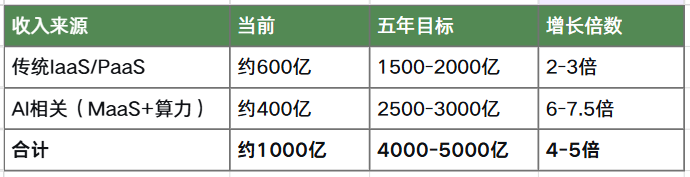
💡Alibaba's $100B AI plan spotlights chip self-reliance edge for cloud AI wars
⚡ 30-Second TL;DR
What Changed
Five-year ambition: $100B AI revenue at 45% CAGR
Why It Matters
Alibaba's aggressive AI push could reshape cloud AI markets if chip self-reliance succeeds, pressuring rivals like AWS. Enterprise users may see competitive pricing emerge.
What To Do Next
Benchmark Alibaba Cloud's token costs against AWS for enterprise AI inference workloads.
Key Points
- •Five-year ambition: $100B AI revenue at 45% CAGR
- •Critical bottlenecks: chips, enterprise/gov adoption, tokens
- •Pingtouge chips as Alibaba's strategic ace card
🧠 Deep Insight
AI-generated analysis for this event — not the original article.
🔑 Enhanced Key Takeaways
- •Alibaba's AI strategy is heavily reliant on the 'Tongyi Qianwen' (Qwen) model series, which has shifted toward an open-weights strategy to capture developer ecosystem share against proprietary models.
- •The 'chip hurdle' is exacerbated by ongoing US export controls on high-end GPUs, forcing Alibaba to accelerate the development of its T-Head (Pingtouge) Xuantie series and Yitian server processors to maintain cloud infrastructure parity.
- •Alibaba is pivoting its cloud business model from traditional IaaS to a 'Model-as-a-Service' (MaaS) architecture, aiming to monetize AI through API-based consumption rather than just raw compute cycles.
📊 Competitor Analysis▸ Show
| Feature | Alibaba (Qwen) | Tencent (Hunyuan) | Baidu (Ernie) |
|---|---|---|---|
| Primary Strategy | Open-weights/Ecosystem | Closed-source/Enterprise | Closed-source/Search-integrated |
| Chip Dependency | High (In-house + GPU) | High (GPU) | High (Kunlun + GPU) |
| Cloud Integration | Deep (AliCloud) | Deep (Tencent Cloud) | Deep (Baidu Cloud) |
🛠️ Technical Deep Dive
- •Qwen-Max/Qwen-Plus architecture: Utilizes a Mixture-of-Experts (MoE) framework to optimize inference latency and reduce compute costs for enterprise-scale deployments.
- •T-Head Yitian 710: A 5nm ARM-based server processor designed to handle high-concurrency AI workloads, featuring 128 cores and 8-channel DDR5 memory support.
- •Model-as-a-Service (MaaS) stack: Integrates ModelScope, an open-source model-as-a-service platform, allowing developers to fine-tune and deploy Qwen models directly on AliCloud infrastructure.
🔮 Future ImplicationsAI analysis grounded in cited sources
⏳ Timeline
Weekly AI Recap
Read this week's curated digest of top AI events →
👉Related Updates



AI-curated news aggregator. All content rights belong to original publishers.
Original source: 钛媒体 ↗
This is a summary, not the original. Read the source, or get the weekly briefing.
The weekly digest
One email a week. Unsubscribe anytime.