Alibaba Pivots to AI Amid E-commerce Slump
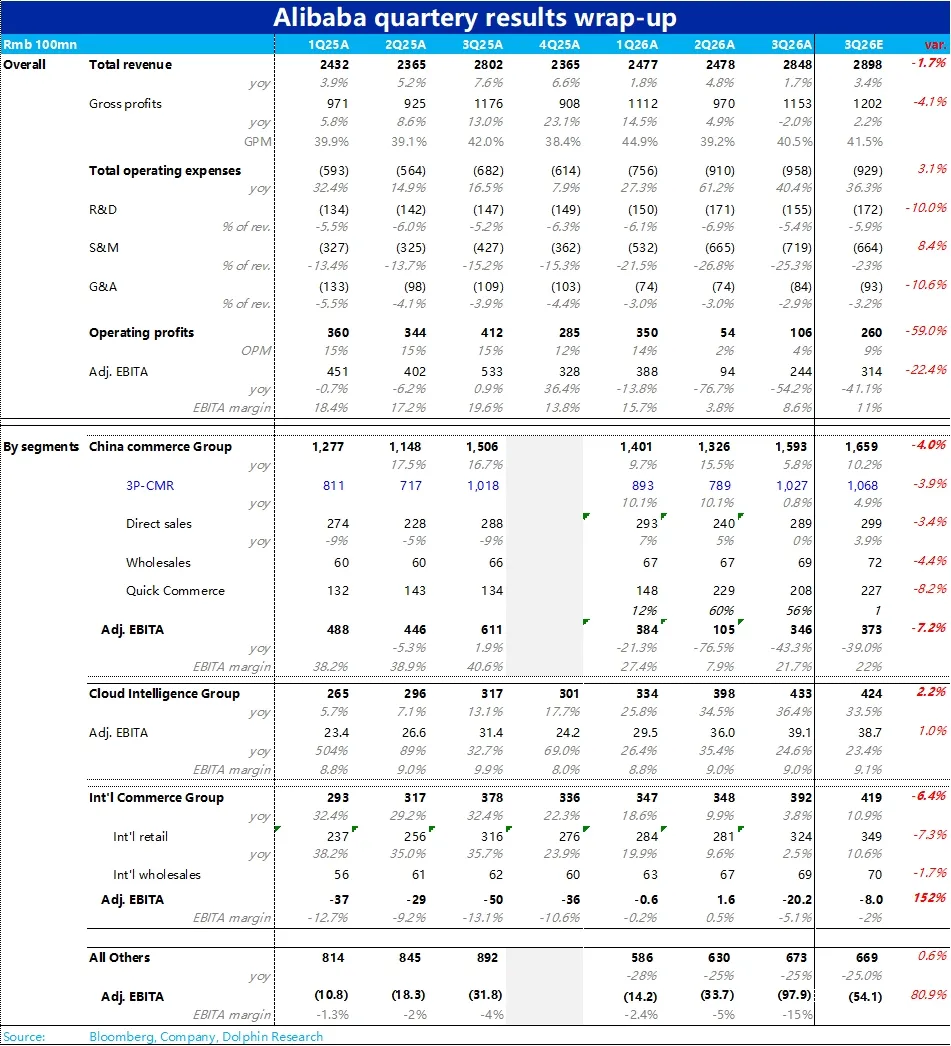
💡Alibaba Cloud surges as e-comm falters: AI strategy shift for enterprises
⚡ 30-Second TL;DR
What Changed
E-commerce segment growth significantly slowing
Why It Matters
Reinforces Alibaba's AI infrastructure bet, benefiting enterprise users. Signals broader trend of big tech leaning on cloud AI amid consumer slowdowns.
What To Do Next
Evaluate Alibaba Cloud's latest AI inference pricing for scaling deployments.
Key Points
- •E-commerce segment growth significantly slowing
- •Alibaba Cloud maintaining robust growth
- •AI identified as key recovery driver
🧠 Deep Insight
Background and context from public sources — not the original article. 10 sources cited.
🔑 Enhanced Key Takeaways
- •Alibaba Cloud has shifted from aggressive discounting (up to 55% cuts in 2024) to significant price increases of up to 34% for AI computing and storage, effective April 2026, signaling a transition from market-share acquisition to margin recovery.
- •AI-related product revenue has maintained triple-digit year-over-year growth for ten consecutive quarters as of March 2026, now serving as the primary offset for stagnant domestic e-commerce margins.
- •The company has successfully vertically integrated its AI stack by deploying proprietary T-Head 'Zhenwu 810E' AI chips at scale to power its Qwen 3.5 models, mitigating the impact of foreign silicon export restrictions.
- •A newly formed 'Alibaba Token Hub' business group was established in March 2026 to focus specifically on high-consumption agentic AI, moving the ecosystem beyond traditional chatbots toward autonomous task execution.
📊 Competitor Analysis▸ Show
| Feature/Metric | Alibaba Cloud (Qwen) | Baidu AI Cloud (Ernie) | Tencent Cloud (Hunyuan) |
|---|---|---|---|
| Market Share (Q3 2025) | 36% (Leader) | ~22.5% (AI Cloud specific) | 7-9% |
| Flagship Model | Qwen 3.5 (Native Multimodal) | Ernie 4.5/5.0 | Hunyuan-Turbo |
| Pricing Strategy | Raising prices 5-34% (April 2026) | Raising prices 5-30% (April 2026) | Shifted to usage-based billing |
| Hardware Integration | Proprietary Zhenwu 810E Chips | Kunlun AI Chips | Focus on networking/bandwidth |
| Ecosystem Focus | E-commerce & Open Source | Enterprise Search & Baidu Maps | WeChat & Gaming Integration |
🛠️ Technical Deep Dive
Detailed technical specifications for the Qwen 3.5 architecture released in February 2026:
- Architecture: Sparse Mixture-of-Experts (MoE) utilizing 'Gated Delta Networks' to achieve high-throughput inference with minimal latency.
- Multimodality: Native early-fusion training on trillions of multimodal tokens, allowing the model to process text, images, and video within a single unified architecture rather than using vision adapters.
- Context Window: 256K tokens by default, extensible to 1M+ for long-document reasoning and complex agentic workflows.
- Inference Modes: Dual-mode capability featuring 'Thinking Mode' (extended chain-of-thought for reasoning) and 'Flash Mode' (low-latency responses).
- Hardware: Optimized for the T-Head Zhenwu 810E AI accelerator, achieving near-100% training efficiency compared to text-only predecessors.
🔮 Future ImplicationsAI analysis grounded in cited sources
⏳ Timeline
📎 Sources (10)
Factual claims are grounded in the sources below. Forward-looking analysis is AI-generated interpretation.
Weekly AI Recap
Read this week's curated digest of top AI events →
👉Related Updates

AI-curated news aggregator. All content rights belong to original publishers.
Original source: 钛媒体 ↗
This is a summary, not the original. Read the source, or get the weekly briefing.
Weekly AI briefing
One email a week. Unsubscribe anytime.