Alibaba Cloud's Radical Transformation Strategy
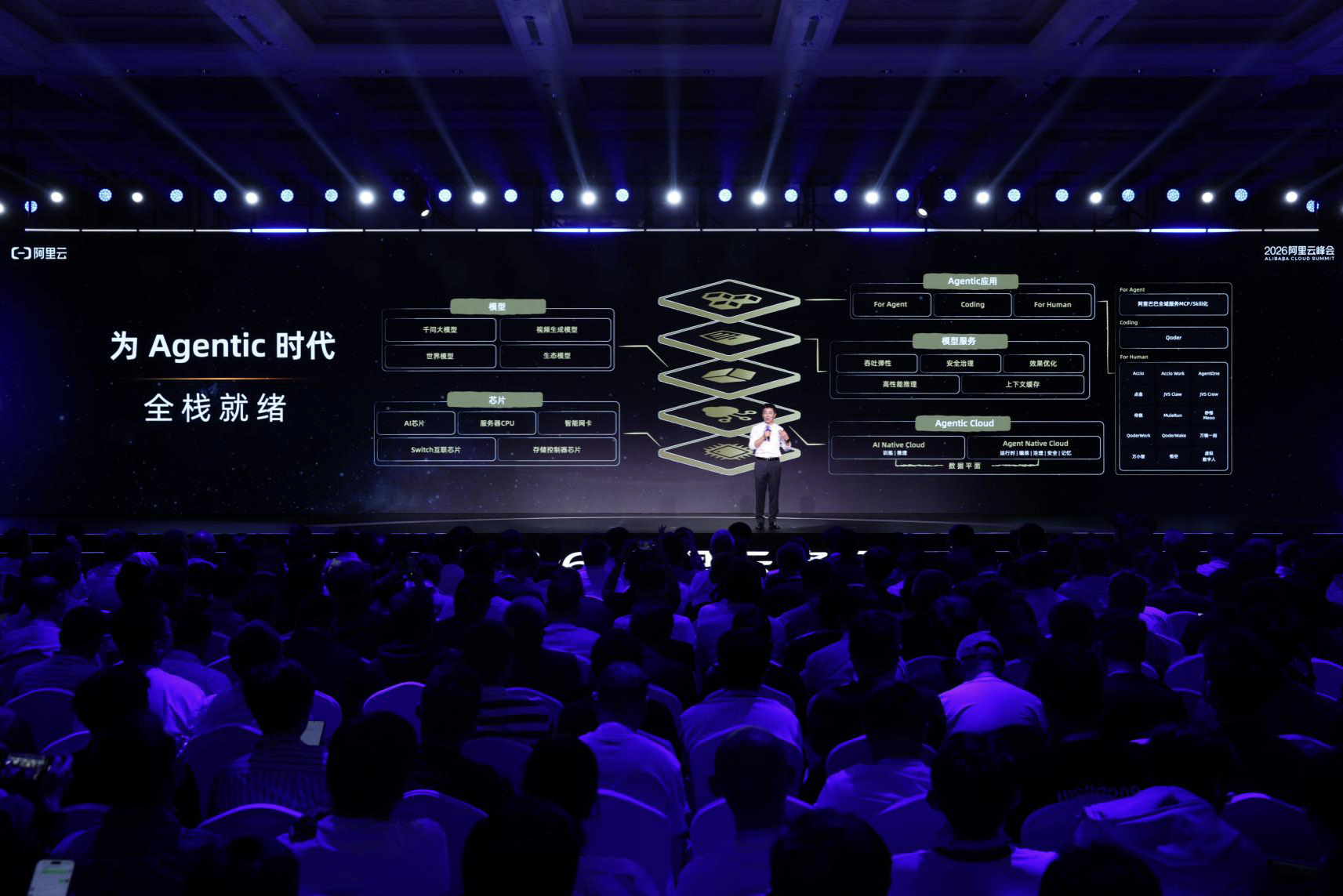
Alibaba Cloud's strategic pivot will significantly impact the AI compute landscape in China.
30-Second TL;DR
What Changed
Alibaba Cloud is restructuring its operations to be more agile.
Why It Matters
As a major infrastructure provider, Alibaba Cloud's strategic pivot directly affects the availability and cost of compute resources for AI developers in the region.
What To Do Next
Monitor Alibaba Cloud's new AI infrastructure service releases to see if they offer cost-effective alternatives for your model training.
Key Points
- •Alibaba Cloud is restructuring its operations to be more agile.
- •The company is heavily betting on future AI-driven cloud infrastructure.
- •The shift aims to maintain its status as China's largest cloud provider.
Deep Insight
Background and context from public sources — not the original article. 21 sources cited.
Enhanced Key Takeaways
- •Alibaba Cloud's AI-related product revenue has demonstrated triple-digit growth for multiple consecutive quarters, and management anticipates it will exceed 50% of external cloud revenue within approximately one year.
- •The company has committed to a substantial capital expenditure plan, intending to invest at least RMB 380 billion (US $53 billion) over three years to advance its cloud computing and AI infrastructure.
- •Alibaba Cloud maintains its leadership as the largest Infrastructure-as-a-Service (IaaS) provider in Asia Pacific with a 22.5% market share in 2025 and holds the top position in China's AI cloud market with a 38.1% share.
- •The transformation strategy involves a shift from an initial AI investment phase to a focus on 'commercialization at scale,' emphasizing model services, AI-native software, proprietary chips, and the Qwen assistant ecosystem.
- •Alibaba Cloud is significantly expanding its global partner ecosystem for 2026, increasing investment in AI incentives tenfold and revamping its service partner framework to be more agile for the AI era.
Competitor Analysis
- China Market Share (Q3 2025 / 2025)
- 36% (Q3 2025 IaaS), 38.1% (2025 AI Cloud)
- Key Strengths (China Market)
- Strong for retail, e-commerce, AI; best ecosystem for SaaS, POS, and omni-channel. Full-stack AI capabilities, open-source Qwen models.
- China Market Share (Q3 2025 / 2025)
- 16% (Q3 2025 IaaS)
- Key Strengths (China Market)
- Ideal for manufacturing, industrial IoT, government-aligned sectors; strong security posture. Accelerating AI adoption in core industry use cases.
- China Market Share (Q3 2025 / 2025)
- 9% (Q3 2025 IaaS)
- Key Strengths (China Market)
- Excellent for video, real-time communication, gaming, live streaming. Clarified model role differentiation within its Hunyuan 2.0-based lineup.
- China Market Share (Q3 2025 / 2025)
- Among top 5 in AI cloud market 2025
- Key Strengths (China Market)
- Leading AI infrastructure; ideal for ML/AI-driven companies.
- China Market Share (Q3 2025 / 2025)
- 12.3% (2025 IaaS)
- Key Strengths (China Market)
- Very stable networks; excellent for factories and distributed operations.
- China Market Share (Q3 2025 / 2025)
- 9.4% (2025 IaaS)
- Key Strengths (China Market)
- Strong for IoT, large field teams, mobile-first scenarios.
| Provider | China Market Share (Q3 2025 / 2025) | Key Strengths (China Market) |
|---|---|---|
| Alibaba Cloud | 36% (Q3 2025 IaaS), 38.1% (2025 AI Cloud) | Strong for retail, e-commerce, AI; best ecosystem for SaaS, POS, and omni-channel. Full-stack AI capabilities, open-source Qwen models. |
| Huawei Cloud | 16% (Q3 2025 IaaS) | Ideal for manufacturing, industrial IoT, government-aligned sectors; strong security posture. Accelerating AI adoption in core industry use cases. |
| Tencent Cloud | 9% (Q3 2025 IaaS) | Excellent for video, real-time communication, gaming, live streaming. Clarified model role differentiation within its Hunyuan 2.0-based lineup. |
| Baidu AI Cloud | Among top 5 in AI cloud market 2025 | Leading AI infrastructure; ideal for ML/AI-driven companies. |
| China Telecom (eCloud) | 12.3% (2025 IaaS) | Very stable networks; excellent for factories and distributed operations. |
| China Mobile (Mobile Cloud) | 9.4% (2025 IaaS) | Strong for IoT, large field teams, mobile-first scenarios. |
Technical Deep Dive
- The Qwen model family, developed by Alibaba Cloud, includes open-source large language models (LLMs) and multimodal models (MLLMs).
- Qwen2.5 is a multimodal AI model capable of processing text, images, audio, and video, pre-trained on a large-scale dataset of up to 18 trillion tokens.
- The Qwen3 model family features both dense and Mixture-of-Experts (MoE) models, trained on 36 trillion tokens across 119 languages and dialects, and supports hybrid thinking modes for flexible reasoning performance.
- Alibaba Cloud offers specialized Qwen models such as Qwen-VL (visual language models), Qwen-TTS (text-to-speech), Qwen-Audio, and the latest Qwen3-Omni, which can process and reason across text, audio, and vision modalities simultaneously.
- The company is developing proprietary inference chips and orchestration software to manage heterogeneous chip clusters, forming a full-stack AI capability from hardware to application layers.
- Alibaba Cloud's Platform for AI (PAI) provides tools for building and deploying AI models, including an integration with the NVIDIA Physical AI software stack to accelerate advancements in humanoid robotics and Physical AI solutions.
Future ImplicationsAI analysis grounded in cited sources
Timeline
- 2009-09Alibaba Cloud is officially established.
- 2023-04Alibaba Cloud unveils its AI model, Tongyi Qianwen (Qwen).
- 2025-02Alibaba Group announces plans to invest at least RMB 380 billion (US $53 billion) over three years in cloud computing and AI infrastructure.
- 2026-01The Qwen model family surpasses one billion cumulative downloads on Hugging Face.
- 2026-03Alibaba Cloud's Cloud Intelligence Group revenue grows 36%, with AI-related product revenue delivering triple-digit growth for the tenth consecutive quarter.
- 2026-04Alibaba Cloud is recognized as the largest IaaS provider in Asia Pacific (22.5% market share in 2025) and the top in China's AI cloud market (38.1% share in 2025).
Sources (21)
Factual claims are grounded in the sources below. Forward-looking analysis is AI-generated interpretation.
Weekly AI Recap
Read this week's curated digest of top AI events →
AI-curated news aggregator. All content rights belong to original publishers.
Original source: 钛媒体 ↗
This is a summary, not the original. Read the source, or get the weekly briefing.
The weekly digest
One email a week. Unsubscribe anytime.