AIST Physical AI Tackles 100K-Year Gap
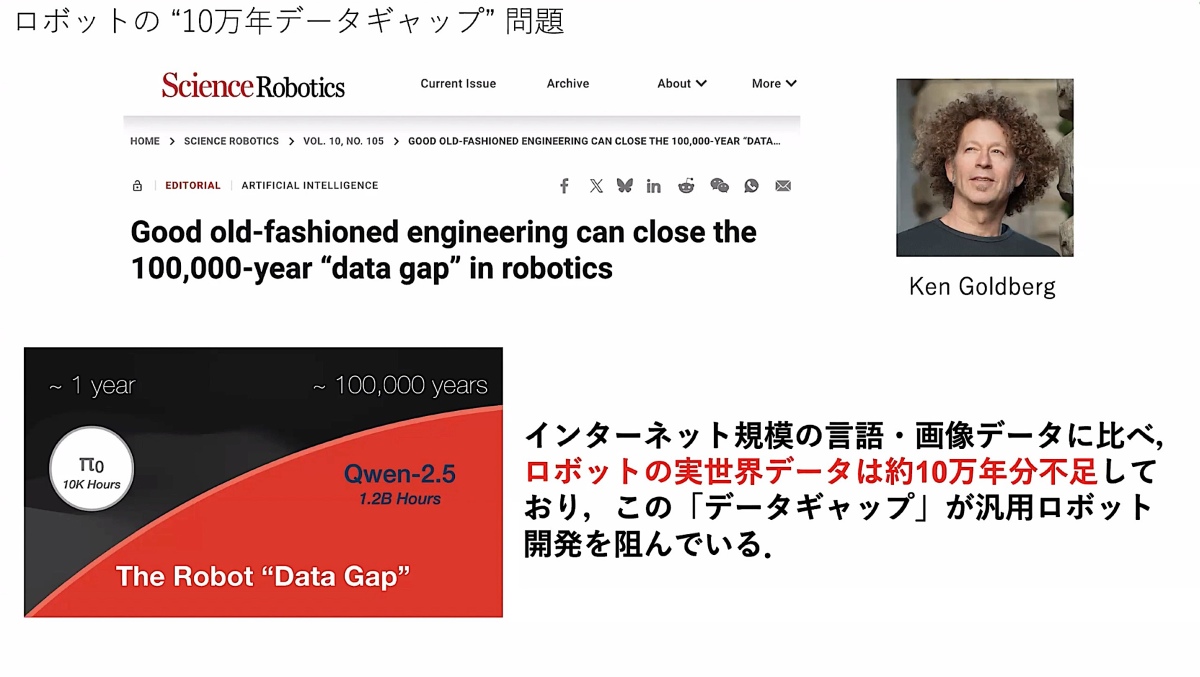
💡Japan's AIST unveils physical AI breakthroughs to bridge 100K-year sim-real gap
⚡ 30-Second TL;DR
What Changed
AIST webinar detailed Physical Domain Generative AI R&D project
Why It Matters
Advances embodied AI by narrowing simulation-to-real-world gaps, potentially speeding robotics development for researchers and builders.
What To Do Next
Review AIST Physical AI webinar materials on ITmedia AI+ for embodied AI insights
Key Points
- •AIST webinar detailed Physical Domain Generative AI R&D project
- •Six research groups shared latest outcomes
- •Project targets '100,000-year gap' in physical AI evolution
- •Focus on foundation models for physical domains
🧠 Deep Insight
AI-generated analysis for this event — not the original article.
🔑 Enhanced Key Takeaways
- •The '100,000-year gap' refers to the disparity between the rapid evolution of digital LLMs and the slow, data-constrained progress of physical-world robotics and material science automation.
- •AIST is leveraging its 'ABCI' (AI Bridging Cloud Infrastructure) supercomputing resources to train these foundation models, specifically focusing on multi-modal integration of sensor data with physical simulation.
- •The project emphasizes 'Physical Domain' specificity, aiming to move beyond general-purpose LLMs by incorporating laws of physics and material properties directly into the model's latent space to ensure real-world safety and reliability.
🛠️ Technical Deep Dive
- •Architecture utilizes a hybrid approach combining Transformer-based generative models with physics-informed neural networks (PINNs) to enforce thermodynamic and mechanical constraints.
- •Data ingestion pipelines integrate high-fidelity simulation data from AIST’s digital twin platforms with sparse, high-cost real-world experimental data.
- •Focus on 'Embodied AI' benchmarks that measure zero-shot transferability from simulated environments to physical robotic manipulators.
- •Implementation of cross-modal attention mechanisms that allow the model to correlate unstructured text instructions with structured sensor telemetry and CAD-based geometry.
🔮 Future ImplicationsAI analysis grounded in cited sources
⏳ Timeline
Weekly AI Recap
Read this week's curated digest of top AI events →
👉Related Updates
AI-curated news aggregator. All content rights belong to original publishers.
Original source: ITmedia AI+ (日本) ↗
This is a summary, not the original. Read the source, or get the weekly briefing.
The weekly digest
One email a week. Unsubscribe anytime.