ai16z Falls as Crypto AI Loses Its Edge
ai16z的終結揭示:AI Agent的長期價值來自可用產品與收入,而不是代幣敘事。
30-Second TL;DR
What Changed
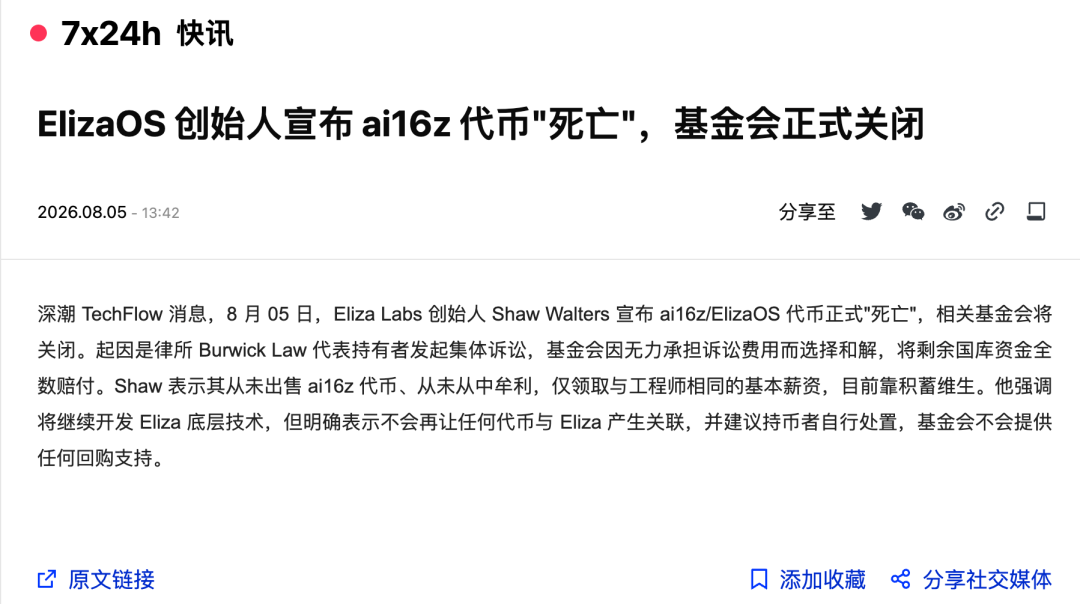
Shaw Walters said the ai16z token was effectively dead, the foundation had closed, and no buyback would occur.
Why It Matters
The collapse weakens the investment narrative of issuing tokens around generic AI Agent concepts, while strengthening the case for products tied to measurable compute, developer usage, or revenue. For builders, separating an open-source framework from speculative token economics can improve hiring, funding, and long-term product resilience.
What To Do Next
Prototype Eliza OS as a token-free service and measure agent latency, inference cost, developer adoption, and paid API usage before considering any crypto integration.
Key Points
- •Shaw Walters said the ai16z token was effectively dead, the foundation had closed, and no buyback would occur.
- •ai16z grew from a 420.69 SOL crowdfunding target to a reported market capitalization of 2.6 billion dollars in under three months.
- •The project illustrates how token narratives and prices advanced ahead of working AI Agent products.
- •Eliza's open-source framework remains active and may have broader paths through enterprise partnerships or services without a token.
Deep Insight
AI-generated analysis for this event — not the original article.
Enhanced Key Takeaways
- •The collapse of ai16z was preceded by internal governance disputes regarding the allocation of the DAO treasury and the role of the Eliza framework in commercial versus community-led development.
- •Regulatory scrutiny from financial authorities regarding the classification of ai16z as an unregistered securities offering contributed to the foundation's decision to dissolve.
- •The Eliza OS framework has successfully transitioned to a non-tokenized open-source model, with several enterprise-grade AI agent platforms adopting its codebase for autonomous trading and social media management.
- •On-chain data analysis revealed that a significant portion of the $2.6 billion peak market capitalization was driven by wash trading and liquidity mining incentives that failed to convert into long-term user retention.
- •Shaw Walters has pivoted to a new consultancy model, focusing on providing technical infrastructure for AI agents without the regulatory and volatility risks associated with native governance tokens.
Competitor Analysis
- ai16z (Defunct)
- Token-governed DAO
- Virtuals Protocol
- Platform-based Agent Creation
- Theoriq
- Modular Agent Infrastructure
- ai16z (Defunct)
- N/A (Token-based)
- Virtuals Protocol
- Protocol Fees
- Theoriq
- Enterprise Licensing
- ai16z (Defunct)
- Speculative AI Agents
- Virtuals Protocol
- Consumer-facing Agents
- Theoriq
- Developer Tooling
| Feature | ai16z (Defunct) | Virtuals Protocol | Theoriq |
|---|---|---|---|
| Model | Token-governed DAO | Platform-based Agent Creation | Modular Agent Infrastructure |
| Pricing | N/A (Token-based) | Protocol Fees | Enterprise Licensing |
| Core Focus | Speculative AI Agents | Consumer-facing Agents | Developer Tooling |
Technical Deep Dive
- Eliza OS utilized a multi-agent architecture built on Node.js, integrating LangChain for orchestration and various LLM backends including Llama 3 and Claude 3.5.
- The framework implemented a specialized memory module using vector databases (typically Pinecone or Milvus) to maintain long-term context for agent interactions.
- Agent autonomy was governed by a plugin-based system, allowing developers to inject custom tools for blockchain interaction, web scraping, and social media API integration.
- The system relied on a character-file configuration format (JSON/YAML) to define agent personality, goals, and constraints, which served as the system prompt for the underlying LLM.
Future ImplicationsAI analysis grounded in cited sources
Timeline
- 2024-10Eliza OS framework is open-sourced and gains initial traction in the developer community.
- 2024-11ai16z token launches via crowdfunding, reaching a 420.69 SOL target.
- 2025-01ai16z market capitalization peaks at approximately $2.6 billion amid intense speculative interest.
- 2026-07Shaw Walters announces the dissolution of the ai16z foundation and the end of the token project.
Weekly AI Recap
Read this week's curated digest of top AI events →
AI-curated news aggregator. All content rights belong to original publishers.
Original source: 虎嗅 ↗
This is a summary, not the original. Read the source, or get the weekly briefing.
The weekly digest
One email a week. Unsubscribe anytime.