🌍The Next Web (TNW)•Stalecollected in 74m
AI Writes 80% of OpenAI's Code
💡OpenAI AI generates 80% internal code—test for your dev productivity boost?
⚡ 30-Second TL;DR
What Changed
AI writes ~80% of OpenAI's code
Why It Matters
Indicates rapid AI integration in elite AI labs' development, potentially accelerating innovation cycles. Practitioners should validate similar gains amid skepticism on metrics.
What To Do Next
Benchmark OpenAI's GPT-4o on your codebase to test 80% automation feasibility.
Who should care:Developers & AI Engineers
Key Points
- •AI writes ~80% of OpenAI's code
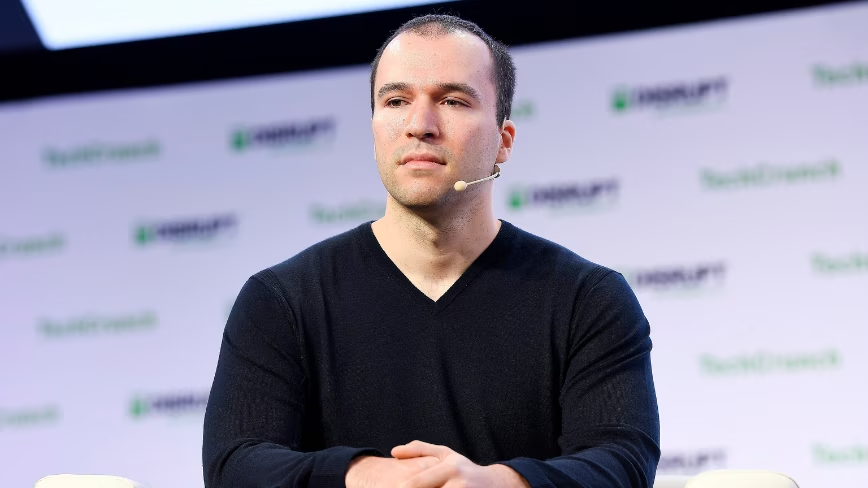
- •Greg Brockman at Sequoia AI Ascent 2026
- •Pattern of self-reinforcing productivity stats
- •AI coding productivity evidence contested
🧠 Deep Insight
AI-generated analysis for this event.
🔑 Enhanced Key Takeaways
- •OpenAI's internal deployment relies heavily on a specialized, fine-tuned iteration of the o3-series reasoning models, which are optimized for multi-step software architecture planning rather than just snippet generation.
- •The 80% figure specifically refers to the volume of code commits generated by AI agents within OpenAI's internal 'Dev-Agent' framework, which includes automated testing and security verification loops.
- •Industry analysts note that while code volume has increased, the 'human-in-the-loop' time has shifted from writing syntax to high-level system architecture review and debugging complex model-generated logic errors.
📊 Competitor Analysis▸ Show
| Feature | OpenAI (Dev-Agent) | Anthropic (Claude Dev) | Google (Gemini Code Assist) |
|---|---|---|---|
| Primary Focus | Autonomous agentic coding | Collaborative pair programming | Enterprise integration/IDE support |
| Model Architecture | o3-series (Reasoning) | Claude 3.5/3.7 Sonnet | Gemini 1.5/2.0 Pro |
| Internal Usage | ~80% of codebase | Estimated 50-60% | Not publicly disclosed |
🛠️ Technical Deep Dive
- •Implementation utilizes a 'Chain-of-Thought' (CoT) prompting architecture that forces the model to draft a design document before generating any functional code.
- •The system integrates with a proprietary 'Sandboxed Execution Environment' that runs unit tests in real-time as the AI writes, allowing for iterative self-correction.
- •The model utilizes a massive context window (up to 2M tokens) to maintain awareness of the entire repository structure, preventing the 'hallucinated dependency' issues common in smaller models.
🔮 Future ImplicationsAI analysis grounded in cited sources
Software engineering roles will transition to 'AI Systems Orchestrators' by 2027.
As AI handles the majority of syntax generation, human value will shift entirely to managing agentic workflows and verifying system-level security.
Standardized 'Code-to-AI' metrics will replace Lines of Code (LOC) as the primary productivity KPI.
Traditional metrics are becoming obsolete as AI-generated code volume decouples from human effort, necessitating new ways to measure engineering output.
⏳ Timeline
2022-11
Launch of ChatGPT, sparking the shift toward generative coding assistance.
2024-05
OpenAI releases GPT-4o, significantly improving latency for real-time coding tasks.
2025-02
OpenAI introduces the o3 reasoning model series, designed for complex problem-solving and coding.
2026-05
Greg Brockman announces at Sequoia AI Ascent that AI writes 80% of OpenAI's code.
📰
Weekly AI Recap
Read this week's curated digest of top AI events →
👉Related Updates

Small businesses use AI to augment, not replace, workers
The Guardian Technology•Jul 26

The Hidden Costs of Solo Sales Handoffs
The Next Web (TNW)•Jul 28
Hotel groups launch ChatGPT apps for travel booking
The Next Web (TNW)•Jul 28

Nvidia may guarantee $250bn for OpenAI data center
The Next Web (TNW)•Jul 27
AI-curated news aggregator. All content rights belong to original publishers.
Original source: The Next Web (TNW) ↗