AI, Weapons, and the Philosophy of Innovation
A philosophical guide for AI builders on how to maintain human relevance in an era of super-intelligent machines.
30-Second TL;DR
What Changed
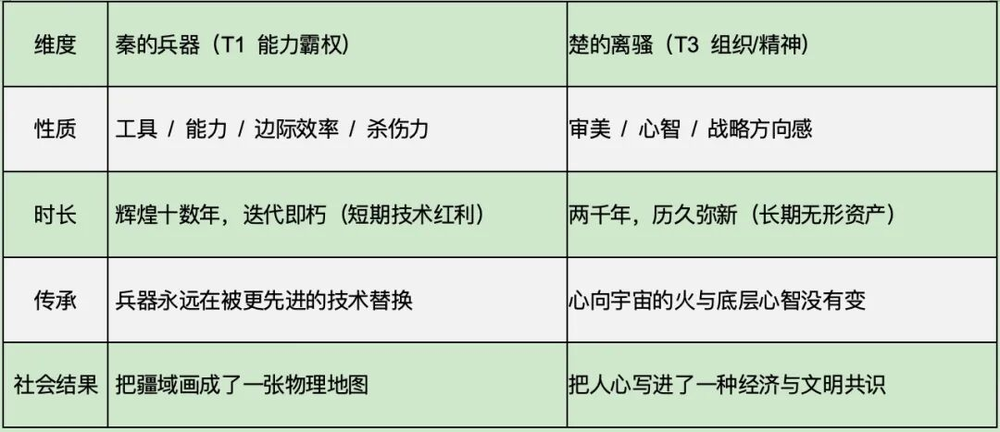
AI is the modern 'weapon' (T1 capability) that challenges human cognition.
Why It Matters
Encourages developers to shift focus from raw model performance to product-market fit and ethical alignment.
What To Do Next
Define a clear 'why' for your AI product by identifying a specific human problem that requires creative judgment rather than just data processing.
Key Points
- •AI is the modern 'weapon' (T1 capability) that challenges human cognition.
- •Technological efficiency alone is insufficient for long-term success without a clear 'direction' (T3 spirit).
- •Human advantage lies in 'questioning' and defining the purpose of AI, not just answering tasks.
- •The ideal future involves integrating advanced AI tools with human aesthetic and strategic judgment.
Deep Insight
AI-generated analysis for this event — not the original article.
Enhanced Key Takeaways
- •The concept of 'T1 capability' in Chinese AI discourse often refers to the 'Tier 1' strategic threshold, where AI systems transition from assistive tools to autonomous agents capable of independent decision-making in high-stakes environments.
- •Recent regulatory frameworks in China, such as the 'Interim Measures for the Management of Generative AI Services,' emphasize that AI development must align with 'core socialist values,' reinforcing the article's call for human-centric direction.
- •The 'T3 spirit' mentioned in the context of Chinese tech philosophy frequently draws from the 'Three-Step Strategy' of modernization, applying long-term national development logic to corporate AI innovation cycles.
- •Leading Chinese AI labs are increasingly shifting focus from parameter scaling (LLM size) to 'Reasoning-as-a-Service' (RaaS) architectures, which prioritize the 'questioning' and logical verification capabilities highlighted in the article.
- •Industry reports from 2025-2026 indicate a growing 'alignment gap' where technical performance in benchmarks often fails to correlate with enterprise-level utility, validating the article's argument that efficiency is not synonymous with strategic success.
Future ImplicationsAI analysis grounded in cited sources
Timeline
- 2023-07China releases Interim Measures for the Management of Generative AI Services.
- 2024-03The 'AI+' initiative is formally introduced in the Chinese government work report.
- 2025-11Major Chinese AI labs shift focus toward agentic reasoning models over pure parameter scaling.
Weekly AI Recap
Read this week's curated digest of top AI events →
AI-curated news aggregator. All content rights belong to original publishers.
Original source: 虎嗅 ↗
This is a summary, not the original. Read the source, or get the weekly briefing.
The weekly digest
One email a week. Unsubscribe anytime.