Source36氪•Stalecollected in 2m
AI Video Agents Boom Before Big Tech Crush
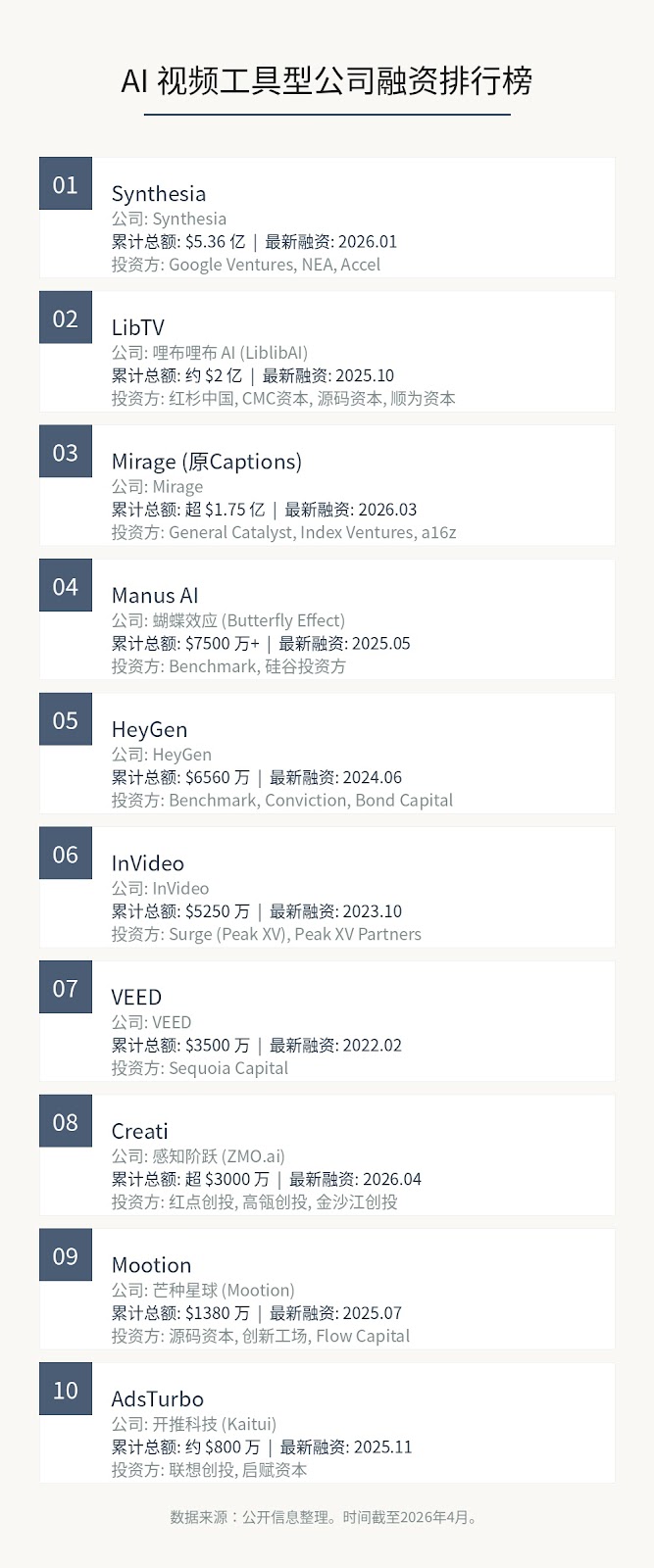
AI video tools hit $20M ARR fast—learn survival vs ByteDance/Alibaba
30-Second TL;DR
What Changed
Creati: 10M+ global users, $20M ARR in one year.
Why It Matters
Signals hot AI video market with quick monetization but high risk from big tech; founders should prioritize data moats and services over pure tools.
What To Do Next
Benchmark Kling and Seedance APIs for video workflow integration costs.
Who should care:Founders & Product Leaders
Key Points
- •Creati: 10M+ global users, $20M ARR in one year.
- •LiblibAI (LibTV): $130M B-round from Sequoia China.
- •Models: Seedance/Kling weekly updates; HappyHorse 720P at 0.9 RMB/sec.
- •Tools specialize in idea gen (ZeroCut), editing (LibTV), e-comm (TapNow).
- •Head tools burn millions monthly on compute/ads.
Key numbers80%$20M
Deep Insight
AI-generated analysis for this event — not the original article.
Enhanced Key Takeaways
- •The surge in AI video agent adoption is heavily driven by the 'short drama' (micro-drama) industry in China, where production costs have plummeted by 70-80% due to automated script-to-video workflows.
- •Regulatory scrutiny is intensifying; the Cyberspace Administration of China (CAC) has recently issued new guidelines requiring mandatory watermarking and provenance metadata for all AI-generated video content to combat deepfake proliferation.
- •Venture capital focus has shifted from foundational model training to 'application-layer moats,' specifically targeting proprietary fine-tuning datasets that allow tools like Creati to maintain consistent character identity across long-form video sequences.
Competitor Analysis
Primary Focus
- Creati
- Workflow/Agentic Automation
- Kling (Kuaishou)
- High-Fidelity Generation
- Seedance (ByteDance)
- Short-form/Social Integration
Pricing Model
- Creati
- Subscription/Usage-based
- Kling (Kuaishou)
- Token-based (Freemium)
- Seedance (ByteDance)
- Integrated into Ad Platform
Key Benchmark
- Creati
- 95% Character Consistency
- Kling (Kuaishou)
- 1080p/60fps Motion Quality
- Seedance (ByteDance)
- Real-time Ad Creative Gen
| Feature | Creati | Kling (Kuaishou) | Seedance (ByteDance) |
|---|---|---|---|
| Primary Focus | Workflow/Agentic Automation | High-Fidelity Generation | Short-form/Social Integration |
| Pricing Model | Subscription/Usage-based | Token-based (Freemium) | Integrated into Ad Platform |
| Key Benchmark | 95% Character Consistency | 1080p/60fps Motion Quality | Real-time Ad Creative Gen |
Technical Deep Dive
- •Architecture: Most Chinese video agents utilize a hybrid approach, combining a Diffusion-based video backbone (e.g., U-Net or DiT) with a specialized 'Agentic Orchestrator' layer that manages multi-step reasoning for scene planning.
- •Character Consistency: Implementation of 'Reference-Net' or 'IP-Adapter' modules that inject identity embeddings from a user-provided image into the cross-attention layers of the video diffusion model.
- •Inference Optimization: Utilization of TensorRT-based acceleration and custom CUDA kernels to reduce latency for 720p generation, achieving sub-second time-to-first-frame in production environments.
- •Data Pipeline: Heavy reliance on synthetic data generation (using LLMs to generate prompts for video models) to bypass copyright limitations on training data.
Future ImplicationsAI analysis grounded in cited sources
Consolidation of the AI video tool market will occur by Q4 2026.
High GPU compute costs and aggressive customer acquisition spending will force smaller, non-profitable startups to be acquired by major platforms like Alibaba or ByteDance.
AI-generated video will account for over 40% of Chinese e-commerce ad spend by 2027.
The rapid iteration speed and lower cost per asset compared to traditional film crews provide a clear ROI advantage for merchants on platforms like Douyin.
Timeline
2024-06
Kuaishou officially releases Kling to public beta, marking a shift in Chinese AI video capabilities.
2025-02
Creati reaches the 5 million user milestone, signaling mass-market adoption of agentic video tools.
2025-11
LiblibAI secures $130M Series B funding, valuing the platform as a key infrastructure player in the AI creative ecosystem.
- 2024-06Kuaishou officially releases Kling to public beta, marking a shift in Chinese AI video capabilities.
- 2025-02Creati reaches the 5 million user milestone, signaling mass-market adoption of agentic video tools.
- 2025-11LiblibAI secures $130M Series B funding, valuing the platform as a key infrastructure player in the AI creative ecosystem.
Weekly AI Recap
Read this week's curated digest of top AI events →
AI-curated news aggregator. All content rights belong to original publishers.
Original source: 36氪 ↗
This is a summary, not the original. Read the source, or get the weekly briefing.
The weekly digest
One email a week. Unsubscribe anytime.