AI Toys: Next Pop Mart Opportunity?
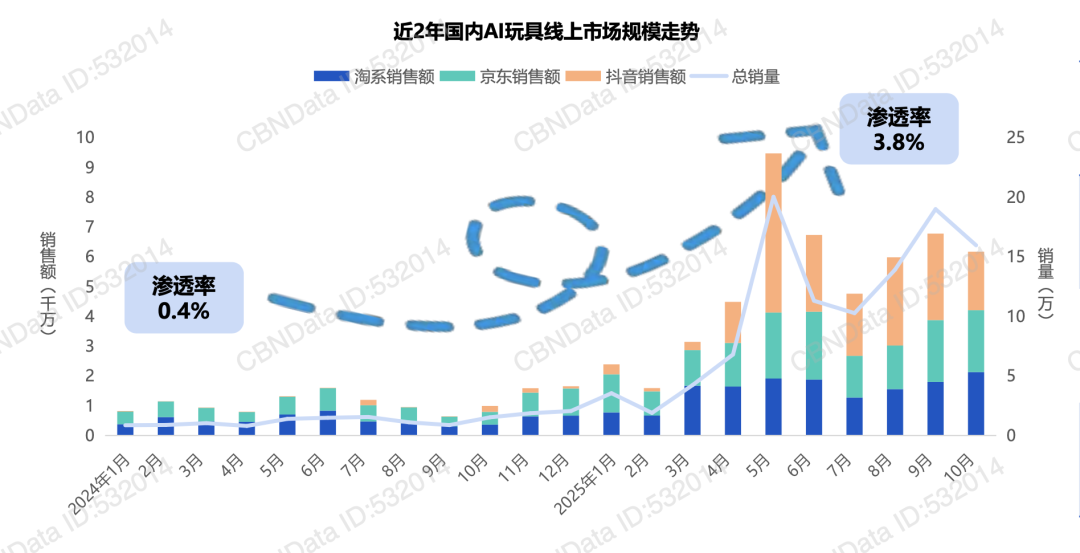
💡AI toys could explode like Pop Mart—spot early consumer AI biz trends.
⚡ 30-Second TL;DR
What Changed
AI toys positioned as Pop Mart successor
Why It Matters
Signals shift to AI-driven consumer products, opening markets for LLM-powered toys. Founders can tap into emotional AI companionship trends.
What To Do Next
Prototype AI toy with Llama 3 for voice companionship to test market fit.
Key Points
- •AI toys positioned as Pop Mart successor
- •Focus on companionship for all ages
- •New business model in interactive toys
- •Hints at booming AI consumer market
🧠 Deep Insight
Background and context from public sources — not the original article. 7 sources cited.
🔑 Enhanced Key Takeaways
- •Global AI toys market was valued at USD 48.9 million in 2024, projected to reach USD 91.9 million by 2032 at a 9.1% CAGR, driven by demand for educational smart toys with speech recognition and adaptive learning.[1]
- •Smart AI toys market estimated at USD 1,745 million in 2023, forecasted to grow to USD 7,502 million by 2033 at 15.7% CAGR, with 2026 value at USD 2,703 million amid rising adoption of AI for children's education and entertainment.[2]
- •North America leads the AI toys market while Asia-Pacific, especially China, shows the fastest growth due to rising disposable incomes, STEM education support, and large child populations.[1][3][4]
- •Key technologies in AI toys include voice recognition, natural language processing, machine learning for adaptive learning, image processing, and emerging emotional intelligence features.[1]
- •Major players innovating in AI/smart toys include LEGO, Hasbro, Mattel, Spin Master, VTech, Fisher-Price, Sphero, and WowWee, focusing on AI integration and educational content.[3][5]
📊 Competitor Analysis▸ Show
| Competitor | Key Features | Pricing (Typical Range) | Benchmarks |
|---|---|---|---|
| LEGO | AI-driven personalization, app integration, modular robotics kits | $50-$200 | Leads in educational STEM toys, strong North America presence [3][5] |
| Hasbro | Interactive AI play, voice recognition, AR features | $30-$150 | High market share in entertainment toys [3][5] |
| Mattel | Adaptive learning, Bluetooth connectivity, multilingual content | $40-$180 | Focus on early childhood, safety enhancements [3][5] |
| VTech | Speech recognition, educational apps, eco-friendly options | $20-$100 | Dominant in Asia-Pacific mass-market [3][5] |
| Sphero | Robotics with ML algorithms, coding integration | $100-$250 | Benchmarks in programmable AI toys [3] |
🛠️ Technical Deep Dive
- •Voice recognition and natural language processing (NLP) enable interactive conversations and commands in AI toys.[1][4]
- •Machine learning (ML) powers adaptive learning algorithms that adjust content based on child's pace, preferences, and skill level.[1][3][4]
- •Image processing supports visual recognition and AR features for immersive play.[1]
- •Bluetooth connectivity preferred for low power consumption, parental controls, and cost-efficiency over Wi-Fi in mid-range products.[4]
- •Integration with smartphones (44.35% market share) for control, display, and audio enhances ecosystem functionality.[5]
🔮 Future ImplicationsAI analysis grounded in cited sources
📎 Sources (7)
Factual claims are grounded in the sources below. Forward-looking analysis is AI-generated interpretation.
- intelmarketresearch.com — AI Toys Market 21272
- scoop.market.us — Smart AI Toys Market News
- marketresearchfuture.com — Smart AI Toy Market 24471
- fortunebusinessinsights.com — Smart Toys Market 100337
- mordorintelligence.com — Smart Toys Market
- htfmarketinsights.com — 4177026 Smart AI Toys Market
- thebusinessresearchcompany.com — Smart Toys Global Market Report
Weekly AI Recap
Read this week's curated digest of top AI events →
👉Related Updates

AI-curated news aggregator. All content rights belong to original publishers.
Original source: 钛媒体 ↗
This is a summary, not the original. Read the source, or get the weekly briefing.
Weekly AI briefing
One email a week. Unsubscribe anytime.