AI Short Drama Platforms Split Strategies
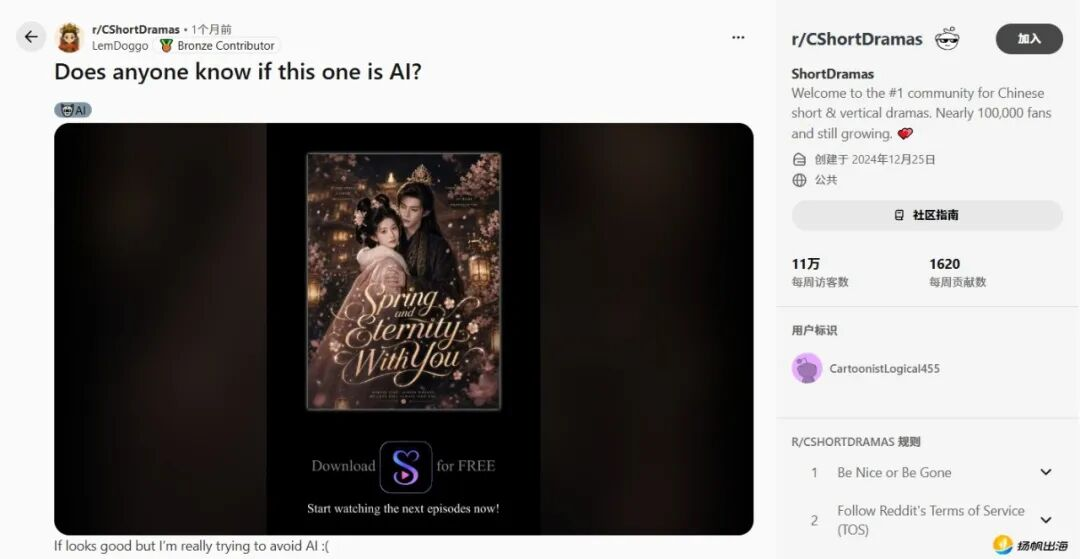
AI short dramas are splitting into viral, premium, and hybrid models—revealing what actually converts overseas viewers.
30-Second TL;DR
What Changed
TikTok’s AI short dramas accounted for 40% of short-drama consumption time, with non-human characters such as seahorses and fruit people driving viral views.
Why It Matters
The market is separating between attention-optimized AI content and payment-optimized premium storytelling. Developers will need to choose whether their primary moat is distribution, content quality, or monetization design rather than treating AI generation alone as the differentiator.
What To Do Next
Prototype two acquisition funnels—TikTok viral clips and an ad-plus-IAP standalone app—and compare retention, episode completion, and paid conversion before scaling production.
Key Points
- •TikTok’s AI short dramas accounted for 40% of short-drama consumption time, with non-human characters such as seahorses and fruit people driving viral views.
- •StoryReel reached No. 4 in the U.S. App Store free entertainment ranking less than four months after launch.
- •Playlet uses AI to expand its premium local-drama production capacity while preserving polished scripts, cinematography, and visual quality.
- •MoboDrama focuses on AI comics and web-novel adaptations, using advertising, subscriptions, and in-app purchases to test willingness to pay.
Deep Insight
AI-generated analysis for this event — not the original article.
Enhanced Key Takeaways
- •The rise of AI-generated short dramas is significantly lowering production costs by an estimated 60-80% compared to traditional live-action filming, enabling rapid content iteration cycles.
- •Major Chinese platforms are increasingly utilizing 'AI-in-the-loop' workflows where human directors curate AI-generated assets to maintain narrative coherence, addressing the 'uncanny valley' effect in early AI video models.
- •Regulatory scrutiny in international markets regarding AI-generated content labeling and copyright ownership is forcing platforms like StoryReel to implement automated watermarking and transparency disclosures.
- •Data indicates that AI-generated short dramas are achieving higher retention rates in the first 5 seconds of viewing compared to traditional dramas, likely due to the hyper-stylized visual nature of AI animation.
- •Cross-border payment integration and localized content adaptation remain the primary technical bottlenecks for Chinese AI drama apps expanding into the North American and Southeast Asian markets.
Competitor Analysis
- StoryReel
- AI-Native/Viral
- Playlet
- Hybrid AI/Live-Action
- MoboDrama
- AI-Comics/Web-Novel
- Traditional Platforms (e.g., ReelShort)
- Live-Action Only
- StoryReel
- Ad-Supported/Freemium
- Playlet
- Premium Subscription
- MoboDrama
- Hybrid (Ads/IAP)
- Traditional Platforms (e.g., ReelShort)
- Pay-per-episode
- StoryReel
- Ultra-Fast (Days)
- Playlet
- Moderate (Weeks)
- MoboDrama
- Fast (Days)
- Traditional Platforms (e.g., ReelShort)
- Slow (Months)
- StoryReel
- Stylized/Experimental
- Playlet
- High/Polished
- MoboDrama
- Graphic/Comic-style
- Traditional Platforms (e.g., ReelShort)
- Cinematic/Realistic
| Feature | StoryReel | Playlet | MoboDrama | Traditional Platforms (e.g., ReelShort) |
|---|---|---|---|---|
| Primary Content | AI-Native/Viral | Hybrid AI/Live-Action | AI-Comics/Web-Novel | Live-Action Only |
| Monetization | Ad-Supported/Freemium | Premium Subscription | Hybrid (Ads/IAP) | Pay-per-episode |
| Production Speed | Ultra-Fast (Days) | Moderate (Weeks) | Fast (Days) | Slow (Months) |
| Visual Quality | Stylized/Experimental | High/Polished | Graphic/Comic-style | Cinematic/Realistic |
Technical Deep Dive
- Platforms are leveraging fine-tuned versions of open-source video diffusion models (such as Stable Video Diffusion or proprietary variants) to maintain character consistency across multiple episodes.
- Implementation of LoRA (Low-Rank Adaptation) training is standard for creating consistent character 'digital twins' that can be reused across different story arcs.
- Integration of LLM-based scriptwriting agents allows for automated scene-to-prompt conversion, significantly reducing the manual labor required for storyboarding.
- Use of lip-syncing AI models (e.g., Wav2Lip or similar architectures) is being deployed to synchronize AI-generated character speech with localized audio tracks in multiple languages.
Future ImplicationsAI analysis grounded in cited sources
Timeline
- 2025-09Initial testing of AI-generated short-form content begins on TikTok by Chinese developers.
- 2026-02StoryReel launches in the U.S. market, focusing on rapid-fire AI-generated entertainment.
- 2026-05StoryReel achieves top 5 ranking in U.S. App Store entertainment category.
Weekly AI Recap
Read this week's curated digest of top AI events →
AI-curated news aggregator. All content rights belong to original publishers.
Original source: 虎嗅 ↗
This is a summary, not the original. Read the source, or get the weekly briefing.
The weekly digest
One email a week. Unsubscribe anytime.