AI Shopping Wins Discovery, Retailers Keep Checkout
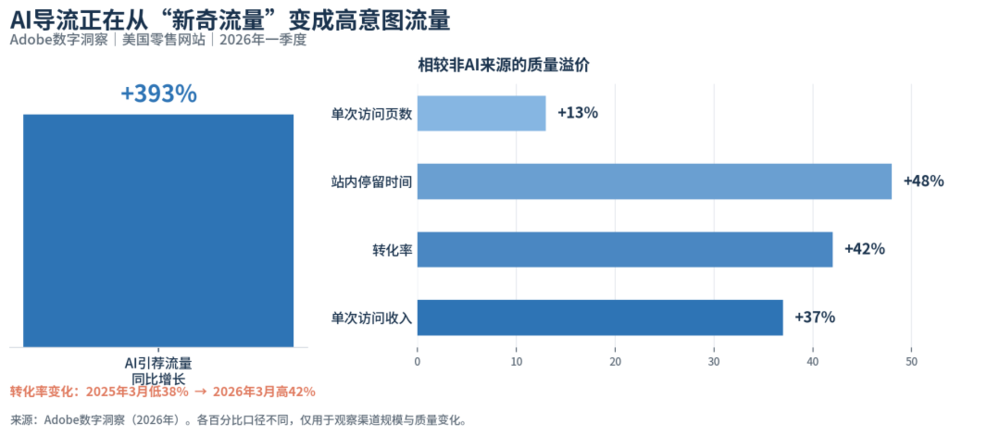
AI now sends higher-intent shoppers, but retailers still control the data and systems that make transactions profitable.
30-Second TL;DR
What Changed
Adobe reported that AI-referred traffic to U.S. retail sites grew 393% year over year in Q1 2026, while March conversion rates were 42% higher than non-AI traffic.
Why It Matters
AI assistants may become the primary demand-generation layer for commerce, but retailers are unlikely to surrender transaction ownership without clear economics and data safeguards. AI builders should expect hybrid architectures in which the model handles intent and recommendation while merchants retain stateful commerce infrastructure.
What To Do Next
Prototype a shopping agent that uses OpenAI or Gemini for intent extraction but calls a mock retailer API for inventory, pricing, loyalty, and delivery validation before checkout.
Key Points
- •Adobe reported that AI-referred traffic to U.S. retail sites grew 393% year over year in Q1 2026, while March conversion rates were 42% higher than non-AI traffic.
- •OpenAI shopping features and Agentic Commerce Protocol integrations are standardizing how product catalogs, prices, reviews, and specifications are exposed to AI systems.
- •Retailers such as Walmart, Ulta Beauty, Etsy, and Instacart are using AI for discovery while keeping checkout, account data, inventory, delivery, and loyalty relationships in their own systems.
- •The unresolved commercial issue is how AI platforms, retailers, and brands will divide advertising revenue, referral commissions, and customer lifetime value.
Deep Insight
AI-generated analysis for this event — not the original article.
Enhanced Key Takeaways
- •The Agentic Commerce Protocol (ACP) has emerged as a critical middleware layer, utilizing JSON-LD schema extensions to allow AI agents to parse real-time inventory availability and dynamic pricing without scraping.
- •Major retail search engines are shifting from traditional SEO to 'LLM Optimization' (LLMO), where brands prioritize high-quality structured data and conversational context to improve visibility in AI-generated shopping responses.
- •Privacy-preserving federated learning models are being deployed by retailers to share anonymized purchase intent data with AI platforms without exposing sensitive customer PII or loyalty database structures.
- •The rise of 'AI-assisted cart abandonment' has been identified as a new challenge, where AI agents suggest better alternatives or lower prices at the final checkout stage, forcing retailers to implement real-time price matching APIs.
- •Regulatory bodies in the EU and US have begun investigating 'AI gatekeeper' practices, specifically focusing on whether AI platforms prioritize their own retail partnerships or sponsored product placements in conversational discovery.
Competitor Analysis
- OpenAI (SearchGPT/Shopping)
- GPT-4o / o1-series
- Google (Shopping AI)
- Gemini 1.5 Pro
- Amazon (Rufus)
- Bedrock / Custom LLMs
- OpenAI (SearchGPT/Shopping)
- ACP / Third-party Retailers
- Google (Shopping AI)
- Google Merchant Center
- Amazon (Rufus)
- Closed Ecosystem
- OpenAI (SearchGPT/Shopping)
- Referral-based
- Google (Shopping AI)
- Ad-revenue / Direct
- Amazon (Rufus)
- Direct Sales
- OpenAI (SearchGPT/Shopping)
- Open Web / API
- Google (Shopping AI)
- First-party Search Data
- Amazon (Rufus)
- Proprietary Retail Data
| Feature | OpenAI (SearchGPT/Shopping) | Google (Shopping AI) | Amazon (Rufus) |
|---|---|---|---|
| Primary Model | GPT-4o / o1-series | Gemini 1.5 Pro | Bedrock / Custom LLMs |
| Integration | ACP / Third-party Retailers | Google Merchant Center | Closed Ecosystem |
| Conversion Focus | Referral-based | Ad-revenue / Direct | Direct Sales |
| Data Access | Open Web / API | First-party Search Data | Proprietary Retail Data |
Technical Deep Dive
- Agentic Commerce Protocol (ACP) utilizes a RESTful API architecture that supports asynchronous state management for shopping carts across disparate platforms.
- Implementation relies on Function Calling capabilities within LLMs to trigger real-time inventory lookups via retailers' existing ERP systems.
- Retrieval-Augmented Generation (RAG) pipelines are being optimized with vector databases that store product embeddings, allowing for semantic matching between user intent and product attributes.
- Token-efficient schema mapping is used to convert legacy retail product feeds into LLM-readable formats, reducing latency in conversational discovery.
Future ImplicationsAI analysis grounded in cited sources
Timeline
- 2024-05OpenAI announces initial explorations into conversational shopping features.
- 2025-02Industry consortium launches the Agentic Commerce Protocol (ACP) to standardize AI-retailer communication.
- 2025-11Major retailers begin widespread adoption of ACP-compliant APIs for AI discovery.
- 2026-03Adobe reports a 393% YoY surge in AI-referred retail traffic, marking a shift in consumer behavior.
Weekly AI Recap
Read this week's curated digest of top AI events →
AI-curated news aggregator. All content rights belong to original publishers.
Original source: 虎嗅 ↗
This is a summary, not the original. Read the source, or get the weekly briefing.
The weekly digest
One email a week. Unsubscribe anytime.