AI Shopping: China Wins Where OpenAI Fails
💡Why China AI crushes OpenAI shopping & disrupts app traffic forever
⚡ 30-Second TL;DR
What Changed
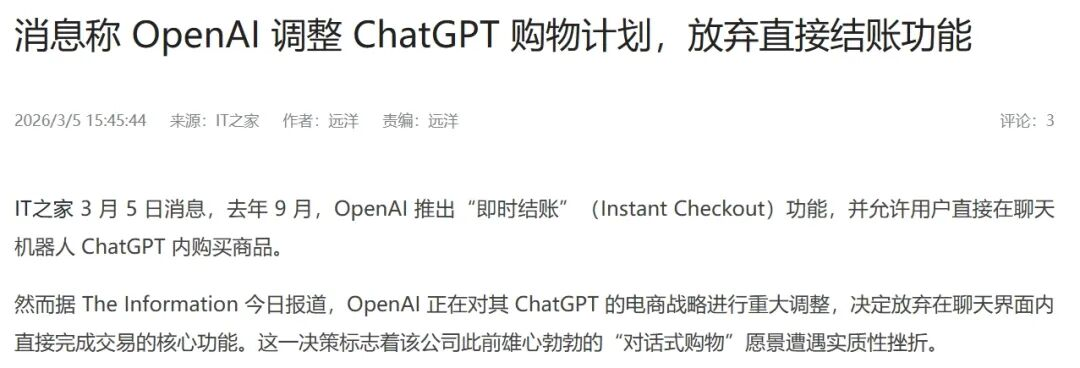
OpenAI ChatGPT shopping flops; redirects to third-party apps
Why It Matters
Boosts OTA stocks short-term but erodes their mindshare/data; China ecosystems prove AI traffic disruption viable.
What To Do Next
Embed e-commerce APIs like Alipay into your AI agent for seamless shopping.
Key Points
- •OpenAI ChatGPT shopping flops; redirects to third-party apps
- •Ali Qwen: 1.3B users, 2B one-sentence orders in Spring Festival
- •ByteDance Doubao tops AI apps with in-app shopping
- •AI owns user data/intent, forces OTA price wars even on redirects
🧠 Deep Insight
Background and context from public sources — not the original article. 7 sources cited.
🔑 Enhanced Key Takeaways
- •OpenAI's Instant Checkout feature, initially launched in September 2025 with Etsy, Shopify, Walmart, and Target partnerships, has been scaled back as of March 2026 due to low merchant adoption—only about a dozen Shopify merchants actively used the native checkout capability[2].
- •OpenAI is pivoting its commerce strategy to prioritize product discovery and search within ChatGPT while shifting actual transactions to retailer-connected apps via the Agentic Commerce Protocol (ACP), co-developed with Stripe, rather than native in-chat checkout[2][5].
- •User behavior data reveals a critical gap in OpenAI's e-commerce model: shoppers actively research products in ChatGPT but do not complete purchases within the platform, indicating that AI-powered shopping currently influences product consideration rather than driving conversions[2].
- •Chinese AI platforms (Alibaba's Qwen and ByteDance's Doubao) have achieved significantly higher transaction volumes through integrated ecosystem approaches—Qwen processed 2 billion orders during Spring Festival 2026, while Doubao leads as the top AI shopping app with 172 million monthly active users[1].
- •The shift reflects merchant concerns about transaction complexity, including real-time inventory management, sales tax collection, and dynamic pricing, which are better handled through individual retailer apps than a centralized ChatGPT checkout system[5].
📊 Competitor Analysis▸ Show
| Feature | OpenAI ChatGPT | Alibaba Qwen | ByteDance Doubao |
|---|---|---|---|
| Primary Function | Product discovery & research | Integrated shopping ecosystem | AI-powered shopping app |
| Transaction Model | Redirect to retailer apps (post-March 2026) | Native in-app checkout | Native in-app shopping |
| User Base | Free, Go, Plus, Pro tiers | 1.3B users | 172M MAU |
| Spring Festival 2026 Orders | N/A | 2B one-sentence orders | N/A |
| Merchant Adoption | ~12 Shopify merchants (native checkout) | Integrated with Alibaba ecosystem | Integrated with ByteDance ecosystem |
| Infrastructure | Agentic Commerce Protocol (ACP) with Stripe | Native e-commerce integration | Native e-commerce integration |
🔮 Future ImplicationsAI analysis grounded in cited sources
⏳ Timeline
📎 Sources (7)
Factual claims are grounded in the sources below. Forward-looking analysis is AI-generated interpretation.
- retaildive.com — 806656
- searchengineland.com — Chatgpt Instant Checkout Plan Change 471033
- OpenAI — Buy It in Chatgpt
- futurism.com — Openai Pivot Into Shopping Disaster
- digitalcommerce360.com — Openai Shifts Checkout Plans Agentic Commerce Strategy
- OpenAI — Chatgpt Shopping Research
- tradingview.com — Reuters.com,2026:newsml L4n3zt061:0 Openai Scales Back Shopping Plans for Chatgpt the Information
Weekly AI Recap
Read this week's curated digest of top AI events →
👉Related Updates


AI-curated news aggregator. All content rights belong to original publishers.
Original source: 虎嗅 ↗
This is a summary, not the original. Read the source, or get the weekly briefing.
Weekly AI briefing
One email a week. Unsubscribe anytime.