AI Reshapes Dev Choices, Octoverse Proves
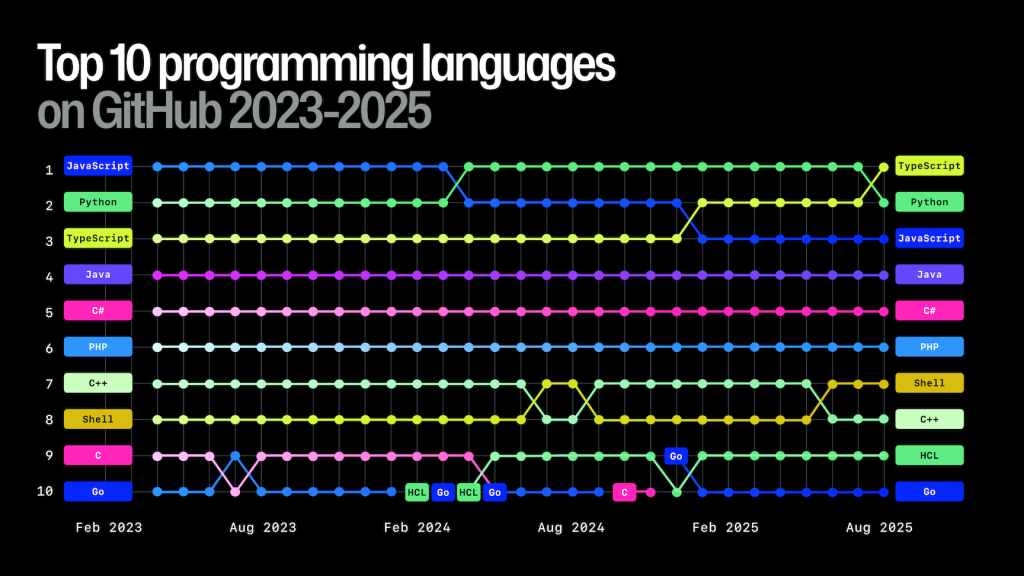
💡Octoverse 2025 data: AI compatibility now dictates dev tool picks
⚡ 30-Second TL;DR
What Changed
Octoverse 2025 analyzes global dev activity showing AI influence
Why It Matters
This trend will accelerate adoption of AI-integrated platforms like GitHub Copilot, pressuring non-AI tools. Developers prioritizing AI compatibility reshape market leaders in dev ecosystems.
What To Do Next
Download GitHub Octoverse 2025 report to benchmark your tools' AI compatibility.
Key Points
- •Octoverse 2025 analyzes global dev activity showing AI influence
- •Convenience loops from AI drive preference shifts
- •AI compatibility emerges as key tech selection standard
🧠 Deep Insight
Background and context from public sources — not the original article. 6 sources cited.
🔑 Enhanced Key Takeaways
- •GitHub's Octoverse 2025 report confirms generative AI has become a standard development tool, fundamentally shifting how developers evaluate and adopt technologies[1][2]
- •Three platforms—GitHub Copilot, Cursor, and Claude Code—have each surpassed $1 billion in annualized revenue by late 2025, demonstrating massive market consolidation around AI-first coding tools[3]
- •Open-source AI coding tools like Cline, Aider, and OpenHands are disrupting the proprietary market, with OpenHands achieving a 65.8% score on SWE-bench Verified and topping competitive leaderboards[3]
- •Autonomous multi-agent systems are reshaping development workflows, with GitHub Copilot's autonomous agent contributing to 1.2 million pull requests monthly and Gartner projecting 40% of enterprise applications will embed AI agents by end of 2026[3]
- •The developer workforce is restructuring around AI orchestration skills rather than raw coding speed, with employment among software developers aged 22-25 falling nearly 20% between 2022-2025 while AI knowledge job postings doubled[3]
📊 Competitor Analysis▸ Show
| Platform | Revenue (Late 2025) | Key Capability | Market Position |
|---|---|---|---|
| GitHub Copilot | $1B+ annualized | Autonomous agent (1.2M PRs/month) | Market leader with enterprise integration |
| Cursor | $1B+ annualized | Multi-agent interface via git worktrees | Strong developer adoption |
| Claude Code | $1B+ annualized | Subagent orchestration | Anthropic-backed alternative |
| Cline (Open-source) | N/A | VS Code extension | No subscription required |
| Aider (Open-source) | N/A | CLI-based Git integration | Developer-friendly alternative |
| OpenHands (Open-source) | N/A | 65.8% SWE-bench Verified score | Top-tier performance without cost |
🛠️ Technical Deep Dive
• Autonomous Agent Architecture: GitHub Copilot's autonomous agent operates at scale (1.2 million pull requests monthly), while Cursor employs multi-agent systems running parallel agents via git worktrees for concurrent task execution[3] • Subagent Orchestration: Claude Code implements a hierarchical model where subagents execute tasks simultaneously while a main orchestration agent coordinates workflow[3] • CI/CD Integration: AI now handles automated test generation (Diffblue Cover), security scanning (Snyk), predictive deployment models, and anomaly detection in production monitoring[3] • Performance Benchmarking: OpenHands achieves 65.8% on SWE-bench Verified, the industry standard for evaluating autonomous coding agents[3] • Developer Productivity: GitLab's AI merge tools, used by 1.5 million developers, deliver 30% faster releases through integrated CI/CD pipeline optimization[3]
🔮 Future ImplicationsAI analysis grounded in cited sources
The convergence of AI compatibility as a selection criterion signals a fundamental market restructuring. By 2027, enterprises will likely prioritize AI-native architectures over traditional development stacks, with Gartner's projected 1,445% surge in multi-agent system inquiries indicating rapid enterprise adoption[3]. The AI agent market's projected growth from $7.84 billion (2025) to $52.62 billion (2030) suggests this is not a temporary trend but a structural shift in software development economics[3]. The 20% employment decline among junior developers (ages 22-25) combined with doubled AI knowledge job postings indicates a skills gap that will reshape hiring, training, and career trajectories. Organizations that embed AI agents into CI/CD pipelines and adopt multi-agent orchestration patterns will gain competitive advantages in release velocity and code quality, while those maintaining traditional workflows risk obsolescence.
⏳ Timeline
📎 Sources (6)
Factual claims are grounded in the sources below. Forward-looking analysis is AI-generated interpretation.
- oreateai.com — Adac079b3b768f238ec9b94807fb2d84
- github.blog — How AI Is Reshaping Developer Choice and Octoverse Data Proves It
- whitehat-seo.co.uk — AI Coding Tools
- faros.ai — Is Github Copilot Worth It Real World Data Reveals the Answer
- cafetosoftware.com — AI Native Platforms Engineering Leadership
- youtube.com — Playlist
Weekly AI Recap
Read this week's curated digest of top AI events →
👉Related Updates
AI-curated news aggregator. All content rights belong to original publishers.
Original source: GitHub Blog ↗
This is a summary, not the original. Read the source, or get the weekly briefing.
Weekly AI briefing
One email a week. Unsubscribe anytime.