🐯虎嗅•Stalecollected in 17m
AI Redesigns Ribosome for 19-Amino-Acid Life
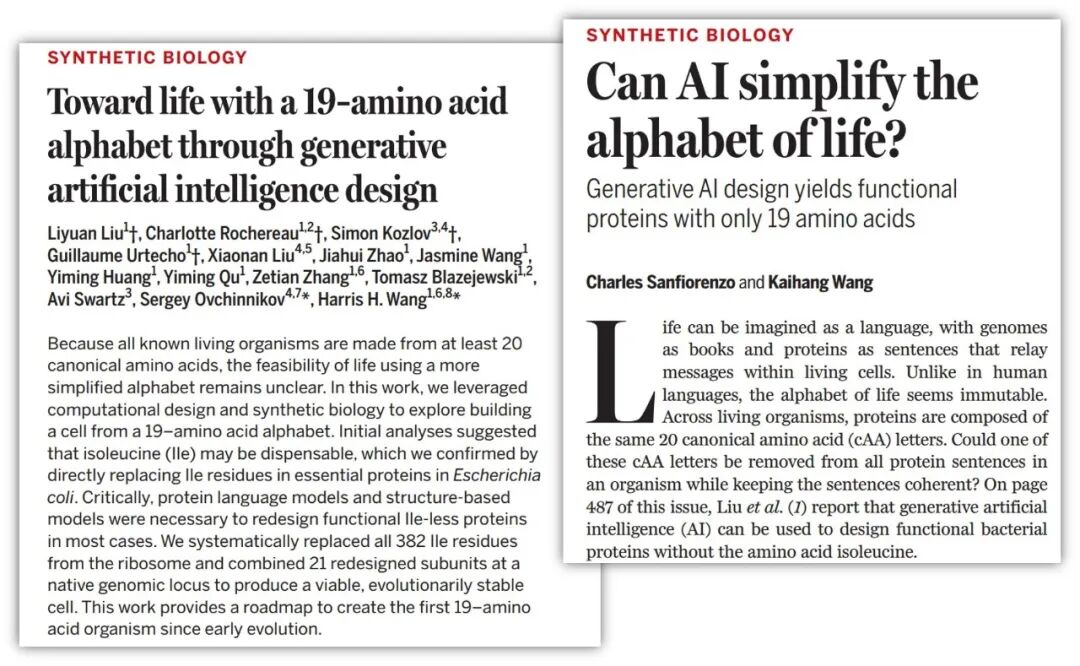
💡AI enables 19-aa life milestone—unlock protein design tools for synthetic bio now.
⚡ 30-Second TL;DR
What Changed
Targeted isoleucine as least essential; AI redesigned 52 ribosomal proteins with 382 sites.
Why It Matters
Demonstrates AI's power in protein engineering, opening doors to minimal genomes and custom biologics for biotech applications.
What To Do Next
Experiment with ProteinMPNN on Colab to redesign proteins avoiding specific amino acids.
Who should care:Researchers & Academics
Key Points
- •Targeted isoleucine as least essential; AI redesigned 52 ribosomal proteins with 382 sites.
- •ESM2/ProteinMPNN predicted folds; introduced non-natural swaps like isoleucine to arginine.
- •Overcame gene overlap issues in rplD/rplW for stable Ec19 strain growing at 61% wild-type speed.
- •First functional 19-aa ribosome, but genome retains ~81k isoleucines elsewhere.
🧠 Deep Insight
AI-generated analysis for this event.
🔑 Enhanced Key Takeaways
- •The research team utilized a 'generative design' approach, specifically leveraging the ProteinMPNN model to optimize the thermodynamic stability of the redesigned ribosomal proteins, ensuring they could fold correctly despite the removal of isoleucine.
- •This study represents a significant milestone in 'xenobiology,' moving beyond simple genetic code expansion to demonstrate that the fundamental machinery of life can be structurally re-engineered to operate with a reduced chemical alphabet.
- •The Ec19 strain serves as a foundational platform for future 'genetic firewall' research, where researchers aim to create organisms that are biologically isolated from natural life by requiring non-canonical amino acids or lacking the ability to process standard ones.
🛠️ Technical Deep Dive
- •Model Architecture: Integrated ESM2 (Evolutionary Scale Modeling) for sequence representation learning and ProteinMPNN (Protein Message Passing Neural Network) for inverse folding and sequence design.
- •Design Strategy: Targeted the 52 ribosomal proteins; utilized a computational pipeline to identify isoleucine residues that were not critical for catalytic activity or structural integrity, replacing them with structurally similar amino acids (e.g., leucine or valine) or charge-compatible alternatives.
- •Validation: Used high-throughput sequencing to verify the stability of the redesigned ribosomal genes and monitored the growth rate of the Ec19 strain in minimal media to assess the fitness cost of the reduced amino acid set.
- •Constraint Handling: Addressed the challenge of overlapping reading frames in the rplD/rplW operon by employing a multi-objective optimization algorithm that balanced protein stability with the preservation of the overlapping gene's sequence constraints.
🔮 Future ImplicationsAI analysis grounded in cited sources
Development of virus-resistant synthetic organisms.
By altering the fundamental translation machinery, these organisms may become immune to natural viruses that rely on standard host ribosomes and tRNA charging mechanisms.
Expansion of the synthetic amino acid repertoire.
The successful redesign of the ribosome proves that the translational machinery is modular enough to accommodate non-canonical amino acids, paving the way for proteins with entirely new chemical properties.
⏳ Timeline
2023-05
Initial computational modeling of the E. coli ribosome using early ESM-based protein design frameworks.
2024-09
Successful in-silico validation of the 19-amino-acid ribosomal protein set.
2026-02
Experimental verification of the functional Ec19 strain and publication of the redesign methodology.
📰
Weekly AI Recap
Read this week's curated digest of top AI events →
👉Related Updates



AI-curated news aggregator. All content rights belong to original publishers.
Original source: 虎嗅 ↗