AI Reconstructs Galaxy History from One Scan
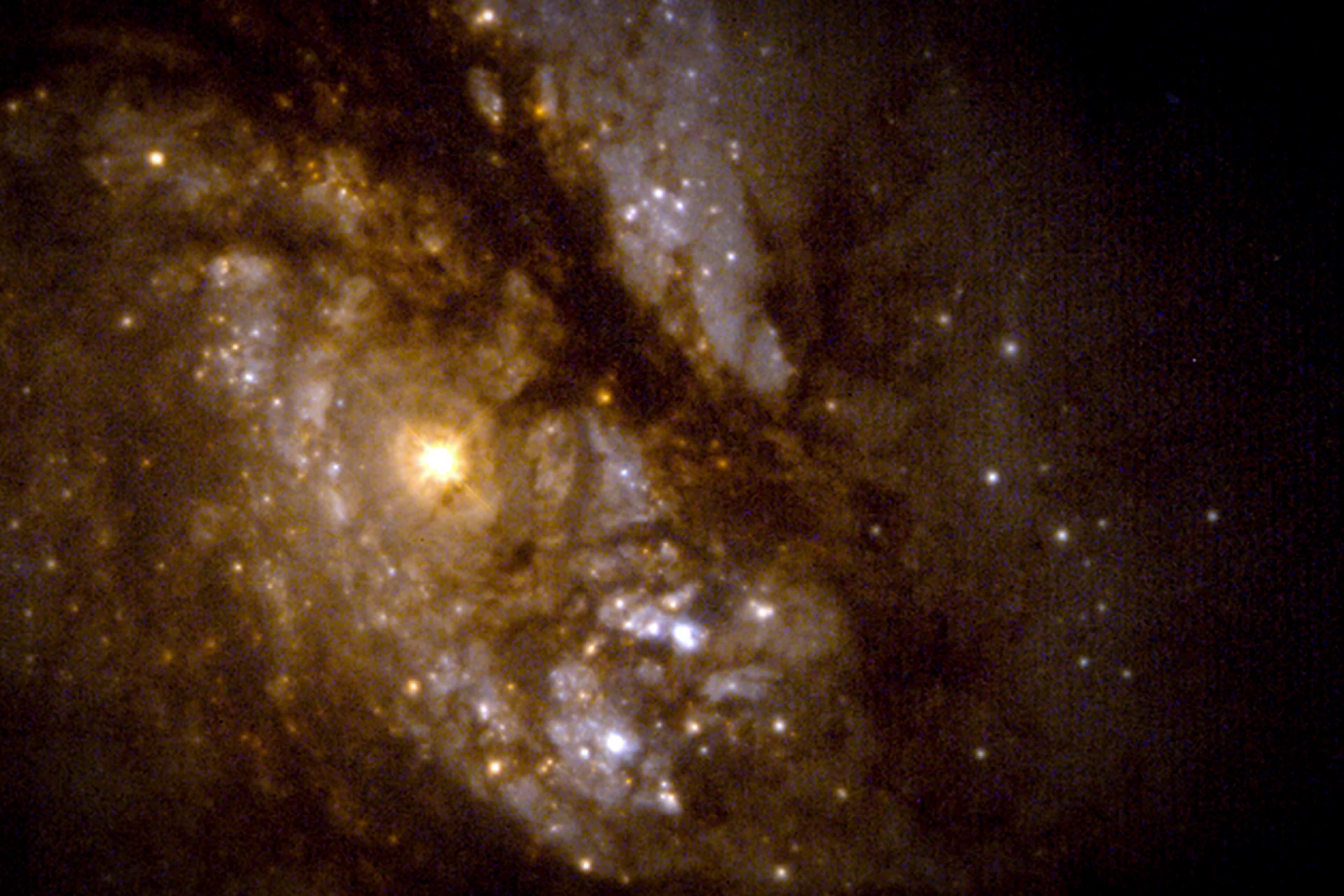
💡AI decodes galaxy histories from one observation—new tool for astro ML research.
⚡ 30-Second TL;DR
What Changed
Single observation reconstructs galaxy's full life history
Why It Matters
This AI-driven approach could transform extragalactic studies, allowing faster historical insights and broader galaxy analysis without extensive observations.
What To Do Next
Experiment with AI on spectral data using libraries like Astropy and scikit-learn for fingerprint analysis.
Key Points
- •Single observation reconstructs galaxy's full life history
- •'Extragalactic Archaeology' method proposed for first time
- •AI analyzes chemical element fingerprints in galaxies
- •Applies to external galaxies beyond Milky Way
- •Spans billions of years across cosmic age
🧠 Deep Insight
AI-generated analysis for this event — not the original article.
🔑 Enhanced Key Takeaways
- •The method utilizes deep learning models trained on high-resolution cosmological simulations, such as IllustrisTNG or EAGLE, to map observed stellar spectra to star formation histories.
- •By leveraging the 'chemical tagging' technique, the AI identifies specific abundance ratios of alpha-elements (like oxygen and magnesium) relative to iron, which act as cosmic clocks for star formation rates.
- •This approach overcomes the 'distance limitation' of traditional galactic archaeology, which previously required resolving individual stars, a feat only possible for the Milky Way and its immediate satellites.
🛠️ Technical Deep Dive
- •Model Architecture: Typically employs Convolutional Neural Networks (CNNs) or Graph Neural Networks (GNNs) to process multi-dimensional spectral data cubes.
- •Input Data: Integrated light spectra (galaxy-wide) rather than resolved stellar populations, requiring the model to disentangle overlapping spectral features of diverse stellar generations.
- •Training Pipeline: Uses synthetic galaxy catalogs generated from hydrodynamical simulations where the ground-truth star formation history and chemical enrichment history are known.
- •Inference Mechanism: The model performs a non-linear regression to map the observed equivalent widths of absorption lines (e.g., H-beta, Mgb, Fe5270) to the galaxy's age-metallicity distribution.
🔮 Future ImplicationsAI analysis grounded in cited sources
⏳ Timeline
Weekly AI Recap
Read this week's curated digest of top AI events →
👉Related Updates
AI-curated news aggregator. All content rights belong to original publishers.
Original source: cnBeta (Full RSS) ↗
This is a summary, not the original. Read the source, or get the weekly briefing.
The weekly digest
One email a week. Unsubscribe anytime.