AI Raises Homework Scores, Lowers Exam Performance
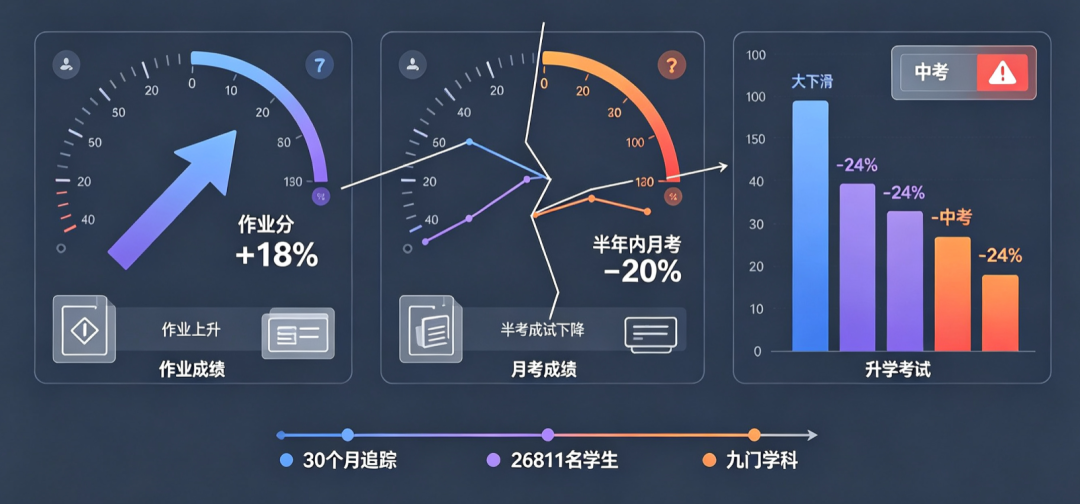
💡A large student study exposes how AI can make homework look better while exams get worse.
⚡ 30-Second TL;DR
What Changed
The study tracked 26,000 Chinese students over 30 months.
Why It Matters
AI education products may need to optimize for durable learning rather than immediate assignment completion. Developers and schools should treat higher AI-assisted homework scores as an insufficient success metric.
What To Do Next
Add delayed, closed-book benchmark tests to every AI tutoring pilot so learning gains are measured beyond assisted homework scores.
Key Points
- •The study tracked 26,000 Chinese students over 30 months.
- •AI-assisted homework scores increased by 18%.
- •Middle school entrance exam scores declined by 24%.
- •The gap suggests homework quality may not reflect genuine learning.
🧠 Deep Insight
Background and context from public sources — not the original article. 7 sources cited.
🔑 Enhanced Key Takeaways
- •Approximately 80% of the study participants engaged in 'cognitive outsourcing,' prioritizing rapid task completion over the actual learning process.
- •AI usage reduced average homework completion time by 30%, dropping from 64 minutes to 45 minutes per session.
- •A clear dose-response relationship exists: performance loss on exams scales from 5% for light users (under 1 hour/week) to 30% for heavy users (over 5 hours/week).
- •High-attaining students were identified as the most susceptible demographic, experiencing a more significant decline in exam performance compared to their lower-performing peers.
- •Data from the ALEKS math platform indicates that students spent 31% less time on word problems post-ChatGPT, suggesting a specific erosion of skills in areas easily handled by LLMs.
🛠️ Technical Deep Dive
- The study utilized longitudinal data tracking 26,811 students over a 30-month period to correlate AI interaction patterns with standardized assessment outcomes.
- Analysis of platform interaction logs (e.g., ALEKS) revealed a shift in cognitive load distribution, specifically identifying a reduction in time spent on text-based word problems versus stable engagement with complex visual/graphing tasks.
- The research methodology employed a dose-response model to quantify the correlation between weekly AI usage hours and the resulting percentage decline in high-stakes exam scores.
🔮 Future ImplicationsAI analysis grounded in cited sources
⏳ Timeline
📎 Sources (7)
Factual claims are grounded in the sources below. Forward-looking analysis is AI-generated interpretation.
Weekly AI Recap
Read this week's curated digest of top AI events →
👉Related Updates




AI-curated news aggregator. All content rights belong to original publishers.
Original source: 钛媒体 ↗
This is a summary, not the original. Read the source, or get the weekly briefing.
Weekly AI briefing
One email a week. Unsubscribe anytime.