AI-powered BI integration with Snowflake and Amazon Quick
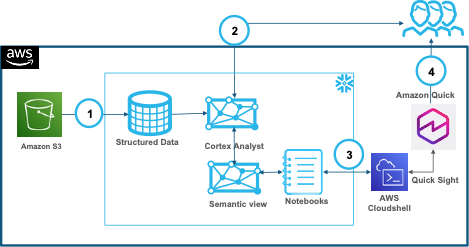
Enable natural-language BI by integrating Snowflake semantic views with Amazon Quick.
30-Second TL;DR
What Changed
Integrates Snowflake semantic views with Amazon Quick
Why It Matters
Streamlines the BI workflow by allowing non-technical users to query governed data layers using natural language.
What To Do Next
Connect your Snowflake semantic layer to Amazon Quick and test Cortex Analyst for natural-language dashboard generation.
Key Points
- •Integrates Snowflake semantic views with Amazon Quick
- •Uses Cortex Analyst for natural-language data querying
- •Automates dataset and dashboard generation for BI teams
Deep Insight
AI-generated analysis for this event — not the original article.
Enhanced Key Takeaways
- •Cortex Analyst leverages Snowflake's internal LLM-powered text-to-SQL engine to translate natural language into optimized SQL queries against semantic models.
- •The integration utilizes the Amazon QuickSight API to programmatically inject the generated SQL results into QuickSight datasets, bypassing manual dashboard construction.
- •Snowflake semantic views act as a governance layer, ensuring that natural language queries respect row-level security and data masking policies defined in the Snowflake environment.
- •This workflow reduces the 'time-to-insight' for business analysts by eliminating the need for manual schema mapping between Snowflake's relational structure and QuickSight's SPICE engine.
- •The architecture supports iterative refinement, where users can provide feedback on generated visualizations, which the system uses to adjust the underlying semantic model context.
Competitor Analysis
- Snowflake Cortex Analyst + QuickSight
- Snowflake Cortex (LLaMA/Mistral/Proprietary)
- Microsoft Fabric + Power BI
- Azure OpenAI (GPT-4)
- Databricks AI/BI + Tableau
- Databricks Mosaic AI
- Snowflake Cortex Analyst + QuickSight
- Snowflake Semantic Views
- Microsoft Fabric + Power BI
- Fabric Semantic Models
- Databricks AI/BI + Tableau
- Unity Catalog
- Snowflake Cortex Analyst + QuickSight
- Consumption-based (Compute/Token)
- Microsoft Fabric + Power BI
- Capacity-based (F64+)
- Databricks AI/BI + Tableau
- DBU-based
- Snowflake Cortex Analyst + QuickSight
- High (Text-to-SQL focus)
- Microsoft Fabric + Power BI
- High (Copilot focus)
- Databricks AI/BI + Tableau
- Medium (Genie focus)
| Feature | Snowflake Cortex Analyst + QuickSight | Microsoft Fabric + Power BI | Databricks AI/BI + Tableau |
|---|---|---|---|
| Primary LLM Integration | Snowflake Cortex (LLaMA/Mistral/Proprietary) | Azure OpenAI (GPT-4) | Databricks Mosaic AI |
| Semantic Layer | Snowflake Semantic Views | Fabric Semantic Models | Unity Catalog |
| Pricing Model | Consumption-based (Compute/Token) | Capacity-based (F64+) | DBU-based |
| Natural Language Query | High (Text-to-SQL focus) | High (Copilot focus) | Medium (Genie focus) |
Technical Deep Dive
- Cortex Analyst operates by ingesting a YAML-based semantic model that defines relationships, metrics, and dimensions within Snowflake.
- The system utilizes a RAG-based approach to retrieve relevant schema metadata before generating SQL, minimizing hallucinations.
- Integration with Amazon QuickSight is facilitated via the QuickSight CreateDataSet API, where the SQL output from Cortex is passed as the physical table definition.
- Authentication is handled via AWS IAM roles mapped to Snowflake OAuth or service tokens, ensuring secure cross-cloud data access.
- The generated SQL is optimized for Snowflake's query optimizer, utilizing result set caching to reduce compute costs for repeated natural language queries.
Future ImplicationsAI analysis grounded in cited sources
Timeline
- 2024-05Snowflake announces Cortex AI services including Cortex Analyst in public preview.
- 2024-11Snowflake makes Cortex Analyst generally available for enterprise production workloads.
- 2025-03AWS and Snowflake expand partnership to simplify cross-cloud data integration workflows.
- 2026-02Introduction of enhanced semantic view support for third-party BI tools via Snowflake APIs.
Weekly AI Recap
Read this week's curated digest of top AI events →
Related Updates

AI-curated news aggregator. All content rights belong to original publishers.
Original source: AWS Machine Learning Blog ↗
This is a summary, not the original. Read the source, or get the weekly briefing.
The weekly digest
One email a week. Unsubscribe anytime.