AI Power Is Moving From Orbit to the Desert
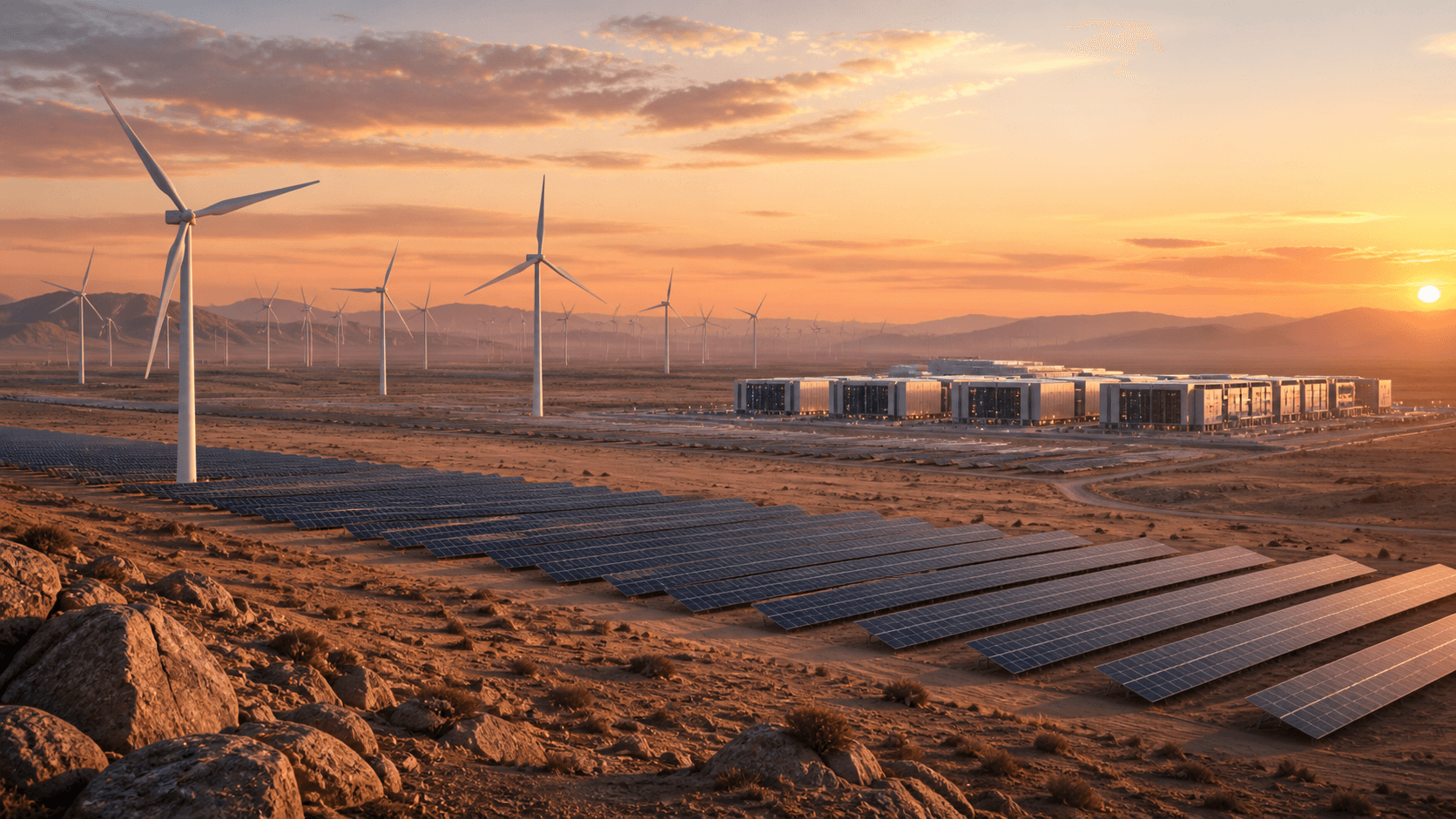
See why renewable-powered desert campuses may beat orbital data centers to practical AI deployment.
30-Second TL;DR
What Changed
Envision Group is operating AI campuses in Inner Mongolia.
Why It Matters
For AI companies, the location of compute may become as important as the hardware itself, particularly as energy demand grows. Regional renewable-powered campuses could offer a more immediately deployable alternative to orbital infrastructure.
What To Do Next
Evaluate whether your next inference deployment could run in a renewable-powered regional data center, and compare its latency and operating cost with your current cloud region.
Key Points
- •Envision Group is operating AI campuses in Inner Mongolia.
- •The desert facilities are already serving customers.
- •The strategy places AI compute near abundant renewable energy.
- •The approach contrasts with SpaceX's vision for orbital data centers.
Deep Insight
AI-generated analysis for this event — not the original article.
Enhanced Key Takeaways
- •Envision Group's Inner Mongolia facility leverages the 'Net Zero Industrial Park' model, which integrates wind, solar, and energy storage systems directly into the compute infrastructure to minimize transmission losses.
- •The project utilizes Envision's proprietary EnOS operating system to manage real-time energy balancing, ensuring AI workloads are dynamically adjusted based on renewable energy availability.
- •Inner Mongolia has become a strategic hub for China's 'East Data, West Computing' (Dongshu Xisuan) national project, which aims to shift data processing from energy-constrained coastal cities to energy-rich western regions.
- •The desert AI campuses are designed to support high-density GPU clusters that require advanced liquid cooling solutions to operate efficiently in arid, high-temperature environments.
- •Beyond compute, these facilities are increasingly being used to train large-scale industrial AI models specifically for energy grid optimization and carbon footprint tracking.
Competitor Analysis
- Envision Group (Desert AI)
- Local Renewable (Wind/Solar)
- SpaceX (Orbital Data Centers)
- Solar (Orbital)
- Traditional Cloud (AWS/Azure)
- Grid-based (Mixed)
- Envision Group (Desert AI)
- Low (Regional)
- SpaceX (Orbital Data Centers)
- High (Orbital-to-Ground)
- Traditional Cloud (AWS/Azure)
- Very Low (Edge)
- Envision Group (Desert AI)
- High (Land-based)
- SpaceX (Orbital Data Centers)
- Low (Launch constraints)
- Traditional Cloud (AWS/Azure)
- Very High
- Envision Group (Desert AI)
- Infrastructure/Cooling
- SpaceX (Orbital Data Centers)
- Launch/Maintenance
- Traditional Cloud (AWS/Azure)
- Electricity/Real Estate
| Feature | Envision Group (Desert AI) | SpaceX (Orbital Data Centers) | Traditional Cloud (AWS/Azure) |
|---|---|---|---|
| Energy Source | Local Renewable (Wind/Solar) | Solar (Orbital) | Grid-based (Mixed) |
| Latency | Low (Regional) | High (Orbital-to-Ground) | Very Low (Edge) |
| Scalability | High (Land-based) | Low (Launch constraints) | Very High |
| Primary Cost | Infrastructure/Cooling | Launch/Maintenance | Electricity/Real Estate |
Technical Deep Dive
- Energy Integration: Utilizes a microgrid architecture that bypasses traditional grid reliance, employing Envision's battery storage technology to maintain 99.99% uptime for AI training clusters.
- Cooling Systems: Employs closed-loop liquid cooling systems that utilize desert-specific heat exchangers to reduce water consumption compared to traditional evaporative cooling towers.
- Compute Density: Optimized for high-performance computing (HPC) racks with power densities exceeding 50kW per rack, supported by direct-to-chip cooling.
- Data Transmission: Connects to national backbone networks via dedicated high-speed fiber optic links to mitigate the geographic distance from urban demand centers.
Future ImplicationsAI analysis grounded in cited sources
Timeline
- 2021-04Envision Group launches its first Net Zero Industrial Park in Ordos, Inner Mongolia.
- 2022-02China officially launches the 'East Data, West Computing' project, providing the policy framework for Envision's desert expansion.
- 2023-11Envision announces the integration of advanced AI computing clusters into its Ordos renewable energy ecosystem.
- 2025-06Full-scale operation of the desert AI campus reaches multi-gigawatt capacity, supporting regional industrial AI applications.
Weekly AI Recap
Read this week's curated digest of top AI events →
Related Updates



AI-curated news aggregator. All content rights belong to original publishers.
Original source: Pandaily ↗
This is a summary, not the original. Read the source, or get the weekly briefing.
The weekly digest
One email a week. Unsubscribe anytime.