AI Office Battles Start With Organization
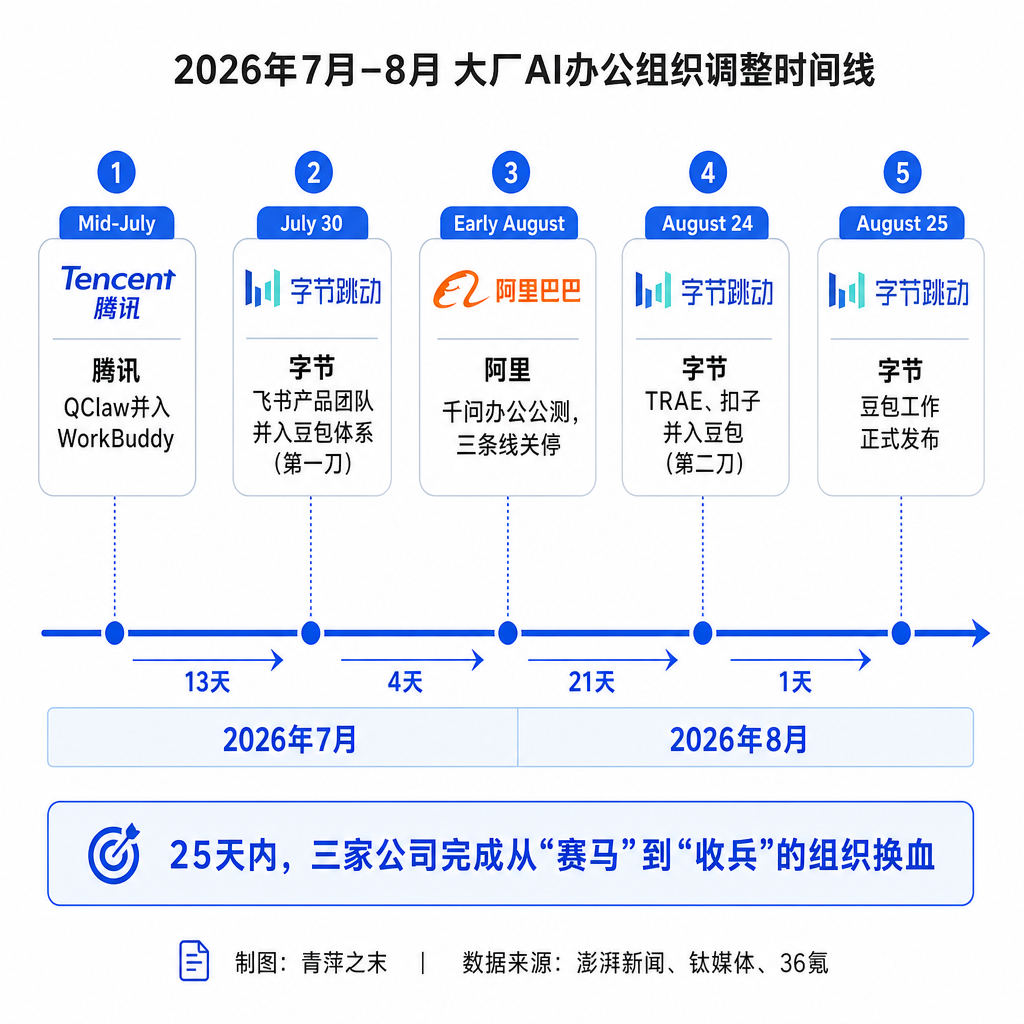
💡The AI office race may be decided by organizational execution before product features mature.
⚡ 30-Second TL;DR
What Changed
Tencent, Alibaba, and ByteDance are competing in the AI office market.
Why It Matters
Organizational design may determine how quickly large companies integrate AI into workplace products and customer workflows. Enterprise buyers should assess not only product features, but also each vendor’s execution model and integration roadmap.
What To Do Next
Compare Tencent WorkBuddy, Qwen Office, Doubao, and Feishu using a pilot workflow that measures integration effort, permissions, and employee adoption.
Key Points
- •Tencent, Alibaba, and ByteDance are competing in the AI office market.
- •Organizational structure is presented as an initial strategic differentiator.
- •The referenced products include Tencent WorkBuddy, Qwen Office, Doubao, and Feishu.
🧠 Deep Insight
Background and context from public sources — not the original article. 5 sources cited.
🔑 Enhanced Key Takeaways
- •AI office competition has shifted from simple conversational interfaces to 'Agent' architectures capable of autonomous tool scheduling and complex task execution.
- •Baidu has entered the fray with its 'Kuku AI' (formerly GenFlow) and claims a monthly active user base exceeding 25 million, though industry analysts have questioned the validity of these metrics.
- •Strategic divergence is evident: Alibaba and Tencent are prioritizing 'Platform-type Agents' for broad tool integration, while ByteDance focuses on 'Ecosystem Integration' by merging its Doubao and Feishu product lines.
- •The push for AI office tools is heavily driven by corporate demand for cost reduction and efficiency gains amidst current macroeconomic pressures.
- •Beyond commercial software, the integration of AI into organizational management is being piloted in research institutions to optimize resource allocation and administrative workflows.
📊 Competitor Analysis▸ Show
| Feature | Tencent WorkBuddy | Alibaba Qwen Office | ByteDance Doubao Work | Baidu Kuku AI |
|---|---|---|---|---|
| Primary Focus | Platform-type Agent | Platform-type Agent | Ecosystem Integration | Personal Productivity |
| Core Strategy | Tool Scheduling | Tool Scheduling | Feishu/Doubao Synergy | Single-point Efficiency |
| Market Position | Enterprise Platform | Enterprise Platform | Organizational Workflow | Consumer/Prosumer |
| Reported MAU | N/A | N/A | N/A | >25 Million (Claimed) |
🛠️ Technical Deep Dive
- Shift toward Agent-based architectures: Systems are moving from LLM-only interfaces to multi-agent frameworks that utilize tool-calling capabilities to interact with enterprise software APIs.
- Integration of specialized models: Products like Qwen Office leverage domain-specific fine-tuning for office automation, while ByteDance utilizes the Doubao model backbone for cross-platform data synchronization.
- Workflow Orchestration: Implementation of automated task chains that bypass traditional manual approval processes, effectively flattening organizational hierarchies through AI-driven resource routing.
🔮 Future ImplicationsAI analysis grounded in cited sources
⏳ Timeline
📎 Sources (5)
Factual claims are grounded in the sources below. Forward-looking analysis is AI-generated interpretation.
Weekly AI Recap
Read this week's curated digest of top AI events →
👉Related Updates



AI-curated news aggregator. All content rights belong to original publishers.
Original source: 钛媒体 ↗
This is a summary, not the original. Read the source, or get the weekly briefing.
Weekly AI briefing
One email a week. Unsubscribe anytime.