AI Job Impact Lower Than Expected
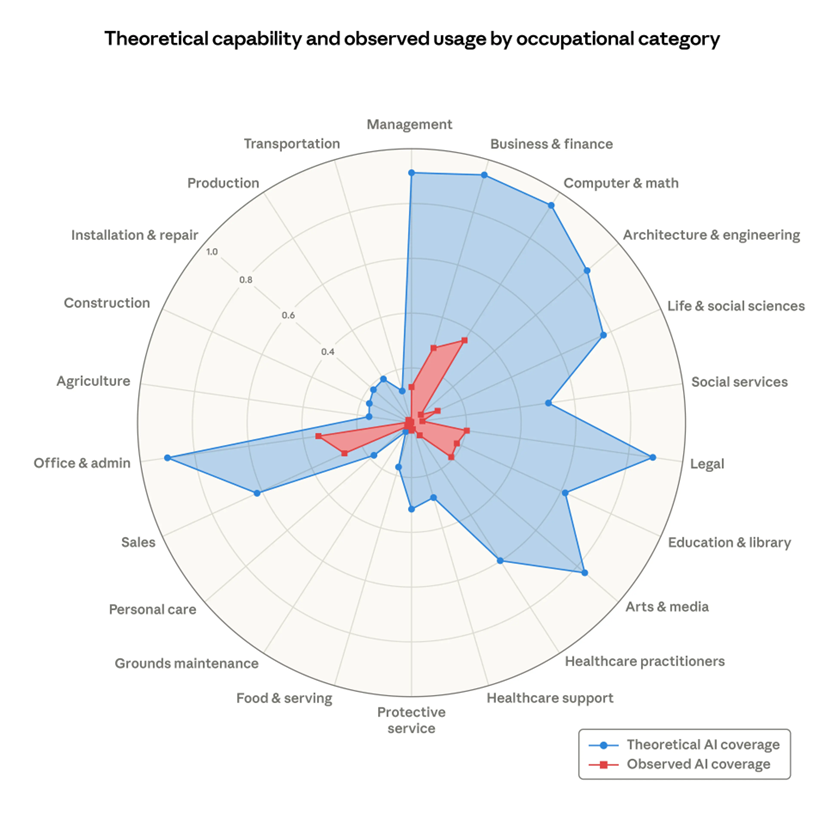
💡Real Claude data shows AI overhyped on jobs—33% tech exposure, not 94%. Check yours.
⚡ 30-Second TL;DR
What Changed
Real AI exposure: 33% in computer/math jobs vs. 94% theory
Why It Matters
AI disruption slower than hyped, giving adaptation time but pressuring tech salaries. White-collar skills may degrade, polarizing high-ed jobs into elite or low-skill.
What To Do Next
Match your job tasks to O*NET and estimate AI exposure using Anthropic's weighting method.
Key Points
- •Real AI exposure: 33% in computer/math jobs vs. 94% theory
- •Top impacted: Programmers (74.5%), customer service via API
- •Method: O*NET matching, task-time weighting, automation (1.0) vs. aid (0.5)
- •Deskilling example: Technical writing drops from 18+ to 13 education years
- •Zero exposure: Manual jobs like chefs, mechanics
🧠 Deep Insight
AI-generated analysis for this event — not the original article.
🔑 Enhanced Key Takeaways
- •Anthropic's methodology utilizes a 'Task-Based Exposure' framework that differentiates between 'automation' (replacing a task entirely) and 'augmentation' (improving speed or quality), which significantly lowers the estimated displacement rate compared to earlier LLM-based studies.
- •The research highlights a 'productivity paradox' where AI adoption in high-exposure roles like programming leads to increased output volume rather than immediate headcount reduction, as firms reallocate human capital to higher-level architectural and oversight tasks.
- •The study identifies a 'bottleneck effect' where AI's inability to handle complex, multi-step workflows requiring physical-world verification or high-stakes legal liability prevents it from reaching the theoretical 94% exposure ceiling in the near term.
📊 Competitor Analysis▸ Show
| Feature | Anthropic (Claude) Economic Index | OpenAI (GPT-4o) Labor Impact Studies | Goldman Sachs AI Report |
|---|---|---|---|
| Methodology | Real-world API/Usage Data | Theoretical Task Decomposition | Macroeconomic Modeling |
| Exposure Focus | Task-level (Time-weighted) | Job-level (Occupation-based) | Sector-level (GDP impact) |
| Primary Metric | 33% (Computer/Math) | ~80% (High exposure) | ~300M jobs (Global) |
🛠️ Technical Deep Dive
- •The index maps O*NET (Occupational Information Network) task descriptions to specific LLM capabilities by evaluating whether a task can be completed by a model without human intervention (Automation weight = 1.0) or with significant human-in-the-loop oversight (Assistance weight = 0.5).
- •Data aggregation was performed on anonymized, aggregated Claude API usage logs to determine the actual frequency and duration of specific task execution, rather than relying on subjective expert surveys.
- •The model uses a 'deskilling' metric calculated by comparing the educational attainment requirements of tasks performed by humans versus those performed by AI-assisted workflows, specifically measuring the reduction in required years of formal training.
🔮 Future ImplicationsAI analysis grounded in cited sources
⏳ Timeline
Weekly AI Recap
Read this week's curated digest of top AI events →
👉Related Updates




AI-curated news aggregator. All content rights belong to original publishers.
Original source: 虎嗅 ↗
This is a summary, not the original. Read the source, or get the weekly briefing.
The weekly digest
One email a week. Unsubscribe anytime.