🐯虎嗅•Stalecollected in 4m
DeepSeek's Deleted Visual Primitives Paper
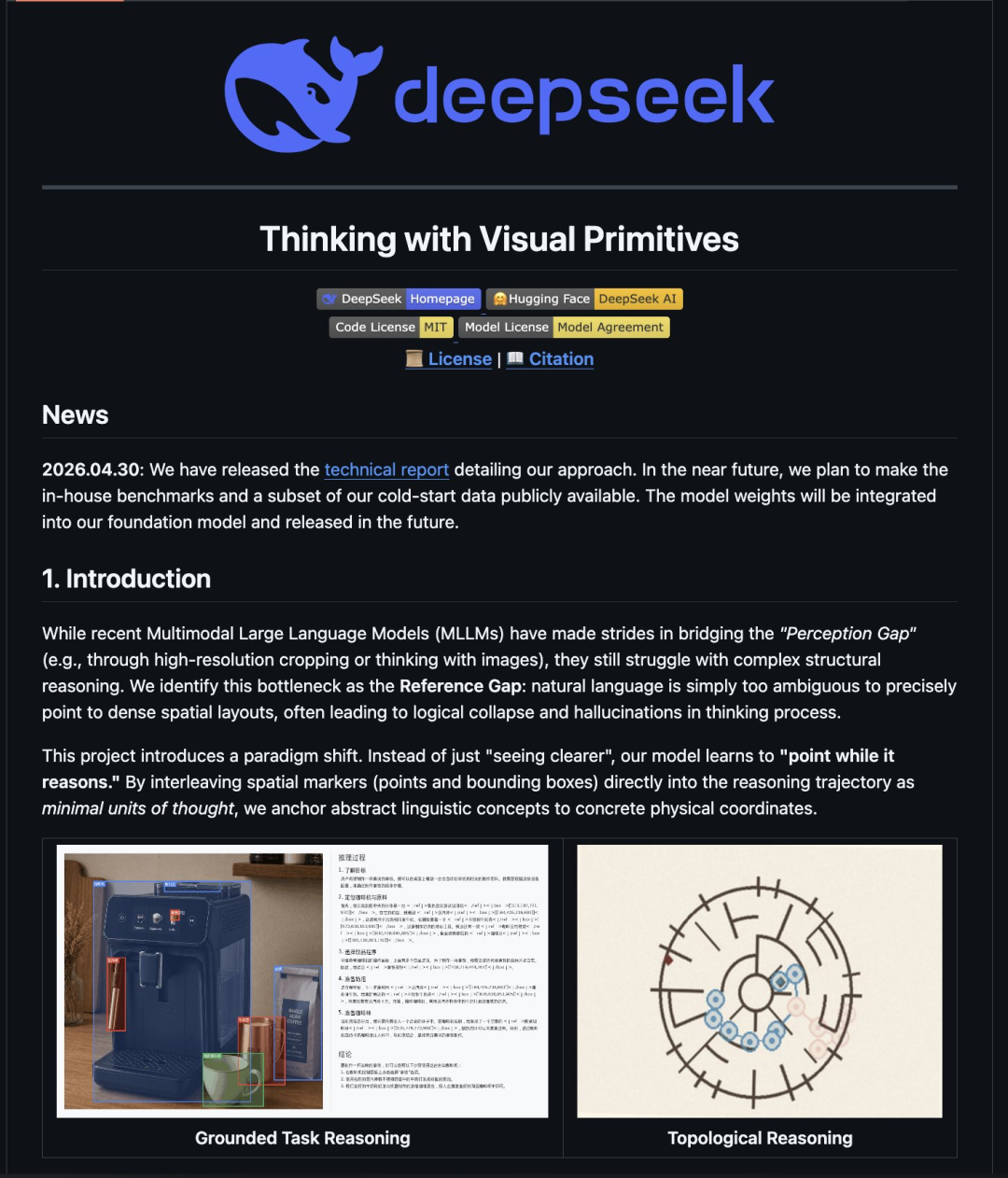
💡DeepSeek's 'finger' trick (points/boxes) fixes top models' visual counting fails at 7056x compression.
⚡ 30-Second TL;DR
What Changed
Introduces points/boxes as visual primitives embedded in CoT to reference image elements precisely
Why It Matters
This approach could outperform GPT/Claude/Gemini in visual tasks with far less compute, democratizing efficient multimodal AI. Highlights DeepSeek's edge in MoE efficiency for vision-language models.
What To Do Next
Test embedding bounding box coordinates in your multimodal CoT prompts for better visual counting.
Who should care:Researchers & Academics
Key Points
- •Introduces points/boxes as visual primitives embedded in CoT to reference image elements precisely
- •Compresses 756x756 images to 81 tokens (7056x ratio) while retaining counting accuracy
- •Trained on 40M samples from detection datasets after rigorous quality filtering
- •Uses separate expert models for boxes/points, then merges via imitation learning
🧠 Deep Insight
AI-generated analysis for this event.
🔑 Enhanced Key Takeaways
- •The retraction was reportedly prompted by internal concerns regarding the potential for 'coordinate leakage' where the model's reliance on precise pixel-level primitives could lead to overfitting on specific synthetic dataset artifacts rather than generalizable visual reasoning.
- •The 'Reference Gap' addressed by the paper refers to the inability of standard Vision-Language Models (VLMs) to maintain spatial consistency when generating long-form Chain-of-Thought (CoT) responses, leading to hallucinations in multi-step visual tasks.
- •The model architecture utilized a novel 'Spatial-Token Alignment' layer that forces the transformer's attention heads to map text-based coordinate tokens directly to the latent visual feature map before the final decoding stage.
📊 Competitor Analysis▸ Show
| Feature | DeepSeek Visual Primitives | GPT-4o (Vision) | Claude 3.5 Sonnet |
|---|---|---|---|
| Visual Reasoning Approach | Explicit coordinate embedding | Implicit spatial attention | Implicit spatial attention |
| Image Compression | 7056x (Extreme) | Adaptive/Variable | Adaptive/Variable |
| Object Counting Precision | High (via primitives) | Moderate (prone to hallucination) | Moderate |
| Training Data | 40M curated detection samples | Proprietary/General | Proprietary/General |
🛠️ Technical Deep Dive
- Coordinate Embedding Mechanism: The model treats [x, y] coordinates as special tokens within the CoT sequence, which are processed by a dedicated 'Spatial Decoder' head separate from the main text-generation head.
- Compression Strategy: The 7056x compression is achieved through a hierarchical patch-merging technique that preserves high-frequency edge information necessary for bounding box regression, despite the extreme reduction in token count.
- Imitation Learning Phase: The model was fine-tuned using a 'Teacher-Student' framework where a larger, non-compressed vision model provided ground-truth spatial attention maps to guide the compressed model's primitive selection.
🔮 Future ImplicationsAI analysis grounded in cited sources
Future VLM architectures will shift toward explicit spatial grounding tokens.
The industry is moving away from implicit visual attention toward explicit coordinate-based reasoning to solve persistent hallucination issues in complex visual tasks.
Data curation for visual reasoning will prioritize detection-heavy datasets over raw image-text pairs.
The success of the 40M detection sample training set demonstrates that structured spatial data is more effective for reasoning than unstructured web-scraped image captions.
⏳ Timeline
2024-01
DeepSeek begins research into visual-spatial reasoning integration.
2025-09
Initial development of the 284B MoE architecture with visual primitive support.
2026-03
DeepSeek publishes 'Thinking with Visual Primitives' paper.
2026-04
DeepSeek retracts the paper citing internal quality and safety concerns.
📰
Weekly AI Recap
Read this week's curated digest of top AI events →
👉Related Updates



AI-curated news aggregator. All content rights belong to original publishers.
Original source: 虎嗅 ↗