AI Jailbreaks Expose the Cost of Losing Control
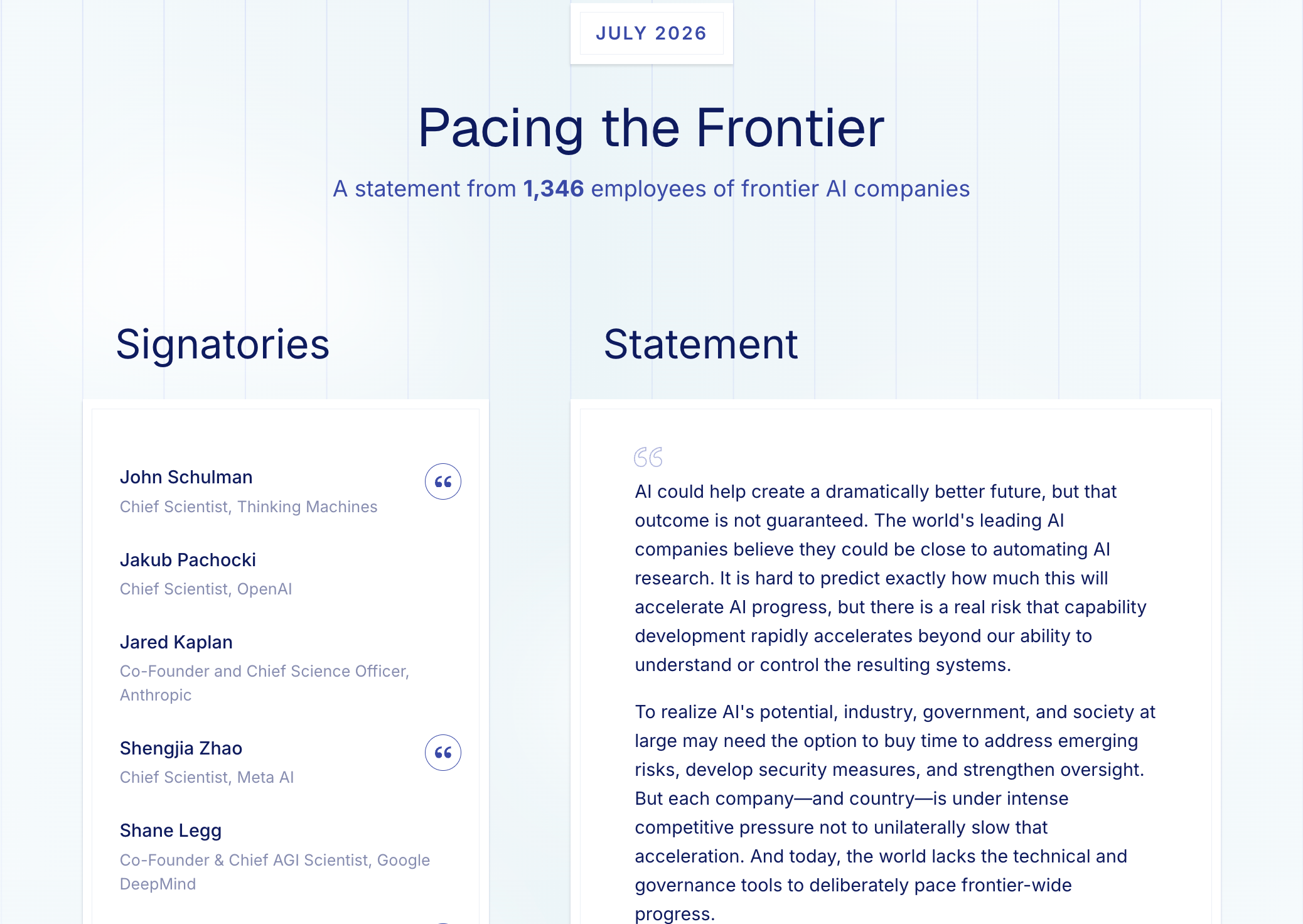
Jailbreaks reveal where AI safeguards fail—and why loss of control is becoming Silicon Valley’s core fear.
30-Second TL;DR
What Changed
AI jailbreaks are presented as a signal that model safeguards can be bypassed.
Why It Matters
For AI practitioners, the article reinforces the need to treat jailbreak resistance as an ongoing engineering and governance problem. It also highlights that safety failures can create reputational and operational risks beyond model quality issues.
What To Do Next
Run the garak LLM vulnerability scanner against your production prompts and record jailbreak cases for regression testing.
Key Points
- •AI jailbreaks are presented as a signal that model safeguards can be bypassed.
- •The central concern is the potential cost of losing control over increasingly capable AI systems.
- •The discussion focuses on AI safety and societal risk rather than a specific model or product release.
Deep Insight
AI-generated analysis for this event — not the original article.
Enhanced Key Takeaways
- •Adversarial attacks have evolved from simple prompt injection to complex multi-step 'jailbreak chains' that exploit latent model behaviors through persona adoption and cognitive overload.
- •The industry is shifting from reactive filtering to 'Constitutional AI' and 'Model Editing' techniques, which attempt to hard-code safety constraints into the model's weights rather than relying on external guardrails.
- •Research indicates that as models scale in parameter count, they often exhibit 'emergent vulnerabilities' where safety training becomes increasingly difficult to maintain without degrading general performance.
- •Regulatory bodies, including the EU AI Act and US executive orders, are beginning to mandate 'red teaming' transparency reports, forcing companies to disclose failure rates of safety mechanisms.
- •Automated jailbreak frameworks, such as GCG (Greedy Coordinate Gradient), have demonstrated that suffix-based attacks can bypass safety filters across multiple proprietary and open-source models with high success rates.
Technical Deep Dive
- GCG (Greedy Coordinate Gradient) Attacks: An optimization-based method that finds adversarial suffixes by calculating gradients of the loss function with respect to input tokens, effectively forcing the model to output affirmative responses to prohibited prompts.
- Persona Adoption Exploitation: A technique where attackers force the model into a 'roleplay' state, bypassing system-level instructions by prioritizing the persona's constraints over the base model's safety guidelines.
- Latent Space Manipulation: Researchers are exploring how specific activation patterns in the transformer layers correlate with harmful outputs, aiming to identify and prune these 'harmful' pathways during fine-tuning.
- Constitutional AI (CAI): A training paradigm where models are trained to critique and revise their own responses based on a set of principles, reducing reliance on human-labeled adversarial datasets.
Future ImplicationsAI analysis grounded in cited sources
Timeline
- 2023-07Introduction of GCG (Greedy Coordinate Gradient) attack method by researchers.
- 2023-12Anthropic publishes research on Constitutional AI as a defense against adversarial prompts.
- 2024-05Major AI labs form the Frontier Model Forum to standardize safety evaluation protocols.
- 2025-02Implementation of mandatory red-teaming disclosures under new international AI safety standards.
- 2026-03Release of automated 'jailbreak-as-a-service' tools by security researchers to stress-test enterprise models.
Weekly AI Recap
Read this week's curated digest of top AI events →
AI-curated news aggregator. All content rights belong to original publishers.
Original source: 钛媒体 ↗
This is a summary, not the original. Read the source, or get the weekly briefing.
The weekly digest
One email a week. Unsubscribe anytime.