AI Infrastructure’s Subprime Debt Risk
AI compute contracts may hide real-estate-style leverage, GPU depreciation, and refinancing risks that can reshape infra
30-Second TL;DR
What Changed
Unlike the 2000 internet bubble, the current AI buildout is primarily debt-funded, making a potential crisis more likely to begin in bond markets.
Why It Matters
AI founders and infrastructure buyers may face higher costs or reduced availability of compute if lenders reassess customer creditworthiness. Developers should treat long-term capacity commitments as balance-sheet and vendor-concentration risks, not merely infrastructure procurement decisions.
What To Do Next
Run a 24-month capacity stress test for your AI workload using 50% lower demand growth, faster GPU depreciation, and a failed refinancing scenario before signing any take-or-pay cloud contract.
Key Points
- •Unlike the 2000 internet bubble, the current AI buildout is primarily debt-funded, making a potential crisis more likely to begin in bond markets.
- •AI labs commit to future compute purchases, while cloud providers and data centers use those contracts and GPU assets as collateral for additional borrowing.
- •Specialized data centers and rapidly depreciating GPUs combine technology risk with real-estate-style leverage risk.
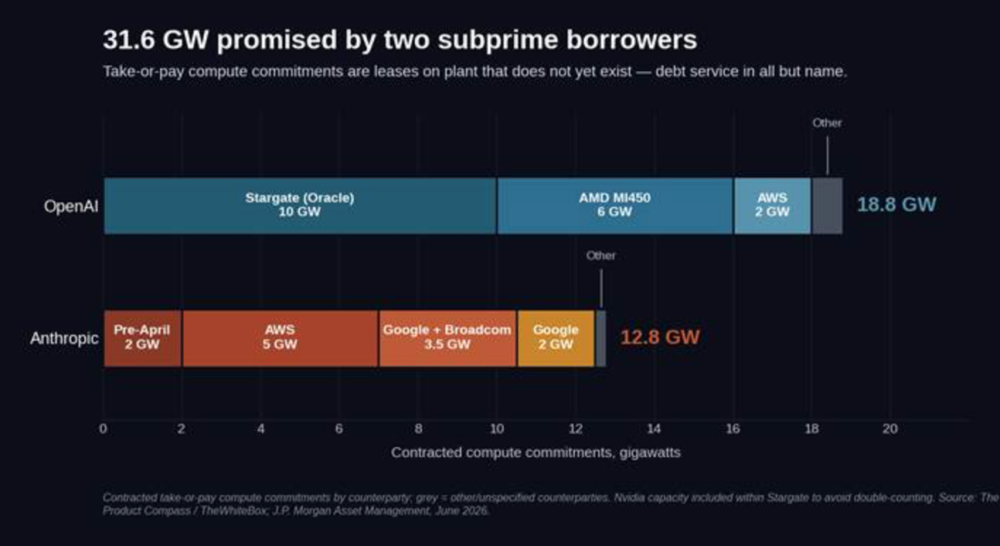
- •OpenAI and Anthropic reportedly account for a large share of the approximately $2.1 trillion in cloud-platform backlog commitments discussed in the article.
- •The financing structure remains viable only if AI companies can keep raising capital and rapidly expand revenue-generating workloads.
Deep Insight
AI-generated analysis for this event — not the original article.
Enhanced Key Takeaways
- •Institutional investors have begun applying 'loan-to-value' (LTV) ratios to GPU clusters, treating them as semi-liquid assets despite their high rate of technological obsolescence.
- •The rise of 'GPU-as-a-service' (GPUaaS) providers has created a secondary layer of leverage, where smaller cloud providers borrow against H100/B200 inventory to fund aggressive data center expansion.
- •Credit rating agencies have expressed concern that the 'take-or-pay' contracts are often structured as off-balance-sheet obligations, potentially obscuring the true debt-to-EBITDA ratios of major AI labs.
- •Secondary markets for used enterprise-grade GPUs have shown increased volatility, signaling that the collateral value of older hardware (A100s) is decoupling from the replacement cost of newer architectures.
- •Regulatory bodies in the US and EU have started monitoring the concentration risk of AI infrastructure financing, fearing that a default by a major AI lab could trigger a liquidity crunch for regional data center operators.
Technical Deep Dive
- GPU depreciation schedules have shifted from 5-year straight-line models to 3-year accelerated models due to the rapid release cycles of Blackwell and successor architectures.
- Take-or-pay contracts often include 'minimum compute utilization' clauses that force AI labs to pay for idle capacity, effectively acting as a synthetic interest payment on infrastructure debt.
- Asset-Backed Securities (ABS) for data centers are increasingly bundling power purchase agreements (PPAs) with compute capacity to stabilize cash flow projections for bondholders.
Future ImplicationsAI analysis grounded in cited sources
Timeline
- 2023-03OpenAI secures massive compute commitments to scale GPT-4 training.
- 2024-05Major cloud hyperscalers report record-breaking capital expenditures focused on AI infrastructure.
- 2025-02First reports emerge of secondary market price drops for legacy AI training hardware.
- 2026-01Financial analysts begin publicly comparing AI infrastructure debt structures to 2008 subprime mortgage vehicles.
Weekly AI Recap
Read this week's curated digest of top AI events →
AI-curated news aggregator. All content rights belong to original publishers.
Original source: 虎嗅 ↗
This is a summary, not the original. Read the source, or get the weekly briefing.
The weekly digest
One email a week. Unsubscribe anytime.