AI inference hits the memory wall: The context tier
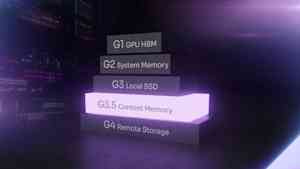
Learn why GPU-heavy infrastructure is failing and why storage architecture is the new bottleneck for AI agents.
30-Second TL;DR
What Changed
Agentic AI systems require persistent state across sessions, causing context data to grow faster than compute capacity.
Why It Matters
Enterprises must rethink their infrastructure beyond just GPU procurement. Failing to optimize storage for inference state will lead to significant performance degradation as agentic workflows scale.
What To Do Next
Audit your current inference infrastructure to determine if your storage latency is creating a bottleneck for long-context or multi-step agentic tasks.
Key Points
- •Agentic AI systems require persistent state across sessions, causing context data to grow faster than compute capacity.
- •Inference I/O is fine-grained and latency-sensitive, making traditional training-focused storage architectures inefficient.
- •Nvidia's CMX architecture formalizes the need for a dedicated flash layer between GPU memory and network storage.
- •Storage optimization is now a primary factor in maintaining AI ROI and system performance.
Deep Insight
AI-generated analysis for this event — not the original article.
Enhanced Key Takeaways
- •The 'context tier' architecture leverages CXL (Compute Express Link) 3.0 protocols to enable memory pooling, allowing GPUs to access expanded context windows without saturating the PCIe bus.
- •Emerging 'KV Cache Compression' techniques, such as PagedAttention and H2O (Heavy Hitter Oracle), are being integrated directly into storage controllers to reduce the physical footprint of context data.
- •Major hyperscalers are shifting from monolithic GPU clusters to disaggregated architectures where context-heavy agents are offloaded to specialized 'Memory-Centric' nodes.
- •The transition to persistent agentic systems has spurred the development of 'In-Storage Computing' (ISC), where flash drives perform basic vector similarity searches to offload pre-processing from the GPU.
- •Industry standards bodies are currently debating the standardization of 'Context-Aware Storage Interfaces' to ensure interoperability between different GPU vendors and flash storage providers.
Competitor Analysis
- Nvidia CMX (Context Memory)
- GPU-centric KV Cache offload
- AMD Infinity Fabric/Memory
- CPU-GPU coherent memory
- Intel CXL-based Memory Expansion
- General purpose CXL memory pooling
- Nvidia CMX (Context Memory)
- Ultra-low (optimized for inference)
- AMD Infinity Fabric/Memory
- Moderate (balanced)
- Intel CXL-based Memory Expansion
- Variable (high capacity)
- Nvidia CMX (Context Memory)
- Proprietary (CUDA/NVLink)
- AMD Infinity Fabric/Memory
- Open/Semi-Open
- Intel CXL-based Memory Expansion
- Open Standard
- Nvidia CMX (Context Memory)
- Tokens per second (long context)
- AMD Infinity Fabric/Memory
- Throughput/Bandwidth
- Intel CXL-based Memory Expansion
- Capacity/Cost-per-GB
| Feature | Nvidia CMX (Context Memory) | AMD Infinity Fabric/Memory | Intel CXL-based Memory Expansion |
|---|---|---|---|
| Primary Focus | GPU-centric KV Cache offload | CPU-GPU coherent memory | General purpose CXL memory pooling |
| Latency Profile | Ultra-low (optimized for inference) | Moderate (balanced) | Variable (high capacity) |
| Ecosystem | Proprietary (CUDA/NVLink) | Open/Semi-Open | Open Standard |
| Benchmark Focus | Tokens per second (long context) | Throughput/Bandwidth | Capacity/Cost-per-GB |
Technical Deep Dive
- CXL 3.0 Integration: Utilizes CXL.mem and CXL.cache protocols to allow the GPU to treat remote flash-based context memory as a NUMA node.
- KV Cache Quantization: Implementation of FP8 and INT4 quantization specifically for KV cache data to reduce storage bandwidth requirements by up to 4x.
- PagedAttention Mechanics: Memory is managed in non-contiguous blocks, similar to virtual memory in operating systems, to eliminate fragmentation in the context tier.
- Direct Memory Access (DMA): Bypasses the CPU host stack to move context data directly from the context tier storage to GPU VRAM, minimizing interrupt latency.
Future ImplicationsAI analysis grounded in cited sources
Timeline
- 2023-09Introduction of PagedAttention in vLLM, laying the groundwork for efficient KV cache management.
- 2024-05CXL 3.0 specifications gain industry-wide adoption, enabling the hardware foundation for memory pooling.
- 2025-03Nvidia announces initial research into CMX (Context Memory) architectures for large-scale inference.
- 2026-01First commercial deployments of dedicated flash-based context tiers in hyperscale data centers.
Weekly AI Recap
Read this week's curated digest of top AI events →
AI-curated news aggregator. All content rights belong to original publishers.
Original source: VentureBeat ↗
This is a summary, not the original. Read the source, or get the weekly briefing.
The weekly digest
One email a week. Unsubscribe anytime.