AI Idol Shows Chase Hype, Not Human Connection
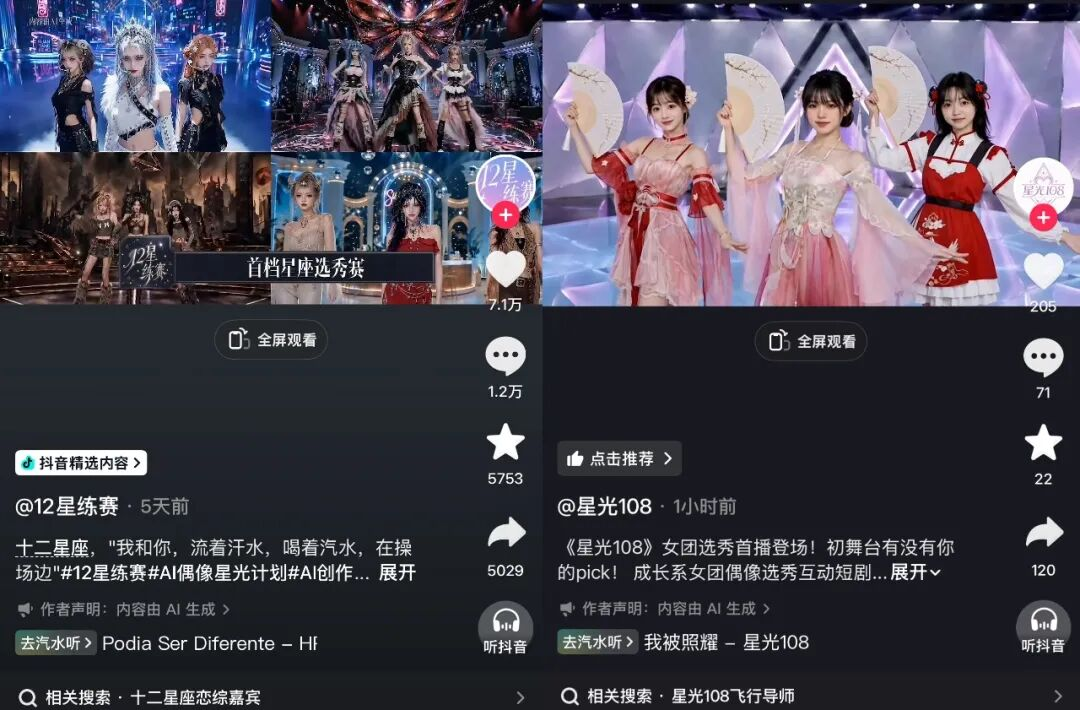
AI content is hitting scale limits: learn why storytelling and character operations matter more than generation volume.
30-Second TL;DR
What Changed
AI talent shows lack the unscripted growth, emotional connection, and character depth that drive human reality shows.
Why It Matters
AI content teams should not assume that lower production costs or novel formats will create audience demand. The article reinforces that sustained AI character businesses require differentiated narratives, ongoing audience interaction, and credible commercialization safeguards.
What To Do Next
Prototype an AI character with a 10-episode narrative arc and a separate lifestyle-content channel, then measure retention and repeat engagement before scaling production.
Key Points
- •AI talent shows lack the unscripted growth, emotional connection, and character depth that drive human reality shows.
- •AI short-drama production is highly saturated: over 95% of first-quarter micro-dramas were AI-generated, while AI content captured only about 4% of total views.
- •The more viable AI entertainer model combines scripted drama with off-platform lifestyle vlogs, as demonstrated by the character Fang Taozi.
- •AI livestreaming remains difficult because current digital humans generally follow scripts and cannot sustain long-form real-time interaction.
- •The core competitive gap is shifting from generation capacity to storytelling, persona design, emotional resonance, and audience trust.
Deep Insight
AI-generated analysis for this event — not the original article.
Enhanced Key Takeaways
- •The rise of AI talent shows is heavily influenced by the 'AIGC + IP' investment trend in China, where platforms seek to lower production costs compared to traditional human-led variety shows.
- •Audience fatigue in AI talent shows is linked to the 'uncanny valley' effect, where high-fidelity visuals fail to mask the lack of spontaneous, non-deterministic personality traits.
- •Regulatory scrutiny in China regarding AI-generated content (AIGC) requires clear labeling, which further breaks the 'suspension of disbelief' necessary for viewers to form parasocial bonds with AI idols.
- •Data indicates that while AI-generated micro-dramas have high output volume, the retention rate for AI-led characters drops by over 60% after the first three episodes compared to human-led content.
- •Industry leaders are pivoting toward 'Hybrid Human-AI' models, where human actors provide motion capture and voice acting to maintain emotional authenticity while AI handles background generation and scaling.
Technical Deep Dive
- Implementation of real-time digital human interaction typically relies on a pipeline involving LLMs for dialogue generation, TTS (Text-to-Speech) for vocal synthesis, and lip-syncing models like SadTalker or LivePortrait.
- Current limitations in AI livestreaming stem from high latency in the inference loop, where the combined time for LLM processing and rendering often exceeds the 500ms threshold required for natural human conversation.
- Persona consistency is maintained through RAG (Retrieval-Augmented Generation) systems that inject character-specific lore and behavioral constraints into the system prompt to prevent 'hallucinated' personality shifts.
Future ImplicationsAI analysis grounded in cited sources
Timeline
- 2024-03Initial surge of AI-generated micro-drama production in China following advancements in Sora and similar video models.
- 2025-01Launch of early AI talent show experiments attempting to gamify AI character development.
- 2025-11Industry reports highlight the 'viewership gap' between AI-generated content and human-led entertainment.
- 2026-05Public discourse shifts toward criticizing AI talent shows as marketing-heavy 'gimmicks' rather than sustainable entertainment.
Weekly AI Recap
Read this week's curated digest of top AI events →
AI-curated news aggregator. All content rights belong to original publishers.
Original source: 虎嗅 ↗
This is a summary, not the original. Read the source, or get the weekly briefing.
The weekly digest
One email a week. Unsubscribe anytime.