AI Growth Shifts From Hype to Systems
Learn why impressive AI demos no longer guarantee revenue—and how GEO, content loops, and enterprise trust reshape growt
30-Second TL;DR
What Changed
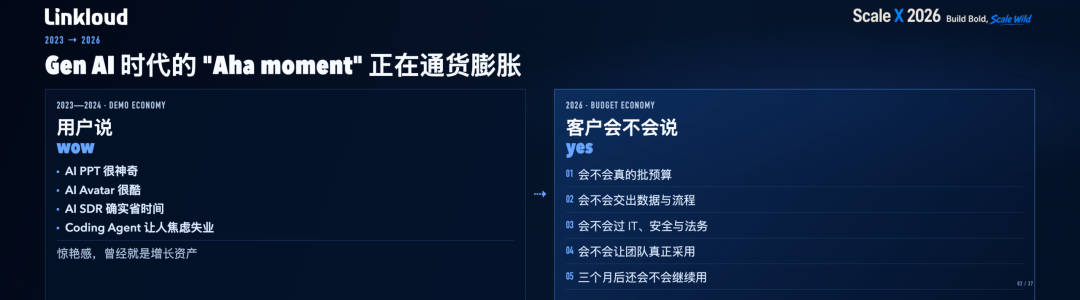
AI demos and '10x productivity' claims are losing differentiation as AHA moments become commonplace.
Why It Matters
AI founders and marketers must shift from optimizing isolated acquisition channels to building durable distribution and trust systems. Enterprise AI products will increasingly be judged by adoption, procurement approval, security review, and retention after the initial demo.
What To Do Next
Audit your product’s visibility in ChatGPT, Perplexity, Google AI Overview, and Gemini for 20 target questions, then publish authoritative answer-focused pages and track brand citations.
Key Points
- •AI demos and '10x productivity' claims are losing differentiation as AHA moments become commonplace.
- •SEO is evolving toward GEO, where brands compete to be cited in AI-generated answers rather than merely ranking in search results.
- •Growth is becoming a system that connects product distribution, content loops, creator workflows, agentized sales, and enterprise risk reduction.
- •Reddit, YouTube, media, reviews, and other third-party sources increasingly serve as credibility signals for AI search systems.
Deep Insight
AI-generated analysis for this event — not the original article.
Enhanced Key Takeaways
- •The shift toward 'Generative Engine Optimization' (GEO) is forcing companies to prioritize LLM-based citation metrics, where model training data and RAG (Retrieval-Augmented Generation) indexing are replacing traditional backlink strategies.
- •Enterprise AI procurement is increasingly gated by 'AI Trust and Safety' audits, requiring vendors to provide verifiable model lineage, data privacy certifications (SOC2/ISO), and explainability reports to mitigate hallucination risks.
- •Agentized sales models are moving beyond simple chatbots to autonomous 'Sales Development Representatives' (SDRs) that utilize CRM data to personalize outreach and manage multi-touchpoint buyer journeys without human intervention.
- •Product-Led Growth (PLG) for AI is pivoting toward 'usage-based friction reduction,' where time-to-value (TTV) is measured by the number of successful API calls or workflow completions rather than mere sign-ups.
- •Creator-led distribution is leveraging 'synthetic influencers' and AI-generated content loops to dominate niche search queries, effectively creating a moat around specific vertical-market AI solutions.
Technical Deep Dive
- Implementation of RAG pipelines now requires hybrid search architectures combining vector embeddings (for semantic similarity) with keyword-based BM25 (for exact entity matching) to improve citation accuracy in AI answers.
- Agentized sales systems utilize ReAct (Reasoning and Acting) prompting frameworks, allowing models to dynamically query external tools like Salesforce or LinkedIn to update lead status in real-time.
- Enterprise risk reduction frameworks are integrating 'Guardrail' layers (e.g., NeMo Guardrails or similar) to enforce output constraints and prevent prompt injection attacks during customer-facing interactions.
- Attribution modeling in GEO is shifting toward tracking 'LLM-referral traffic,' which requires specialized telemetry to detect when a model cites a specific URL in its generated response.
Future ImplicationsAI analysis grounded in cited sources
Timeline
- 2023-11Initial surge of 'AI wrapper' startups focusing on simple UI/UX demos.
- 2024-06Market saturation of productivity tools leads to the '10x productivity' claim fatigue.
- 2025-02Emergence of GEO (Generative Engine Optimization) as a formal marketing discipline.
- 2025-10Enterprise procurement cycles begin mandating AI-specific risk and compliance audits.
- 2026-04Widespread adoption of agentized sales workflows in B2B AI distribution.
Weekly AI Recap
Read this week's curated digest of top AI events →
AI-curated news aggregator. All content rights belong to original publishers.
Original source: 虎嗅 ↗
This is a summary, not the original. Read the source, or get the weekly briefing.
The weekly digest
One email a week. Unsubscribe anytime.