AI Giants' Trillion-Dollar IPOs and Technical Debt
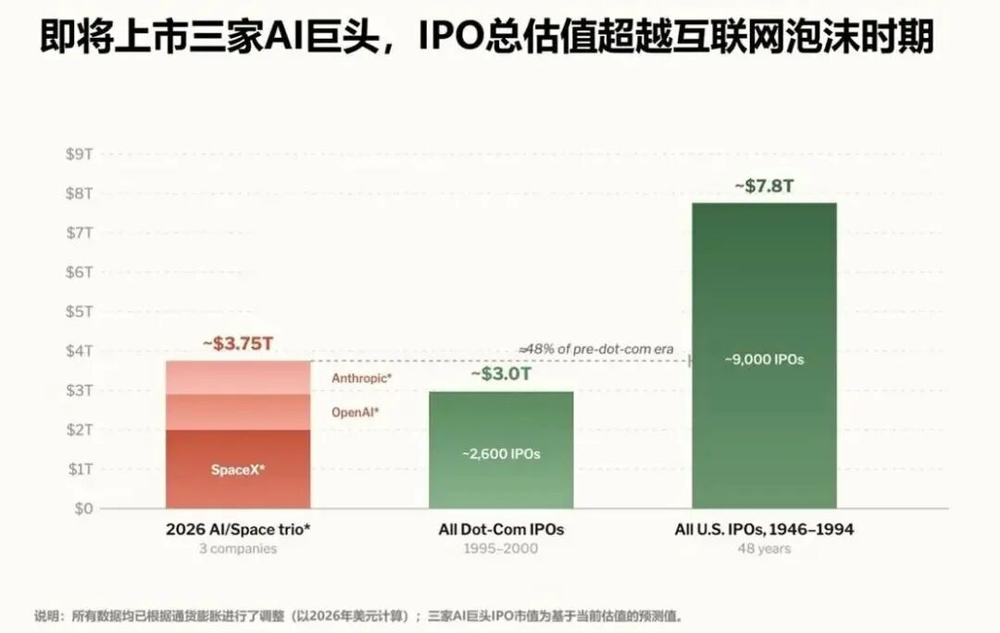
💡Understand the financial sustainability of the AI bubble and the shift toward capital-intensive AI infrastructure.
⚡ 30-Second TL;DR
What Changed
SpaceX, OpenAI, and Anthropic are targeting valuations exceeding $1 trillion each.
Why It Matters
The shift toward 'AI industrial' groups suggests that future AI leaders will be defined by their control over physical infrastructure, not just model performance.
What To Do Next
Monitor the 'compute-to-revenue' ratio of your AI stack to ensure your infrastructure costs don't outpace your product's market adoption.
Key Points
- •SpaceX, OpenAI, and Anthropic are targeting valuations exceeding $1 trillion each.
- •The AI industry is shifting from pure software to capital-intensive 'AI industrial' models.
- •Anthropic is currently outpacing OpenAI in revenue growth and profit margins.
- •Massive capital expenditure is being front-loaded into data centers and energy, creating potential systemic risk.
🧠 Deep Insight
Web-grounded analysis with 34 cited sources.
🔑 Enhanced Key Takeaways
- •SpaceX's anticipated IPO is projected to be the largest in history, aiming to raise approximately $75 billion, which would significantly surpass previous records.
- •Anthropic has demonstrated exceptionally rapid revenue growth, with its annualized run rate reaching $30 billion in April 2026, outperforming OpenAI's at that time, largely due to its focus on enterprise customers.
- •The combined capital raised from the IPOs of SpaceX, OpenAI, and Anthropic could total around $200 billion, exceeding the aggregate proceeds from all US IPOs over $50 million between 2022 and Q1 2026.
- •Global electricity consumption by data centers, driven primarily by AI, is projected to more than double by 2030, reaching approximately 945 terawatt-hours (TWh).
- •OpenAI faces substantial projected losses, with computing expenditure expected to hit $121 billion in 2028 and a net loss of $74 billion that year, contrasting sharply with Anthropic's projection of $17 billion in positive cash flow on $70 billion in revenue for the same year.
📊 Competitor Analysis▸ Show
LLM Provider Comparison (April 2026)
| Feature / Provider | OpenAI (GPT-5 series) | Anthropic (Claude 4 family) | Google (Gemini 2.5) |
|---|---|---|---|
| Primary Strength | General-purpose tool use, ecosystem breadth | Coding accuracy, reasoning depth, long context for document-heavy tasks | Best price-to-performance ratio, native multimodal, large context window |
| Flagship Model | GPT-5.4, GPT-5.5 | Claude Opus 4.6 | Gemini 2.5 Pro |
| Context Window (Max) | 1M tokens (GPT-4.1) | 1M tokens (Claude Opus 4.6) | 1M tokens (standard), 2M (preview) |
| API Pricing (Output/1M tokens) | $10.00 (GPT-5.4), $30.00 (GPT-5.5) | $75.00 (Claude Opus 4.6) | $12.00 (Gemini 2.5 Pro), $2.50 (Gemini 2.5 Flash) |
| Enterprise Revenue Mix | ~40% from enterprise customers | ~80-85% from enterprise customers | Deep integration with Google Cloud and Workspace |
| Coding Benchmarks | Strong, but Anthropic's Claude Sonnet 4.5 leads SWE-Bench | Claude Sonnet 4.5 holds top SWE-Bench score (82%) | Competitive, especially Gemini 2.5 Flash for value |
| Multimodal Capabilities | Text, image, video, audio (native on Gemini) | Primarily text-focused, but evolving | Native multimodal (text, image, video, audio) |
| Ecosystem | Widest model range, most mature function calling, largest ecosystem of tools and libraries | Native MCP (Model Context Protocol) support for external tools/data | Deep integration with Google Cloud and Workspace |
🛠️ Technical Deep Dive
- AI Data Center Power Demands: AI-optimized data centers require significantly more power than traditional ones, with racks demanding 50-150 kilowatts (kW) compared to 10-15 kW for conventional racks. Modern GPUs consume 700-1,200 watts per chip, a substantial increase from traditional CPUs at 150-200 watts.
- OpenAI GPT-4 Architecture: GPT-4 is a Transformer-style model pre-trained to predict the next token in a document. It was trained using a combination of publicly available data (such as internet data) and data licensed from third-party providers. The model was then fine-tuned using Reinforcement Learning from Human Feedback (RLHF). While specific architectural details like model size and hardware are not publicly disclosed due to competitive and safety reasons, it is known to be multimodal, accepting both text and images as input.
- Anthropic Claude Architecture: Anthropic focuses on developing reliable, interpretable, and steerable AI systems, with a key innovation being 'Constitutional AI'. This approach uses a set of principles or a 'constitution' to guide the AI's behavior and responses, aiming to make models helpful, honest, and harmless without extensive human feedback on every interaction.
🔮 Future ImplicationsAI analysis grounded in cited sources
⏳ Timeline
📎 Sources (34)
Factual claims are grounded in the sources below. Forward-looking analysis is AI-generated interpretation.
- ig.com
- medium.com
- forbes.com
- cryptobriefing.com
- reddit.com
- iea.org
- arxiv.org
- certainly.io
- mindstudio.ai
- morphllm.com
- developersdigest.tech
- llmgateway.io
- cloudidr.com
- zapier.com
- ideas2it.com
- hanwhadatacenters.com
- solartechonline.com
- socomec.us
- openai.com
- openai.com
- speechmatics.com
- wikipedia.org
- businessmodelcanvastemplate.com
- issarice.com
- microventures.com
- ricardo-vargas.com
- spglobal.com
- medium.com
- lumenalta.com
- longtermwiki.com
- wikipedia.org
- substack.com
- 36kr.com
- maaal.com
Weekly AI Recap
Read this week's curated digest of top AI events →
👉Related Updates



AI-curated news aggregator. All content rights belong to original publishers.
Original source: 虎嗅 ↗