AI data centers driving up electricity costs for manufacturers
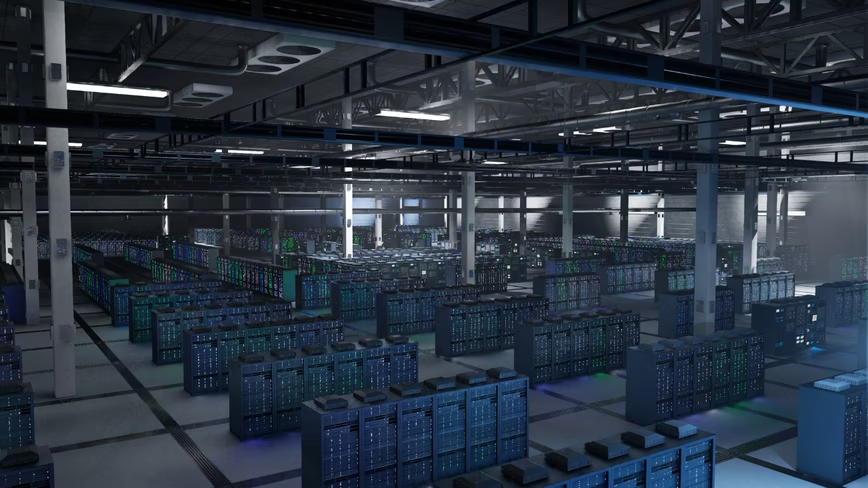
💡Rising energy costs from AI data centers could reshape infrastructure strategy and cloud pricing models.
⚡ 30-Second TL;DR
What Changed
Belden Brick Company reported a 90% increase in electricity costs last year.
Why It Matters
This trend suggests that AI infrastructure costs may soon include significant energy-related externalities, potentially impacting site selection for future data centers.
What To Do Next
Evaluate the energy efficiency of your cloud provider's data center regions to anticipate potential future cost fluctuations.
Key Points
- •Belden Brick Company reported a 90% increase in electricity costs last year.
- •AI data center proliferation is straining regional power grids.
- •Energy-intensive AI infrastructure is creating economic friction with legacy industrial sectors.
🧠 Deep Insight
AI-generated analysis for this event — not the original article.
🔑 Enhanced Key Takeaways
- •Utility regulators in states like Ohio and Pennsylvania are currently reviewing 'load shedding' protocols that prioritize AI data centers over industrial manufacturing during peak demand events.
- •The surge in electricity demand is primarily driven by the transition to liquid-cooled server racks, which require significantly higher power density than traditional air-cooled data centers.
- •Regional Transmission Organizations (RTOs) such as PJM Interconnection have reported a record-breaking backlog of interconnection requests, with AI data centers accounting for over 60% of new capacity applications.
- •Several Rust Belt states are considering legislative 'energy priority' bills that would allow manufacturers to negotiate long-term fixed-rate power purchase agreements to shield them from AI-driven spot price volatility.
- •The increased energy load is forcing grid operators to delay the decommissioning of coal and natural gas plants, complicating state-level decarbonization mandates.
🛠️ Technical Deep Dive
- AI data centers utilize high-density GPU clusters (e.g., NVIDIA Blackwell or equivalent architectures) that operate at power densities exceeding 50-100 kW per rack.
- Implementation of Direct-to-Chip (D2C) liquid cooling systems is becoming standard, requiring specialized power distribution units (PDUs) that draw significantly more constant load than legacy industrial machinery.
- Power Usage Effectiveness (PUE) ratios for these new facilities are being optimized for AI workloads, but the absolute energy consumption remains high due to the 24/7 nature of model training and inference.
- Grid-edge integration involves the deployment of large-scale Battery Energy Storage Systems (BESS) to manage transient power spikes, though these systems often compete for the same grid interconnection capacity as manufacturing facilities.
🔮 Future ImplicationsAI analysis grounded in cited sources
⏳ Timeline
Weekly AI Recap
Read this week's curated digest of top AI events →
👉Related Updates



AI-curated news aggregator. All content rights belong to original publishers.
Original source: The Next Web (TNW) ↗
This is a summary, not the original. Read the source, or get the weekly briefing.
Weekly AI briefing
One email a week. Unsubscribe anytime.