AI Coding's New Pitfalls: Understanding & Cognitive Debt
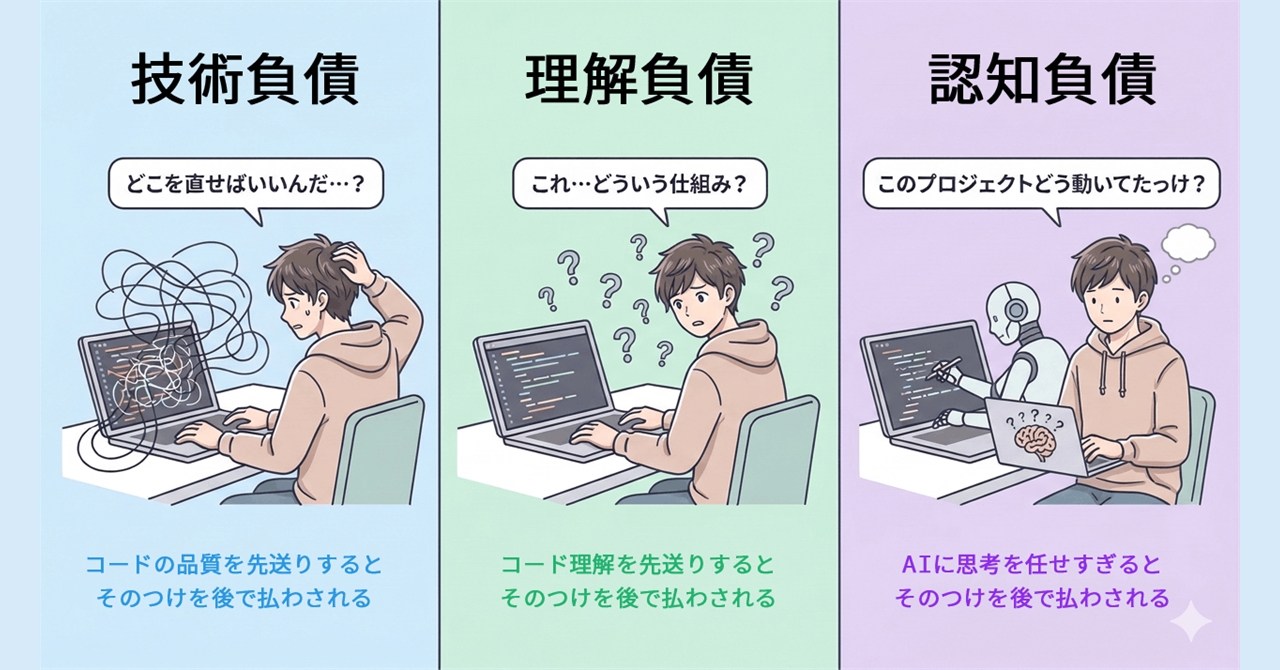
💡Uncover why AI code backfires later—avoid understanding & cognitive debt traps
⚡ 30-Second TL;DR
What Changed
Defines 'understanding debt' as lack of comprehension in AI-generated code logic
Why It Matters
Warns AI practitioners of long-term maintenance risks from over-relying on AI code generation, pushing for hybrid human-AI workflows to reduce debts.
What To Do Next
Audit recent AI-generated code for undocumented logic paths to identify understanding debt early.
Key Points
- •Defines 'understanding debt' as lack of comprehension in AI-generated code logic
- •Introduces 'cognitive debt' from overload of managing opaque AI outputs
- •Outlines three major debts causing post-development pain in AI coding
- •Explains why AI-coded projects become burdensome over time
🧠 Deep Insight
Background and context from public sources — not the original article. 7 sources cited.
🔑 Enhanced Key Takeaways
- •MIT Media Lab's 2025 study empirically measured cognitive debt in LLM-dependent workflows, finding the weakest brain connectivity and learning outcomes compared to traditional methods[1].
- •Teams using heavy AI code generation experience 3-4 times longer incident resolution times on AI-written modules versus human-written ones, despite initial 40% velocity gains[2].
- •Warning signs of cognitive debt include defaulting to AI before thinking through problems and inability to recall or explain AI-assisted work, potentially leading to long-term declines in creativity and critical thinking[3].
- •Mitigation strategies involve pseudo-reimplementing AI-generated code by hand to build true understanding or using AI only for prototypes and known bugs, avoiding overreliance in production[5].
🔮 Future ImplicationsAI analysis grounded in cited sources
⏳ Timeline
📎 Sources (7)
Factual claims are grounded in the sources below. Forward-looking analysis is AI-generated interpretation.
- dianawolftorres.substack.com — Cognitive Debt the Brain Drain Behind
- youtube.com — Watch
- opendatascience.com — Your Brain on Chatgpt Understanding Cognitive Debt in the Age of AI
- simonwillison.net — Cognitive Debt
- rushabhdoshi.com — 2026 02 17 Cognitive Debt
- duggan.ie — Cognitive Debt in AI Coding
- acairns.co.uk — Cognitive Debt
Weekly AI Recap
Read this week's curated digest of top AI events →
👉Related Updates
AI-curated news aggregator. All content rights belong to original publishers.
Original source: ITmedia AI+ (日本) ↗
This is a summary, not the original. Read the source, or get the weekly briefing.
Weekly AI briefing
One email a week. Unsubscribe anytime.