AI Capex Faces the Rate Test
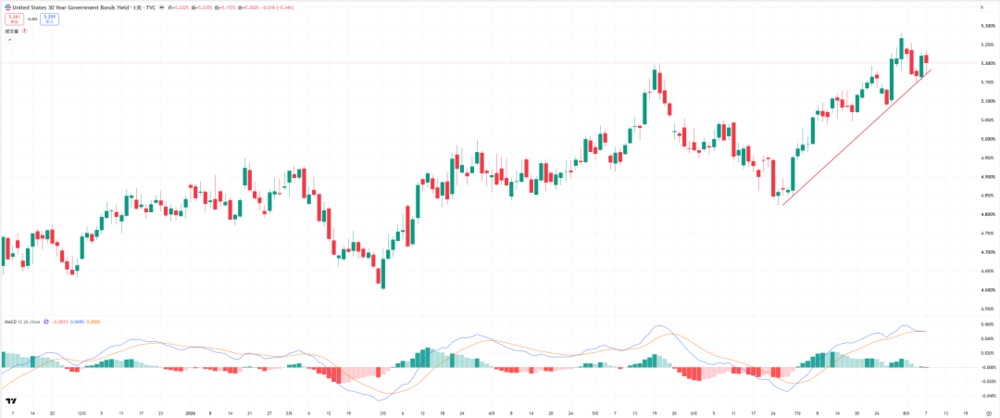
AI spending may determine whether high rates produce a boom, stagflation, or a rotation across hardware and software.
30-Second TL;DR
What Changed
The key unresolved question is whether AI investment intensity can remain high as interest rates rise.
Why It Matters
AI infrastructure companies may face a more volatile funding environment if capex growth slows while long-term yields stay elevated. Developers and founders should account for financing costs, cloud pricing, GPU availability, and demand sensitivity when planning AI workloads.
What To Do Next
Stress-test your AI infrastructure budget under 30%, 60%, and negative capex-growth scenarios, including cloud, GPU, and financing costs.
Key Points
- •The key unresolved question is whether AI investment intensity can remain high as interest rates rise.
- •High earnings growth and strong manufacturing PMI combined with elevated long-term yields could signal a late-cycle economic environment.
- •Portfolio positioning may rotate between AI hardware, software, overseas supply chains, domestic technology chains, gold, and copper depending on the macro scenario.
- •Copper faces high inventories and positioning risks, but LME warehouse cancellations and COMEX-LME spreads leave room for a potential squeeze.
Deep Insight
AI-generated analysis for this event — not the original article.
Enhanced Key Takeaways
- •Hyperscalers including Microsoft, Alphabet, and Meta have reported a combined quarterly capital expenditure exceeding $50 billion as of mid-2026, signaling a shift toward 'AI infrastructure maturity' rather than just experimental capacity building.
- •The 'AI Capex-to-Revenue' ratio has become a primary metric for institutional investors, with recent data showing that while absolute spending remains high, the efficiency of converting this capex into incremental cloud revenue is under increasing scrutiny.
- •Energy grid constraints have emerged as a critical bottleneck for AI capex, with major data center projects in the U.S. facing 24-36 month delays due to power procurement and transmission infrastructure limitations.
- •The correlation between AI hardware spending and long-term Treasury yields has tightened in 2026, as higher borrowing costs directly impact the Weighted Average Cost of Capital (WACC) for large-scale data center financing.
- •Recent trade policy shifts have incentivized a 'bifurcation' in AI supply chains, forcing companies to increase capex for localized, sovereign AI clouds to mitigate geopolitical risks and regulatory compliance costs.
Future ImplicationsAI analysis grounded in cited sources
Timeline
- 2023-01Generative AI investment cycle accelerates following widespread adoption of LLMs.
- 2024-05Hyperscalers announce record-breaking quarterly capex budgets focused on H100/B200 GPU clusters.
- 2025-02Market begins questioning the 'ROI gap' as AI revenue growth fails to match infrastructure spending.
- 2026-03U.S. long-term interest rates stabilize at elevated levels, pressuring debt-financed AI projects.
Weekly AI Recap
Read this week's curated digest of top AI events →
AI-curated news aggregator. All content rights belong to original publishers.
Original source: 虎嗅 ↗
This is a summary, not the original. Read the source, or get the weekly briefing.
The weekly digest
One email a week. Unsubscribe anytime.